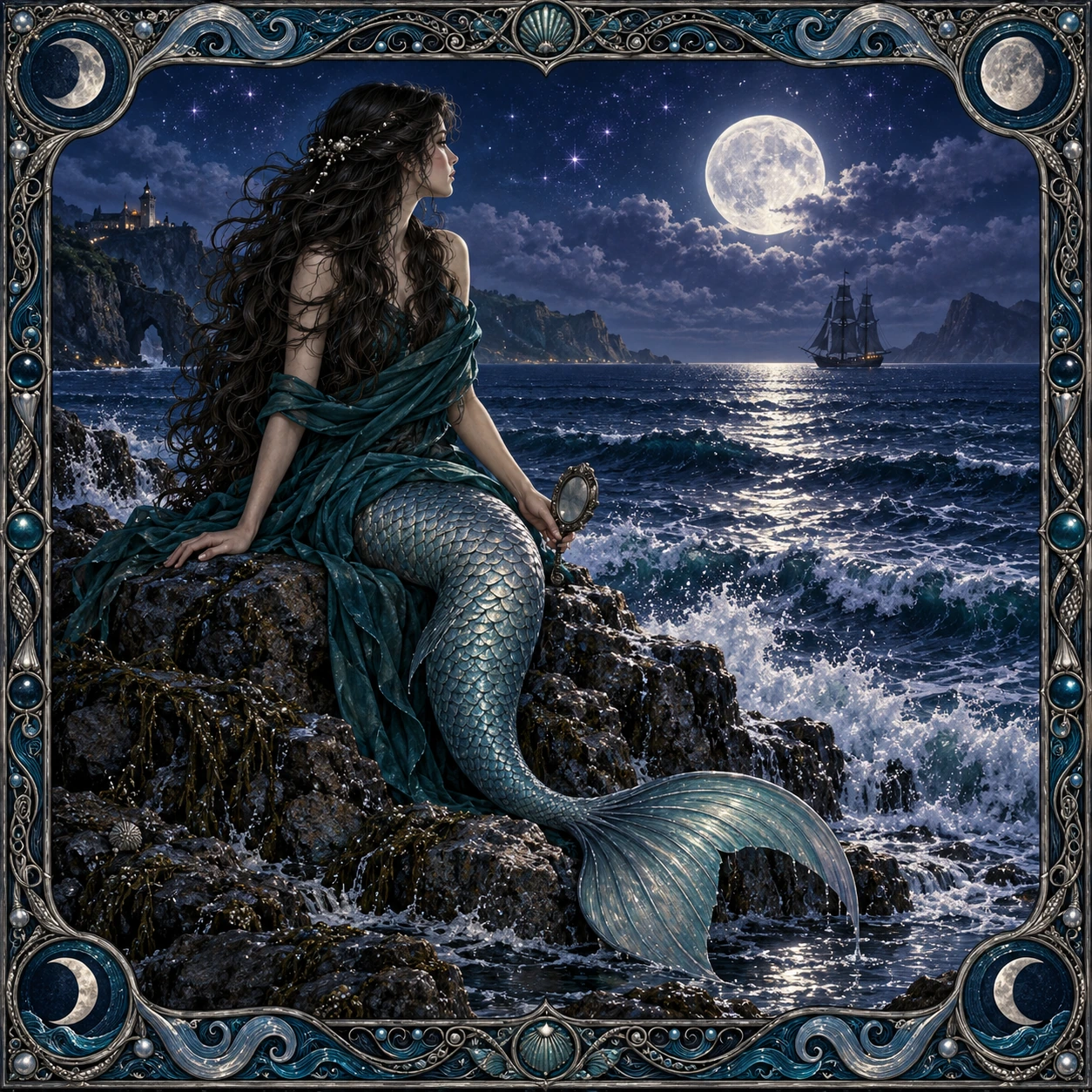
Bottrell’s sea visitor asks a captain to move an anchor blocking her home’s entrance. His telling also connects her with the disappearance of singer Mathey Trewella. It records alternative circumstances for the anchor scene, rather than offering one fully settled sequence. [2]
Tennyson’s complete Mermaid poem, read here in an 1843 collection, shifts the speaking position beneath the sea. Its imagined heroine wants a throne, combs her hair, sings, plays among marine surroundings and decides who may approach her. The conditional first-person voice makes the scene an act of imagining a life, rather than a sailor’s report of an encounter. A sea-snake belongs to that invented company. No Cornish place name fixes the poem’s setting. Its undersea court can therefore be compared with the collected shore stories while remaining a different, individually authored work. [5]