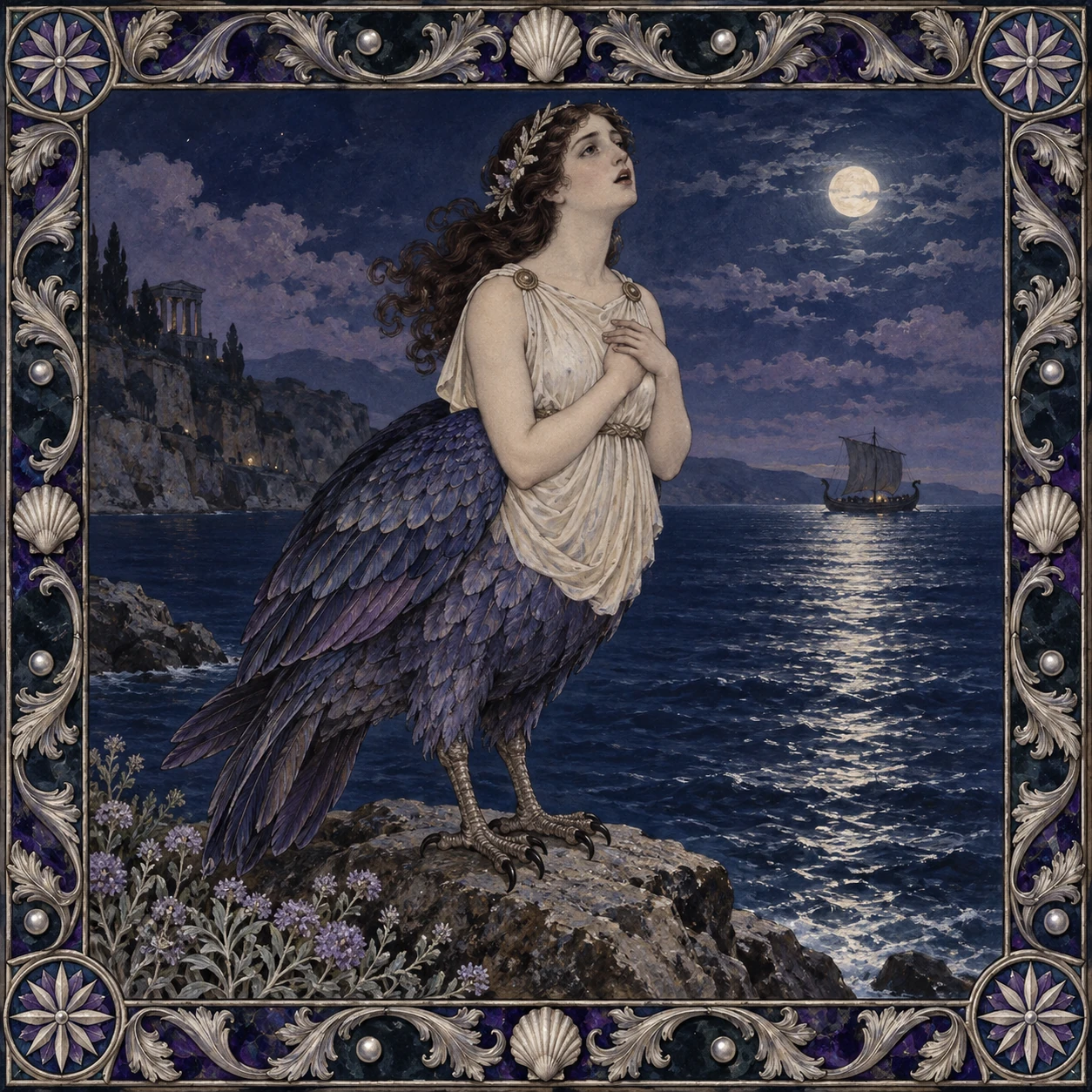
Begin with the two voyages, then compare Helen's lament and the contrasting transformations in Ovid and Hyginus. Read Ferruzza alongside the later return announcement rather than assuming that a catalogue freezes an object's ownership history. Atwood offers a deliberately modern voice. The passages consulted here preserve different acts of singing, listening and mourning; they are not parts of a single canonical biography.
- Odyssey, Book 12 ↗
Homer · Theoi Classical Texts Library · Ancient Greek; consulted English translation · Translated by A. T. Murray
12.36–54; 12.153–200
English translation actually read at 12.36–54 and 12.153–200; warning, song, wax, binding and passage. No anatomical description supplied in these passages.
Checked 2026-10-10
- Argonautica, Book 4 ↗
Apollonius Rhodius · Theoi Classical Texts Library · Ancient Greek; consulted English translation · Translated by R. C. Seaton
4.885–921
English translation actually read at 4.885–921, covering Anthemoessa, genealogy, Persephone's companions, hybrid form, Orpheus, Butes and Aphrodite.
Checked 2026-10-10
- Fabulae 141: Sirens ↗
Hyginus · Brigham Young University, OGCMA · Latin edited to P. K. Marshall, 2002 · Latin and English · Translated by Roger T. Macfarlane
Fabulae 141
Complete short Fable 141 in Latin and Roger T. Macfarlane's English translation actually read; genealogy, punishment, conditional survival, Ulysses and Sirenides. Ancient attribution conventionally Hyginus, not a claim of established biographical authorship.
Checked 2026-10-10
- Metamorphoses, Book 5 ↗
Ovid · Poetry in Translation · 2000 · Latin; consulted English translation · Translated by A. S. Kline
5.552–563
Actual English passage at 5.552–563 read within section 5.533–571: companions' search, requested wings, preserved human faces and voices. A. S. Kline's translation is copyrighted, not public domain.