

Luminary Oddities · Natural history & art
Greater death’s-head hawkmoth
Acherontia lachesis
Lepidoptera / Sphingidae
A skull-like thoracic pattern gives this large Asian hawkmoth its memorable name. Its biology is equally unusual: documented rearing links vividly different caterpillars to adults, and first-person field work distinguishes its rasping defensive sound from that of related death’s-head moths.
Explore this insect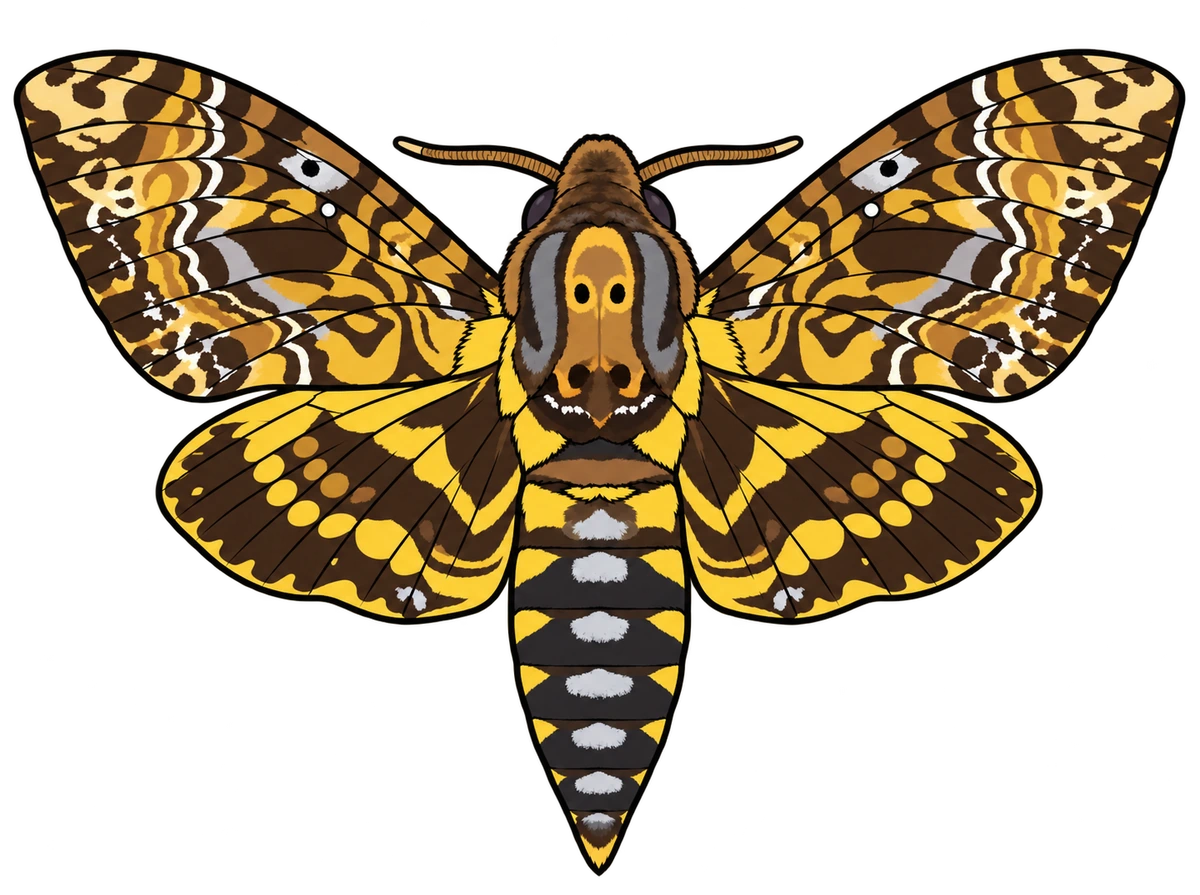
At a glance
- Adult pattern ↘
- The thoracic mark gives rise to the death's-head name. [2]
- Measured host ↘
- Clerodendrum inerme in Dauan Island observations. [3]
One of three death’s-head species
Acherontia lachesis is a valid species, distinct from A. styx and A. atropos. Fabricius named it in 1798; Sphinx lachesis is its original combination. [1]
The shared death's-head common name is useful for the genus but cannot replace the species distinction.
Inspect more than the skull-like mark
The named thoracic pattern is conspicuous, but several Acherontia share that general impression. The specialist taxonomic account uses additional adult characters, including a large dark basal hindwing patch and strong transverse bands. [1][2]
Compare the entire body and wing pattern before using a dramatic common name as an identification.
A regional record can extend the picture
The specialist and Singapore accounts place the species broadly in Asia. Lane and Moulds studied it on Dauan Island in Torres Strait, Australia. [1][3]
That explicitly documented population is more useful than an undated map dot: the study links local adults and developing stages to a named host.
A rearing record with preserved evidence
In Singapore, a final-instar larva found on 20 August 2008 pupated by 2 September and produced an adult on 26 September. Its shed larval skin and empty pupal case were retained as ZRC.LEP.335. [2]
Those dates cover the observed late development, not a full egg-to-adult duration.
Clerodendrum is a directly observed host
All larvae followed by Lane and Moulds on Dauan were feeding on Clerodendrum inerme. Their study photographed the early instars as well as later development. It also acknowledges multiple known larval colour forms. [3]
A green larva and yellow larva should therefore not automatically be assigned different species.
A rasp rather than a simple squeak
Kitching's first-person Thai observations describe lachesis making a rasping or hissing sound, distinct from the purer squeak of atropos and the hoarser sound of styx. [4]
The distinction is especially interesting because it connects identified living moths to sound rather than relying on a silent specimen image.
The name carries a mythological thread
Kitching explains the Acherontia names through Greek mythology. Lachesis was the Fate associated with measuring the thread of life; Acheron supplied the genus's underworld association. [4]
The imagery explains a naming choice, not a biological omen or evidence that the insect's appearance has a supernatural function.
Separate evidence from the honeybee hypothesis
Kitching discussed whether different sounds might accompany use of different honeybee hosts, while explicitly treating the lachesis association as a question requiring evidence. [4]
That is an informative research distinction: observing a sound is direct evidence; proposing why it differs is a hypothesis with further predictions to test.
A historical genus and a current inventory
Sphinx lachesis is useful when searching early descriptions. Acherontia lachesis is the current species heading used by the specialist inventory. [1]
Species identity should be kept intact when older family or tribal arrangements differ from a newer treatment, rather than turning every historical combination into a separate moth.
Do not mistake conspicuousness for abundance
A large larva or dramatically marked adult is easy to notice, but visibility can differ sharply among stages. A survey that mostly finds mature caterpillars is not automatically measuring eggs or early instars. Conservation work should account for detection, locality and season before drawing a population conclusion.
Compare the adult with its linked stages
The Singapore paper's Fig.3 presents an actual newly emerged adult, with its associated immature material catalogued. Other views show caterpillar horns and pupal structure. [2]
Read each as a different stage of one biological account; a larval horn should not be transferred to the adult silhouette.
A dramatic mark within a larger anatomy
The thoracic pattern can draw the viewer inward while the broader wings and banded abdomen supply the full structure. The artwork benefits from keeping that mark in its anatomical position rather than enlarging it into an unrelated emblem that obscures the insect's proportions.
Keep the adult and its records together
Retain a labelled master file and any reference to the associated stage photographs. Large dark wing fields need enough tonal detail in a print to preserve their bands. Physical larvae, pupal cases and adults require different preservation methods; do not treat one digital display recipe as a specimen-preparation method.
Three distinctions worth retaining
Are all death's-head hawkmoths lachesis? There are several distinct species. Do the 2008 dates measure the whole life cycle? They begin with a final-instar larva. Is Kitching's proposed honeybee explanation an observed result? The sound observation and the proposed cause have different evidential status.
Follow the linked rearing evidence
The specialist inventory supplies identity and adult comparison. Singapore's primary observations link late stages, dates and vouchers; the Dauan study documents early stages and a direct host. Kitching supplies the first-person sound comparison and its interpretive limits. Together they support a detailed portrait without conflating observation and hypothesis.
- Acherontia lachesis: taxonomic species account ↗
Sphingidae Taxonomic Inventory; Natural History Museum specialists · Accessed 2026-10-09
Valid species, historical name, type context and adult diagnostic comparison.
- Final instar caterpillars and metamorphosis of Acherontia lachesis in Singapore ↗
Tzi Ming Leong and Vilma D’Rozario; Nature in Singapore 4, 2011 · Accessed 2026-10-09
Primary observations, linked immature-stage material, adult photographs and voucher numbers.
- Life history of Acherontia lachesis from Dauan Island, Australia ↗
David A. Lane and Maxwell S. Moulds; Atalanta 51, 2020 · Accessed 2026-10-09
Primary rearing and observations, including early instars and Clerodendrum inerme host.
- Phylogeny of the death's-head hawkmoths Acherontia and related genera ↗
Ian J. Kitching; Systematic Entomology 28, 2003 · Accessed 2026-10-09
Original phylogenetic research, first-person Thai sound observations and naming history; honeybee-host hypothesis is not proof.
Sources checked 2026-10-09. Illustrations · Luminary Oddities.
Return to the Entomological Atlas ↑