
Luminary Oddities · Natural history & art
Amber-patterned cicada
Ambragaeana ambra
Hemiptera / Cicadidae
Dark wings interrupted by pale amber bars give this cicada its distinctive visual architecture. A Vietnamese voucher anchors its range, while original Thai field work connects nocturnal emergence, daytime canopy life and an analysed male calling song.
Explore this insect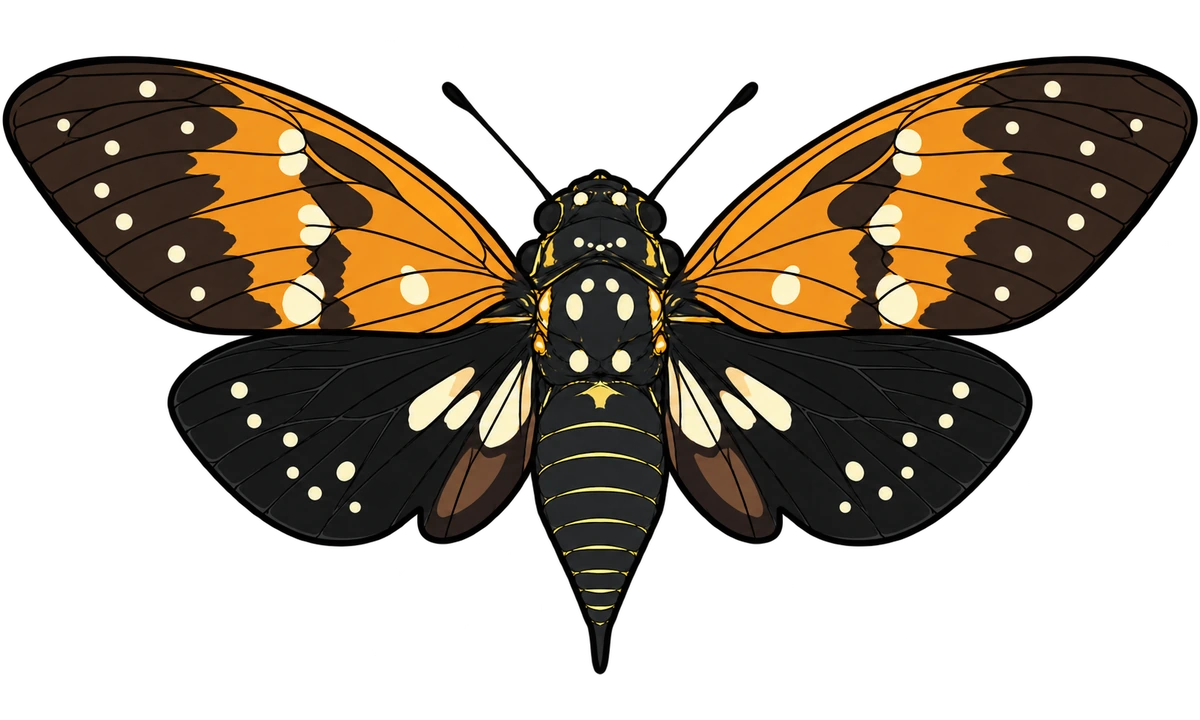
At a glance
- Examined record ↘
- Ngoc Linh Nature Reserve, Vietnam, 1,700 m, 19 April 2004. [3]
- Naming role ↘
- The type species of Ambragaeana. [4]
The species that anchors its genus
Ambragaeana ambra was named by Chou and Yao in 1985 and is the type species of Ambragaeana. The 2025 systematic treatment retains the genus among Gaeanini. [4][1]
A type species anchors a genus name; it is not a claim that every member looks exactly alike.
Pale bars in a dark wing field
The inspected adult photograph shows brown forewings crossed by creamy marks and black hindwings with pale patches. The body is dark. [2]
Compare the individual patches, the dark gaps between them and the wing outline rather than reducing the insect to an amber colour label.
A record at Ngoc Linh
Thai and Yang examined a male collected by Bui Xuan Phuong at Ngoc Linh Nature Reserve, Kon Tum, Vietnam, at 1,700 metres on 19 April 2004. Their account also lists China. [3]
The independent photographed adult is labelled Wiang Papao, Thailand. [2]
These are discrete records with different evidence, not a continuous range survey.
The adult is one developmental stage
Boulard observed adults emerging in March and April at Doi Mon Kia, Thailand. Their final moult began around the middle of the night, with the following morning needed for the adult to acquire its final coloration. [6]
That transition gives the wing pattern a temporal dimension: an incompletely coloured new adult is a developmental state, rather than automatic evidence of a separate taxon. The observation concerns adult emergence; it does not measure the preceding underground years.
Look for documented feeding associations
A plant-host claim should identify whether an observer recorded oviposition, root feeding or adult feeding. These relationships are not interchangeable. The Ngoc Linh adult record contributes locality and date; it does not, on its own, establish that a nearby plant supported the complete life cycle.
Collected position and natural posture
In Boulard's observations, solitary canopy males called intermittently during the hottest part of the day and frequently changed position. Short separated sounds led into a roughly two-second rolling phrase; abdominal extension accompanied calling. [6]
The analysed recording gives a species-specific behavioural reference beyond a silent spread specimen. A useful comparison would link a new recording to the identified adult and the conditions under which it called.
A name-bearing relationship
The type-species role makes ambra more than a visually attractive example. Its name anchors Ambragaeana as a taxonomic unit. [4]
This matters when a guide follows a genus through revisions: the anchor remains a defined species, rather than whichever photograph best fits a descriptive nickname.
Elevation is a record, not a preference curve
The Thai field account describes a strongly sun-associated canopy insect. Boulard compared its flight and calling with a nearby butterfly-like cicada while reporting that the species did not occupy the same immediate canopy settings in his observations. [6]
This complements the Vietnamese 1,700-metre voucher: a record can locate an insect, while direct field watching describes how it uses the vegetation. Neither observation should be expanded into a universal elevation limit.
Authority, genus and descriptive title
Chou and Yao's authorship belongs to the scientific name. [4]
Amber-patterned cicada is a descriptive Atlas title that helps visitors find the page; it is not a separate taxonomic designation. When older sources disagree over higher classification, keep the author, publication and date alongside the original wording.
Build a population question from good records
Reliable identifications and locality data are prerequisites for any conservation assessment. A reserve record can guide future searches, but a single collected male says little about abundance or trend. Repeated surveys should distinguish apparent rarity from limited collecting effort and include the underground habitat where possible.
Trace the bars before zooming
Follow the pale marks from the forewing base outward, then compare their shape with the hindwing patches. View the dark spaces as part of the pattern. A close detail should preserve enough context to show whether a mark belongs to the front or rear wing.
Amber and cream as a visual structure
The collection can bring out the contrast between warm pale marks and a dark ground. The interest lies in their placement and interruption, not simply in increasing colour saturation. A restrained palette lets the wing geometry remain legible while allowing the piece to express its own artistic character.
Keep warm tones accurate
Use a colour-managed master and inspect a proof before producing a larger print: amber and cream can shift toward the same yellow. Protect physical prints according to their paper and ink specifications. Store a real insect separately in an appropriate enclosure and handle its container rather than the wings.
Reading the locality correctly
Does the nature-reserve record prove a mountain specialist? It establishes one elevation. Is the descriptive English title a second species name? No. Does the type-species designation describe a special life stage? It is a nomenclatural relationship between a species and its genus.
Use the examined specimen as the anchor
The Vietnamese study is primary evidence for a specimen, collector, date and elevation. The database establishes the type-species relationship, the recent revision supplies current placement and the original photograph supplies a visual comparison. Their roles remain separate so each claim can be followed back to its evidence.
- Phylogeny, diversification and biogeography of charming moth-like cicadas in Gaeanini ↗
Wang, Zhou, Zhang and Wei; Systematic Entomology, 2025 · Accessed 2026-10-09
Primary phylogenetic and systematic study; current generic and tribal placements.
- The butterfly cicadas: original photographs ↗
Photographs by Michel Chantraine and Jeff Blincow, hosted by Cicada Mania · Accessed 2026-10-09
Actual adult images and their individual locality captions; visual reference, not a complete life-history study.
- Ambragaeana ambra: examined Vietnamese specimen ↗
Pham Hong Thai and Jeng-Tze Yang; Zootaxa 2249, 2009; Plazi/Zenodo · Accessed 2026-10-09
Primary specimen record from Ngoc Linh Nature Reserve and distribution statement.
- Ambragaeana Chou and Yao, 1985 ↗
World Auchenorrhyncha Database · Accessed 2026-10-09
Genus authority and type-species designation.
- Rearing Cicadas ↗
Smithsonian Tropical Research Institute · Accessed 2026-10-09
General cicada developmental framework and why species-specific root hosts and durations need direct rearing evidence.
- Ethologie sonore et statut acoustique de quelques cicadas thailandaises ↗
Michel Boulard; Annales de la Societe entomologique de France 39(2), 2003 · Accessed 2026-10-09
Original Thai field observations, adult emergence photograph and analysed male calling song; Ambragaeana ambra account on p.117.
Sources checked 2026-10-09. Illustrations · Luminary Oddities.
Return to the Entomological Atlas ↑