

Luminary Oddities · Natural history & art
White albatross butterfly
Appias albina
Lepidoptera / Pieridae
A pale albatross butterfly can be more variable than its common name suggests. Museum pattern, female colour forms and precise northern Australian host records connect this species to a particularly instructive piece of regional natural history.
Explore this insect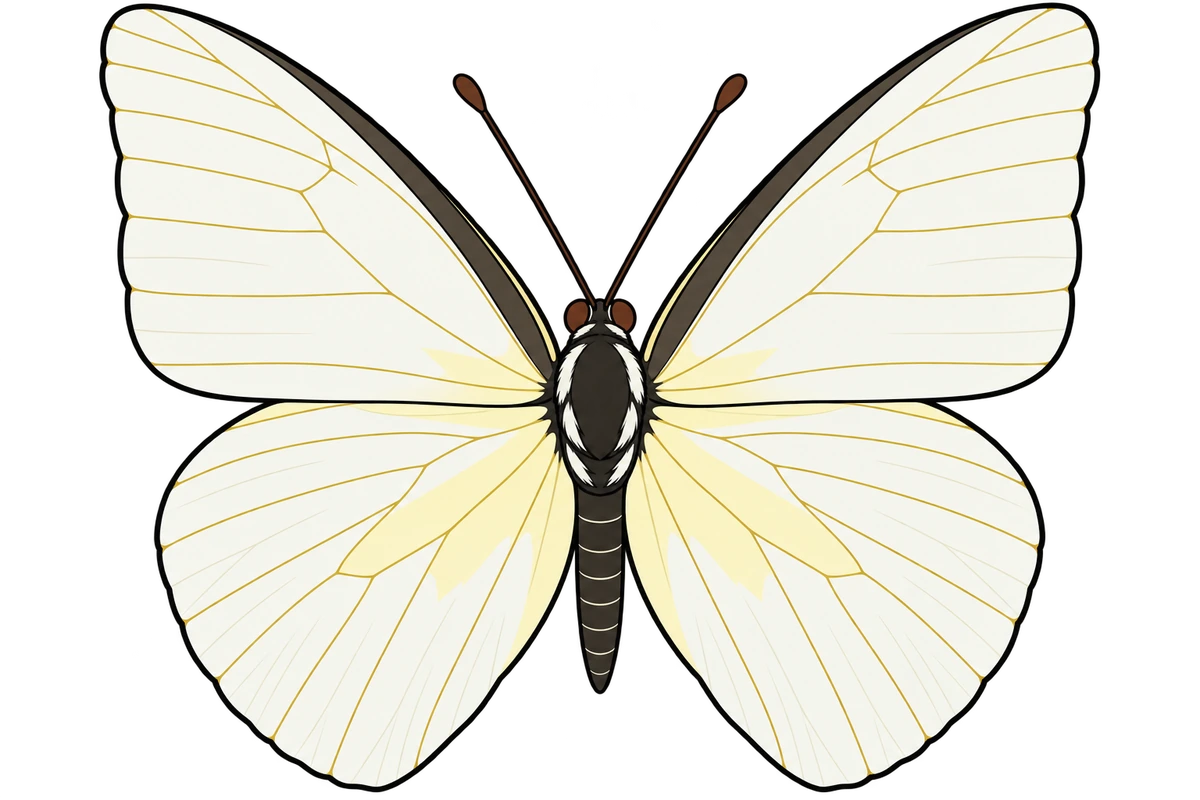
At a glance
- Regional host ↘
- Drypetes deplanchei in northern Australian observations. [3]
- Variation ↘
- Females include white, yellow and intermediate forms in the Australian study. [3]
The white albatross
Appias albina is a pierid butterfly. The 2010 revision treats it within Appias (Catophaga), while the northern Australian field study specifies the nominate subspecies albina. [1][2][3]
A species heading makes the broad identity searchable; regional records retain their subspecies wording rather than silently losing that precision.
A pale butterfly with several female forms
The inspected museum adult has pale wings, a narrow dark forewing costal edge and pale-yellow basal areas. Northern Australian females occur in white, yellow and intermediate forms. [5][3]
The English name therefore does not predict every individual's colour. Compare pattern boundaries and sex alongside hue.
Northern Australia provides a local portrait
Braby and colleagues connect the northern Australian population with coastal semideciduous monsoon vine-thicket and lateritic landforms. [3]
This is a regional habitat account, not a restriction on the species throughout its wider distribution. The precise locality and form should accompany any attempt to compare that population with Asian material.
Development follows fresh plant growth
The Australian study connects adult activity with monsoonal fresh growth and reports a short laboratory cycle. [3][4]
A controlled rearing interval belongs to the temperature, food and conditions of that experiment; it is not an adult lifespan. The regional atlas treats dry-season survival as a biological question rather than a completed observation.
Drypetes in the field record
Drypetes deplanchei is the documented larval host in the northern Australian account. [3]
That relationship concerns caterpillars consuming foliage. It supplies a concrete botanical connection, stronger than an adult merely settling on a plant. Botanical family placements can change after publication, so the plant's species name is the clearest link to the original record.
A flight calendar has a geography
The northern Australian atlas places the local adult observations mainly in the wet-season part of the year. [4]
Those dates are useful for planning a regional search. They should not be copied into a global calendar, because rainfall, latitude and local plant growth can make another population's seasonal context different.
White can conceal biological variation
A familiar common name makes the species easy to find but can also encourage a too-simple mental image. The female colour forms are a direct example: a yellow individual need not represent a new species. Taxonomic comparison gains strength when colour is read alongside structure, locality and variation.
The immature stage connects the landscape
An adult survey and a host survey answer complementary questions. Adults locate activity in a landscape; caterpillars on a named plant provide direct evidence of development there. Connecting both is especially useful in seasonal vegetation, where the emergence of suitable foliage can be as informative as a passing butterfly.
A type-locality correction matters
The Appias revision addresses the historical albina name and its type-locality problem: Ambon is relevant to the original material, while an old Brazil label is erroneous. [2]
This is a nomenclatural correction, not evidence that the species recently moved continents. Historical label errors deserve correction without inventing a distribution narrative.
Seasonal records need repeated sampling
A butterfly seen briefly during a favourable season may be difficult to find later. Before interpreting an apparent decline, compare surveys made at equivalent dates and host-growth conditions. Regionally bounded evidence is more useful than a common-name assumption that an albatross must be abundant or secure everywhere.
Read the dark apex against the pale field
Begin with the full outline, then inspect the forewing's costal shading, basal colour fields and fine venation. Keep both sides of the specimen distinguishable. A pale wing can appear almost blank at small web sizes, so use a detail view that preserves veins and pattern edges rather than simply increasing saturation.
A study in pale space
The artwork's interest can come from the measured dark boundary around a broad pale field. Subtle cream or yellow tones should retain their variation instead of being flattened into pure white. A clear scientific caption lets the restrained composition remain connected to a particular butterfly.
Print the pale tones carefully
Check a proof on the intended paper, where light cream may disappear into the substrate. Retain a master with enough tonal information to distinguish the wings from the background. Handle any real insect through its frame or box; the pale appearance is no reason to touch or clean the wing scales.
Names, forms and the wet season
Can a yellow female belong to the white albatross? Yes, the regional study documents female colour variation. Does Drypetes establish a host for every Appias? The record concerns this named butterfly and population. Is an Australian wet-season calendar valid everywhere? Its geographic scope remains part of the evidence.
Taxonomy, rearing and field context
The taxonomic revision resolves the name and historical locality. The northern Australian study supplies examined biology, while the regional atlas adds seasonal field context. The museum image supports the visual comparison. Reading those sources together gives a fuller portrait without making a local experiment into a universal life-history rule.
- Appias: museum specimen images and taxonomy ↗
University of Florida BioCosmos · Accessed 2026-10-09
Actual labelled specimen images; species identity and dorsal appearance.
- A revision of Appias (Catophaga) ↗
Yata and colleagues; Systematic Entomology, 2010 · Accessed 2026-10-09
Primary taxonomic revision of the subgenus, including Appias albina.
- Occurrence of Appias albina albina in northern Australia, with notes on its biology ↗
Braby, Lane and Weir; Entomological Science 13, 2010; Australian National University · Accessed 2026-10-09
Original northern Australian field and rearing study; abstract and bibliographic record.
- Atlas of Butterflies and Diurnal Moths of Northern Australia: White Albatross account ↗
Michael F. Braby and collaborators; regional field atlas, DBCA library copy · Accessed 2026-10-09
Regional host, habitat and seasonal observations; not species-wide flight dates.
- Appias albina specimen ZMA.INS.5172695: dorsal photograph ↗
Naturalis Biodiversity Center · Accessed 2026-10-09
Labelled specimen from Puerto Galera, Mindoro, Philippines, 22 February1985. Exact dorsal appearance reference; corresponding underside is ZMA.INS.5172695_2.
Sources checked 2026-10-09. Illustrations · Luminary Oddities.
Return to the Entomological Atlas ↑