
Luminary Oddities · Natural history & art
Becquartina versicolor cicada
Becquartina versicolor
Hemiptera / Cicadidae
Angular pale markings and red wing veins make this Asian cicada an arresting subject. Its butterfly-like appearance also introduces a less visible story: recent research changed its tribal placement without changing the species itself.
Explore this insect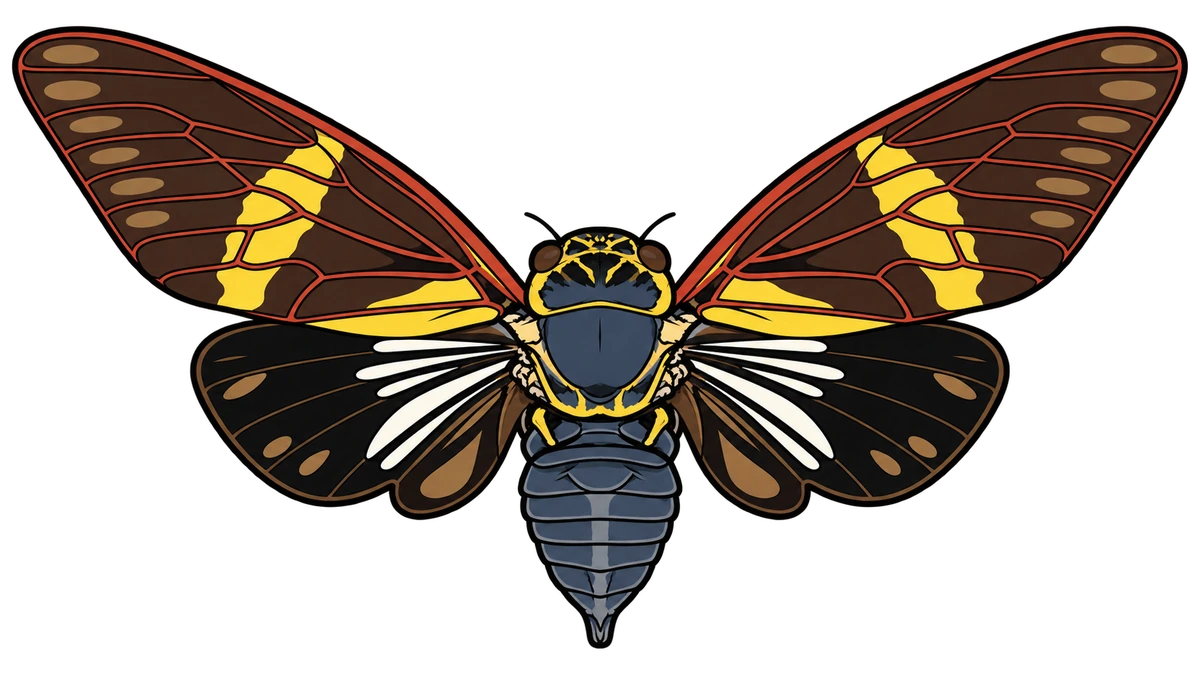
At a glance
- Reference locality ↘
- An individually labelled adult photograph from Wiang Papao, Thailand. [2]
- Taxonomy ↘
- Becquartina belongs to Leptopsaltriini in the 2025 revision. [1]
A cicada behind the wing pattern
Becquartina versicolor is a valid cicada species named by Boulard in 2005. The 2025 phylogeny places Becquartina in Leptopsaltriini. [4][1]
Its wings may suggest a butterfly, but the taxonomic identity remains Hemiptera rather than Lepidoptera.
Follow the angles across the wings
The reference adult has dark forewings, reddish veins and angular yellow markings. Creamy elongated marks radiate across black hindwings. A dark, substantial body anchors the pattern. [2]
Shape, placement and venation are more useful to compare than a single colour swatch.
A precise Thai record
The photographed specimen is labelled Wiang Papao, Thailand, with an April collecting date. [2]
This is a locality record attached to one insect, not a map of every population. For research, retain the town and date together; neither should be reconstructed from wing colour or an artistic background.
From underground nymph to winged adult
The cicada developmental framework is egg, underground nymph and adult, with no butterfly-like pupal stage. Species-specific development time requires rearing evidence. [3]
An adult collecting month answers a different question: when that particular insect was obtained.
A plant relationship below the surface
Root feeding belongs to the cicada nymphal framework. [3]
A host record for versicolor should identify the plant, developmental stage and observation method. A specimen collected from a tree is weaker feeding evidence than a documented nymph associated with its roots.
The photograph holds one moment
A spread specimen reveals both wing pairs at once. It cannot demonstrate flight speed, the daily calling schedule or courtship. Those behavioural questions are best approached through an identified living insect, a field record and, for acoustic work, a linked recording.
Resemblance and relationship diverge
Butterfly-like colour is a useful visual description, but it does not define a biological tribe. [1]
The revised placement makes this species a particularly good reminder that outward resemblance and evolutionary relationship answer different questions. A beautiful shared pattern need not imply the closest shared ancestry.
Connect an insect to a landscape
The Wiang Papao label gives a starting point for ecological study. Linking verified adults with emergence sites, plants and seasonal observations would build a much stronger account than collecting unrelated sightings under a common name. Keep the evidence attached to the locality at which it was obtained.
Keep the species name stable
The name Becquartina versicolor remains the species heading when higher classification changes. [4]
The date following an authority is a nomenclatural date, not the age of a specimen or an estimate of the species' evolutionary origin. Old labels can remain historically useful if their taxonomic context is preserved.
Local evidence before a conservation badge
An old specimen or striking photograph provides no population trend by itself. Conservation work would require repeat observations, a defined study area and evidence of habitat change. The taxonomic revision should help records resolve to the right species before those records are used in a status assessment.
Read the forewing and hindwing separately
Begin with the complete outline. Follow the red veins through the angular forewing marks, then compare the long pale hindwing streaks. An enlarged crop is most informative when its location is clear in the full image. Avoid treating a symmetrical presentation as proof that every small marking is identical.
An angular rhythm in the collection
The visual interest comes from two different geometries: broken angles in front and radiating streaks behind. A drawing can emphasize that rhythm through line weight and colour. The scientific caption should remain linked to the insect's identity even when composition makes a more expressive image.
Preserve detail when displaying the work
Choose a print size that keeps the thin veins distinct rather than merging them into the dark wing field. Keep a high-quality master file before resizing for the web. A physical insect frame needs separate handling appropriate to fragile wings; viewing an enlargement requires no contact with the specimen.
Questions that improve the record
Why call it a butterfly cicada? The phrase describes the appearance. Does the April label prove a one-month season? It records one collection. Can a patterned wing establish a root host or a calling rhythm? Those questions need different observations from the ones recorded in a spread adult photograph.
A photograph and a revised classification
The original adult photograph supplies the visual reference and locality caption. ITIS supplies the species authority. The 2025 systematic study controls the higher placement used here, while Smithsonian's rearing account provides a clearly separated developmental framework. Each source addresses a different part of the portrait.
- Phylogeny, diversification and biogeography of charming moth-like cicadas in Gaeanini ↗
Wang, Zhou, Zhang and Wei; Systematic Entomology, 2025 · Accessed 2026-10-09
Primary phylogenetic and systematic study; current generic and tribal placements.
- The butterfly cicadas: original photographs ↗
Photographs by Michel Chantraine and Jeff Blincow, hosted by Cicada Mania · Accessed 2026-10-09
Actual adult images and their individual locality captions; visual reference, not a complete life-history study.
- Rearing Cicadas ↗
Smithsonian Tropical Research Institute · Accessed 2026-10-09
General cicada developmental framework and why species-specific root hosts and durations need direct rearing evidence.
- Becquartina versicolor ↗
Integrated Taxonomic Information System · Accessed 2026-10-09
Scientific name and Boulard 2005 authority; older higher classification is not used.
Sources checked 2026-10-09. Illustrations · Luminary Oddities.
Return to the Entomological Atlas ↑