
Luminary Oddities · Natural history & art
Festive cicada
Callogaeana festiva
Hemiptera / Cicadidae
A bold dark-and-pale pattern can surround orange or blue-green hindwings in this cicada. Its long naming history and visible colour variation make it an especially useful subject for looking beyond one familiar colour form.
Explore this insect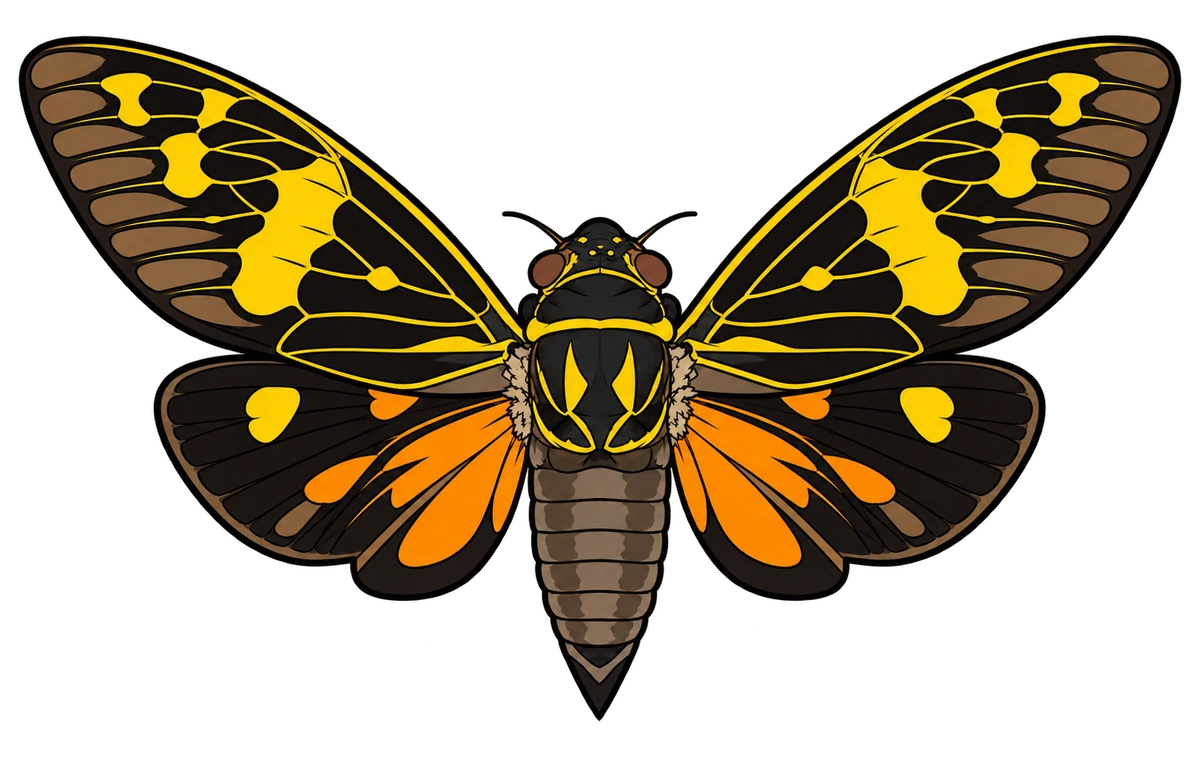
At a glance
- Current name ↘
- Callogaeana festiva. [1]
- Historical name ↘
- Tettigonia festiva Fabricius, 1803. [2]
- Variation ↘
- Historical descriptions record several pattern forms. [2]
A festive cicada with a long history
Callogaeana festiva is the current name retained in the 2025 treatment. Fabricius originally named it Tettigonia festiva in 1803. Distant's monograph used Gaeana festiva. [1][2]
These combinations refer to the same named species, not three separate additions to a collection.
Pattern matters beyond orange or green
The orange reference form has dark forewings broken by pale bands and orange hindwings bordered in dark colour. [3]
Distant described greenish-ochre forewings and blue-green hindwings, including dark-expanded variants. His account details the positions of bars, spots and margins, demonstrating why colour alone is an incomplete key. [2]
Read historical localities in context
Distant recorded material from Sikkim and Darjeeling, Sumatra and Ambon, with an especially dark variant from Assam south of the Brahmaputra. [2]
Those nineteenth-century identifications are historical records rather than a modern range revision.
The photographed orange adult is separately labelled Wiang Papao, Thailand, in May. [3]
Dates do not establish a periodic cycle
A collection date places an adult in time. It does not establish how many years its nymph spent underground or whether a population emerges periodically. The butterfly-like adult pattern also does not imply a pupal stage: the relevant developmental model is the cicada's egg–nymph–adult sequence. [4]
Keep plant claims tied to a life stage
For a cicada, a plant may provide an egg-laying site, nymphal root resources or a place for an adult to rest. These are different associations. A useful host entry should say which was observed and how the insect was identified, rather than assigning every tree at a collecting site.
What an open-wing adult can show
A spread specimen makes the hindwing colours visible and allows the dark margins to be compared. It does not reproduce a living insect's posture or establish a calling pattern. Those questions require their own field evidence; the adult pattern remains a valuable identification starting point.
Variation was noticed early
Distant described both increased dark areas and a pale longitudinal pronotal band in variants. [2]
His observations are a historical warning against naming every conspicuous colour difference as another species. The proper comparison includes structural characters, geographically documented material and, where available, modern taxonomic evidence.
An ecological record needs more than a colour form
Marova and colleagues collected voucher MZMU2409 near Hualtu, Mizoram, at 1,345 metres on 14 June 2021. The insect was beside a forest track under a Schima tree in cultivated secondary forest surrounded by primary forest; the paper includes its adult photograph. [5]
The record documents landscape context. It does not demonstrate that the tree was a nymphal food plant. Preserving the voucher number makes the ecological description recoverable as an occurrence of a particular identified insect.
Search old names without multiplying species
Gaeana festiva remains an important search name for older literature and specimen labels. The original Tettigonia combination carries the naming history further back. [2]
Use those aliases to recover evidence, then reconcile it under Callogaeana festiva. A new genus combination changes a label without automatically creating a new species.
A historical abundance word needs a date
An old collecting account or a colourful adult image cannot supply a current population trend. Conservation comparisons should use identified records, dated surveys and explicit geographic boundaries. This is particularly important when variable colour forms may otherwise be mistaken for different species in an occurrence dataset.
Compare one form consistently
Start with a full adult view and identify the forewing's pale bands, then the hindwing's basal colour and outer border. A gallery comparison can show variation most clearly when each adult retains its own caption. Combining the orange of one specimen with the markings of another creates an illustration that obscures the comparison.
A strong dark frame around colour
The species offers an emphatic contrast between patterned front wings and more open hindwing colour. An artwork can use that contrast to direct attention without changing the locations of the major markings. Different colour forms can each support a distinct piece while preserving a shared scientific identity.
Protect the contrast in print
A proof should keep the darkest wing areas from swallowing their fine veins and pale breaks. Retain the original file before preparing smaller web versions. For a real specimen, handle the frame or box rather than using the insect itself as a movable colour sample.
Colour forms and scientific names
Is the orange individual automatically a different species from a blue-green one? Colour needs a fuller taxonomic comparison. Are Gaeana festiva and Callogaeana festiva separate Atlas subjects? They are successive combinations of one name. Does a May label establish a short adult season? It documents that particular collection.
History alongside current systematics
Distant's public-domain monograph supplies the original-name trail, descriptions and historical locality records. The 2025 systematic study controls the current combination. The photographer's labelled adult supplies the colour form shown in the visual reference. None of these roles should be substituted for a measured life-history or population study.
- Phylogeny, diversification and biogeography of charming moth-like cicadas in Gaeanini ↗
Wang, Zhou, Zhang and Wei; Systematic Entomology, 2025 · Accessed 2026-10-09
Primary phylogenetic and systematic study; current generic and tribal placements.
- A monograph of Oriental Cicadidae, pp.105–107 ↗
W. L. Distant, 1889–1892; University of Toronto copy · Accessed 2026-10-09
Public-domain original species descriptions, historical specimen localities and plates. Historical classification is superseded.
- The butterfly cicadas: original photographs ↗
Photographs by Michel Chantraine and Jeff Blincow, hosted by Cicada Mania · Accessed 2026-10-09
Actual adult images and their individual locality captions; visual reference, not a complete life-history study.
- Rearing Cicadas ↗
Smithsonian Tropical Research Institute · Accessed 2026-10-09
General cicada developmental framework and why species-specific root hosts and durations need direct rearing evidence.
- A report on the occurrence of Callogaeana festiva from Mizoram, India ↗
Marova, Malsawmdawngliana, Muansanga and Lalremsanga; Journal of Threatened Taxa14(6), 2022 · Accessed 2026-10-09
Original field record, adult photograph and voucher MZMU2409; Hualtu, Serchhip, Mizoram on14June2021.
Sources checked 2026-10-09. Illustrations · Luminary Oddities.
Return to the Entomological Atlas ↑