

Luminary Oddities · Natural history & art
Hagen’s cicada
Callogaeana hageni
Hemiptera / Cicadidae
Pale green wings with carefully bounded dark margins distinguish the historical portrait of Hagen’s cicada. Its original Sumatran material supplies a firm point of reference for a species whose detailed biology remains a separate research question.
Explore this insect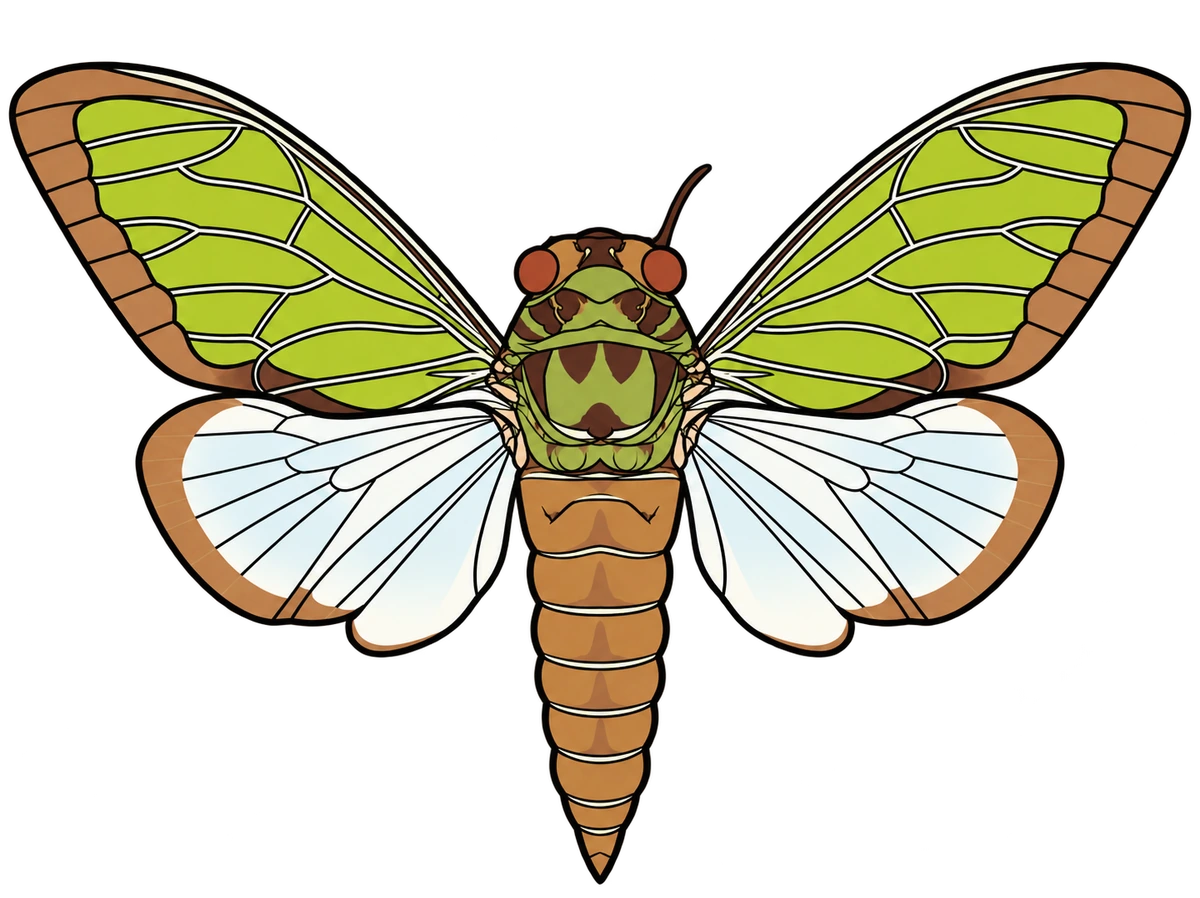
At a glance
- Current name ↘
- Callogaeana hageni. [2]
- Original authority ↘
- Distant, 1889. [1]
- Historical locality ↘
- Tandjong Morawa, Serdang, Sumatra. [1]
Hagen’s cicada in its current genus
Distant named Gaeana hageni in 1889. The species is included as Callogaeana hageni in the 2025 systematic treatment. [1][2]
The Atlas follows that combination while retaining the old name as an alias, so the original diagnosis can still be found.
A pale field with a dark outer edge
Distant described an olive-brown body, pale green forewings, a broad dark apical border and a rounded dark spot near the third apical cell. The hindwings were pale blue-green with a narrow dark outer border. He also described a variant with an additional smaller forewing spot. [1]
A named Sumatran collecting locality
The monograph records Tandjong Morawa, Serdang, Sumatra, associated with Dr. B. Hagen and material in Leiden and Distant's collection. [1]
This is substantially more informative than an unqualified country label. It anchors the historical account without asserting that the species occurs everywhere on Sumatra.
The adult does not measure the hidden years
The cicada life cycle links eggs, underground nymphs and winged adults. [3]
A specimen diagnosis addresses the adult's identity, not its developmental timetable. For hageni, an exact underground duration would need a linked emergence or rearing record rather than an analogy with another cicada.
A feeding record must name the evidence
No plant is established by the original adult diagnosis. A future botanical connection should preserve a named plant and the observed insect stage. Adult capture on a branch, egg deposition and a root-associated nymph would each answer a different feeding or reproductive question.
Sound requires an identified recording
Distant compared the exposed sound-organ region with related species. [1]
That anatomical observation is not a transcription of a call. A sound profile should connect the recording to an identified individual, locality and conditions; the visible colour pattern alone cannot establish frequency or rhythm.
A small spot can carry diagnostic weight
The rounded mark near the forewing's third apical cell and the additional mark in Distant's variant illustrate the precision of an adult diagnosis. [1]
Following vein-defined positions is more repeatable than calling a wing simply spotted. It also makes comparisons possible when colour has faded in old material.
Locality labels can guide renewed study
The historical Sumatran locality can help orient a search for modern evidence. Contemporary observers would need to document habitat, date and identity independently. The original account supplies a starting point, not proof that present-day vegetation or populations remain unchanged at the same place.
An authority preserved across a genus change
The authority Distant, 1889 belongs to the species' nomenclatural history. Gaeana hageni and Callogaeana hageni are successive combinations of that name. [1]
Older catalogue entries and plate captions should be searchable through the alias, with the current heading used for the consolidated species account.
Separate a rare record from a risk category
The limited historical evidence cannot by itself establish a modern conservation category. Few accessible records may reflect limited collecting, identification difficulty or genuine scarcity. A responsible assessment needs a defined geographic area, dated surveys and habitat evidence, starting with reliably identified material.
Locate the apical cells
Read the outer forewing border first, then trace the veins inward to locate the rounded spot described by Distant. Compare the forewing's broad edge with the narrower hindwing border. This attention to different wing regions is more useful than assuming that every dark marking has the same diagnostic value.
A quieter cicada palette
A cicada’s outline offers a useful starting point for looking closely: the head, thorax, segmented abdomen and paired wings have different roles. Wing pattern alone should be read together with a securely identified specimen and the taxonomic record.
Keep pale greens distinct
A print proof should separate the green forewing field from the cooler hindwing tone and preserve the thin dark margins. Keep the labelled master image and its original resolution before preparing display copies. Any physical specimen should be examined through photography and handled by its enclosure.
Names, spots and biological limits
Is the older Gaeana label a different species? It is the original combination. Does a pale green wing alone identify hageni? The diagnostic border, spot positions and structural comparison also matter. Does a nineteenth-century Sumatran record establish a current season or plant host? Those require new evidence.
Start with the diagnosis, then update the name
Distant's public-domain monograph supplies the original description, variant and locality. The 2025 systematic study supplies the current combination. The guide uses each for its particular purpose, leaving life-history measurements to studies that actually follow identified insects through development.
- A monograph of Oriental Cicadidae, pp.105–107 ↗
W. L. Distant, 1889–1892; University of Toronto copy · Accessed 2026-10-09
Public-domain original species descriptions, historical specimen localities and plates. Historical classification is superseded.
- Phylogeny, diversification and biogeography of charming moth-like cicadas in Gaeanini ↗
Wang, Zhou, Zhang and Wei; Systematic Entomology, 2025 · Accessed 2026-10-09
Primary phylogenetic and systematic study; current generic and tribal placements.
- Rearing Cicadas ↗
Smithsonian Tropical Research Institute · Accessed 2026-10-09
General cicada developmental framework and why species-specific root hosts and durations need direct rearing evidence.
Sources checked 2026-10-09. Illustrations · Luminary Oddities.
Return to the Entomological Atlas ↑