

Luminary Oddities · Natural history & art
Delias blanca
Delias blanca
Lepidoptera / Pieridae
A Bornean and Philippine jezebel whose contrasting dark veins and pale fields are easier to describe than its unsettled position within Delias evolutionary groups.
Explore this insect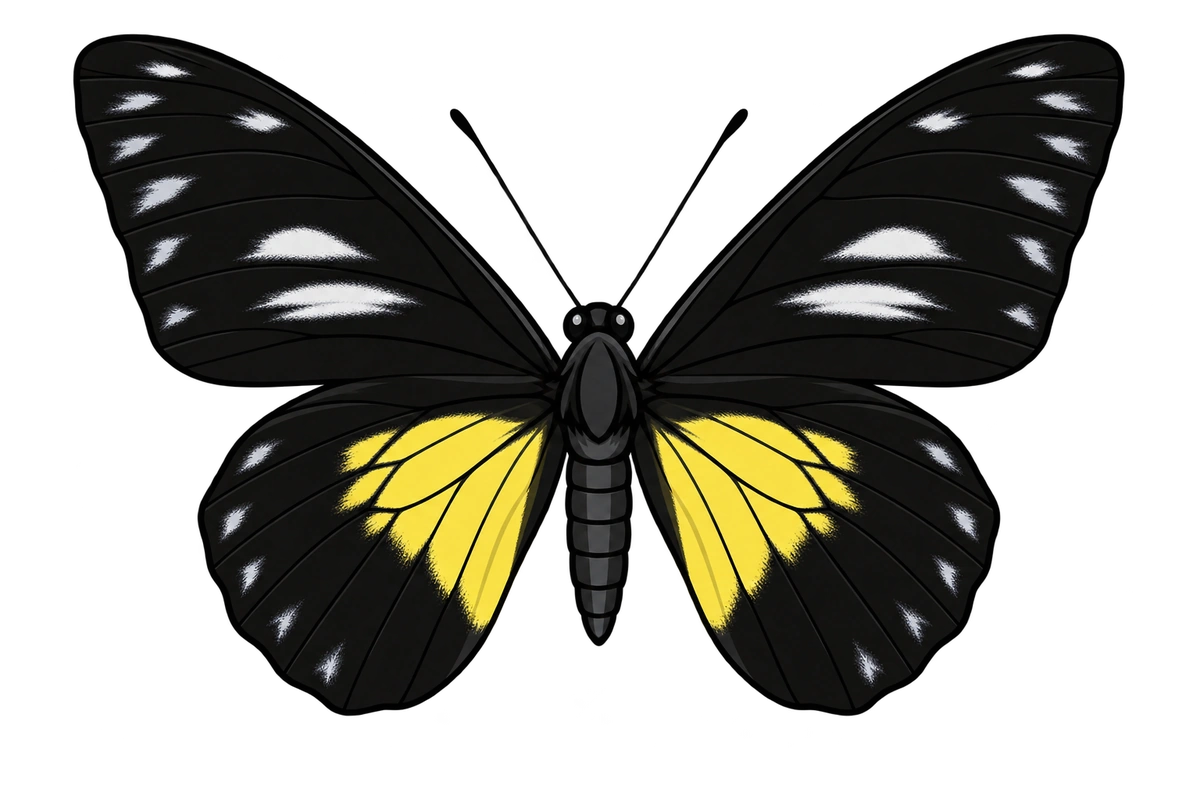
At a glance
- Range context ↘
- Borneo and several Philippine islands [2]
- Identification detail ↘
- Pale forewing band on a dark ground [2]
- Biological reference ↘
- Phylogenetic position unresolved in the 2012 study [3]
Identity and close relatives
Delias blanca is recognized as a species. Its position among comparison groups has shifted: a 2012 molecular study moved it into the pasithoe group while explicitly leaving its exact phylogenetic position unresolved. A useful species account can state both findings without turning a tentative relationship into certainty. [1][3]
How to look at the wings
The specialist account describes a dark brown male with pale white or bluish-grey forewing marks. The proximal hindwing area is lemon yellow with contrasting dark veins, while paler spots occur farther out. Read the locations and boundaries together; overall brightness is a weak substitute for pattern. [2]
Range and living habitat
The account includes northern Luzon, northern Borneo, Mindanao, Negros and Bohol. Retain the island on the record rather than assuming one photograph represents every population. The listing establishes geographic context, not a continuous distribution or a quantified local abundance. [2]
A life in four stages
The checked sources provide adult comparisons and molecular placement rather than a complete life cycle. A documented developmental series would need a determined adult and a precise island locality. The resulting information could add a useful independent comparison among the geographically separated populations.
Leaves for larvae, food for adults
A particular blanca larval food plant was not established in the sources checked. A host from another pasithoe-group species cannot be transferred merely because a molecular analysis placed blanca nearby. Food associations are biological observations, whereas group placement is a hypothesis of relationship.
Behaviour in the living landscape
A comparison plate reveals the adult but does not establish flight or courtship. Island-specific living observations could document actual resting, feeding and reproductive events. Each event should carry its locality and the characters used to separate blanca from similar dark Bornean or Philippine pierids.
A closer scientific story
Blanca provides a good example of the distinction between identification and phylogenetic certainty. A butterfly can be consistently recognized while its branching position remains unclear in a particular analysis. The 2012 paper's explicit uncertainty is a scientific result, not a reason to conceal the taxon. [3]
Connections in the ecosystem
The female's resemblance to Bornean Prioneris cornelia offers an ecological question, but a similar pattern does not itself prove a defensive mechanism. Study of predators, chemical defence and local encounters would be needed to test an explanation beyond the descriptive resemblance.
Names and natural-history records
Changes in comparison-group placement should not produce multiple Atlas entries for blanca. The scientific binomial links the adult accounts across those changes. Preserve the treatment and publication date when citing a group name, because an old placement and a later phylogeny may use different boundaries.
Habitat and conservation context
The checked sources do not establish a current global threat category. The separated island records suggest locality-specific monitoring as a useful starting point. Neither a broad island list nor uncertainty about evolutionary placement measures the condition of a particular living population.
Reading the specimen views
Read forewing band, hindwing fields and dark venation on the correctly labelled surface. Compare the same sex and, where possible, the same island population. A female cornelia reference can clarify the resemblance, but it should not be used to complete obscured blanca markings.
From biological reference to artwork
Preserve the reference butterfly's pale fields and dark veins without making the yellow unnaturally uniform. Record the island and sex when known. The artwork can communicate the adult clearly while the guide keeps its evolutionary placement appropriately open.
Caring for a framed specimen
Avoid wing contact when handling the enclosure. Link the reference island and sex to the catalogue entry, and retain the phylogenetic paper with any group label. If a new analysis changes the placement, add that source without erasing the earlier interpretation. [4]
Questions worth asking
Where does blanca fall in a broader, voucher-linked phylogeny? Are its island populations morphologically and genetically consistent? Which hosts support their larvae? These questions address relationship, geographic variation and ecology separately rather than letting one stand in for the others.
Sources and further reading
The 2012 molecular paper supplies the explicit placement uncertainty. The specialist account supplies the adult comparison and regional synthesis, while the catalogue supports species rank. Read the molecular result at its stated level: it does not describe a fully resolved lineage for blanca.
- Delias classification and museum-image catalogue ↗
University of Florida Lepiverse; Catalogue of Life 2026-08-26 XR · Accessed 2026-10-09
Indexed genus classification lists the named taxon at species rank; this supports catalogue status, not a resolved species boundary.
- Delias blanca: specialist records and comparison plates ↗
Delias of the World; international Delias specialists · Accessed 2026-10-09
Specialist island records and diagnostic comparison plate; documents changing group assignments.
- Delving into Delias: fine-scale biogeography, phylogenetics and systematics ↗
Müller, Matos-Maraví and Beheregaray; Journal of Biogeography (2012) · Accessed 2026-10-09
Primary molecular study proposes pasithoe-group placement for blanca but explicitly notes unresolved phylogenetic position.
- Caring for natural history collections ↗
Canadian Conservation Institute; Fiona Graham · Accessed 2026-10-09
Preventive care of fragile biological collections; the brief enclosure-handling and environment recommendations are general collection practice. Species-label recordkeeping recommendations are editorial.
Continue exploring
Sources checked 2026-10-09. Illustrations · Luminary Oddities.
Return to the Entomological Atlas ↑