

Luminary Oddities · Natural history & art
Delias patrua
Delias patrua
Lepidoptera / Pieridae
A Chinese and mainland Asian jezebel distinguished in comparison by the absence of a yellow upper hindwing costal patch, with regional names that require careful taxonomic bookkeeping.
Explore this insect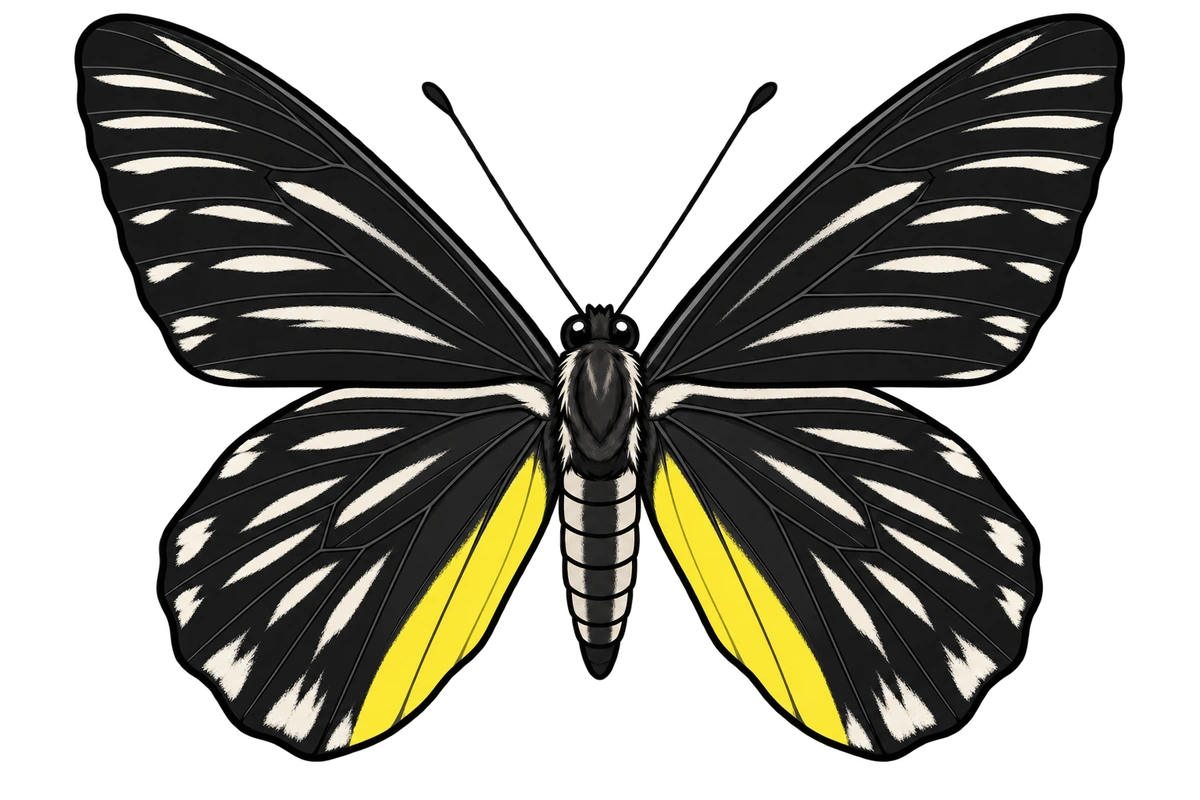
At a glance
- Range context ↘
- Chinese and mainland Asian regional records [2]
- Identification detail ↘
- No yellow costal patch in the upper hindwing comparison [2]
- Biological reference ↘
- Living Laos photograph from May 2023 [2]
Identity and close relatives
Delias patrua is recognized as a species and placed in the belladonna comparison group. Its specialist account includes several geographic names with different taxonomic outcomes. Counting those names requires checking whether they are accepted forms, rejected combinations or names reassigned to another species. [1][2]
How to look at the wings
The specialist comparison emphasizes the absence of a yellow costal patch on the upper hindwing. An absence character needs a clear view of the relevant area: a folded wing or cropped edge cannot demonstrate it. Check the remaining pale marks and outline alongside this feature. [2]
Range and living habitat
The account includes Chinese localities in Hubei, Yunnan and Sichuan and northern Myanmar, with named Thai and Lao forms. A living Phou Samsoum, Laos, photograph from May 2023 is credited to Steeve Collard. Keep that locality distinct from a generalized mainland Asian range. [2]
A life in four stages
The adult comparisons and living photograph do not establish a complete life cycle. A reared patrua sequence would need a determined adult from the same locality. Such evidence could help compare regional forms without relying only on slight differences in adult pattern.
Leaves for larvae, food for adults
A specific patrua larval host was not established by the checked sources. Finding larvae near a mistletoe should lead to documentation, botanical identification and rearing, rather than an immediate species label. The adult's similar relatives make that final determination important.
Behaviour in the living landscape
The dated Laos photograph supplies one living encounter. It does not establish an annual flight period or a regular feeding routine. Repeated observation with effort recorded would make a behavioural account possible and separate local activity from chance photographic opportunity.
A closer scientific story
Patrua's nomenclature shows why a list of names is not a species inventory. The specialist account rejects guiyangensis under patrua and reallocates that name within a berinda treatment. A rejected placement belongs in the naming history, not in the count of accepted patrua populations. [2]
Connections in the ecosystem
Ecological summaries should use the same taxonomic boundaries as the occurrence records. A name reassigned to berinda should not continue supplying patrua habitat or host data merely because an older source used that combination. Review locality and determination before pooling observations.
Names and natural-history records
The specialist page includes a recent Lao form called laotiana and discusses the reassignment of guiyangensis. The present account reports those catalogue details without claiming an unread original description was examined. Harvard's taxon record provides an additional institutional anchor for patrua. [2][3]
Habitat and conservation context
No current global threat category was established here. A modern range assessment should exclude records whose former names now identify another taxon, while keeping the correction traceable. Otherwise nomenclatural errors can create apparent range changes with no change in the living populations.
Reading the specimen views
Show the upper hindwing costa clearly to explain the absent yellow patch. A distribution map is useful context but cannot serve as a biological pattern reference. The living Lao photograph and labelled adult plate should retain their exact source determinations.
From biological reference to artwork
A reference-based illustration should preserve the upper costal area without adding a yellow patch from a similar jezebel. Keep the locality and regional form caption when known. That small fidelity matters more for identification than a stronger overall decorative contrast.
Caring for a framed specimen
Keep the enclosure free from physical knocks. Retain reassigned names as historical search terms with their correction noted. The catalogue should distinguish a synonym trail from an accepted identification so a later user does not revive the original labelling error. [4]
Questions worth asking
Which adult characters separate patrua across its regional forms? What evidence supports the recent Lao form? Which host records are directly linked to checked adults? These questions would extend the account while keeping new geographic names separate from new species.
Sources and further reading
The specialist treatment provides the adult comparison, nomenclatural notes and attributed Lao photograph. Harvard supplies an institutional taxon record, and the catalogue establishes rank. Follow links to original descriptions when examining new forms; the synthesis itself should not be mistaken for those papers.
- Delias classification and museum-image catalogue ↗
University of Florida Lepiverse; Catalogue of Life 2026-08-26 XR · Accessed 2026-10-09
Indexed genus classification lists the named taxon at species rank; this supports catalogue status, not a resolved species boundary.
- Delias patrua: specialist records and comparison plates ↗
Delias of the World; international Delias specialists · Accessed 2026-10-09
Original Lao photograph, specialist comparison and current note reallocating guiyangensis to berinda.
- Delias patrua taxon record ↗
Harvard Museum of Comparative Zoology · Accessed 2026-10-09
Primary institutional taxonomic record recognizes the species in Pieridae.
- Caring for natural history collections ↗
Canadian Conservation Institute; Fiona Graham · Accessed 2026-10-09
Preventive care of fragile biological collections; the brief enclosure-handling and environment recommendations are general collection practice. Species-label recordkeeping recommendations are editorial.
Continue exploring
Sources checked 2026-10-09. Illustrations · Luminary Oddities.
Return to the Entomological Atlas ↑