

Luminary Oddities · Natural history & art
Antler-horn Flower Beetle
Dicronocephalus wallichi
Coleoptera / Scarabaeidae
An antler-horn flower chafer whose research story includes both male contests and maternal nest building. Its spread-wing portrait reveals a different side of the armored beetle.
Explore this insect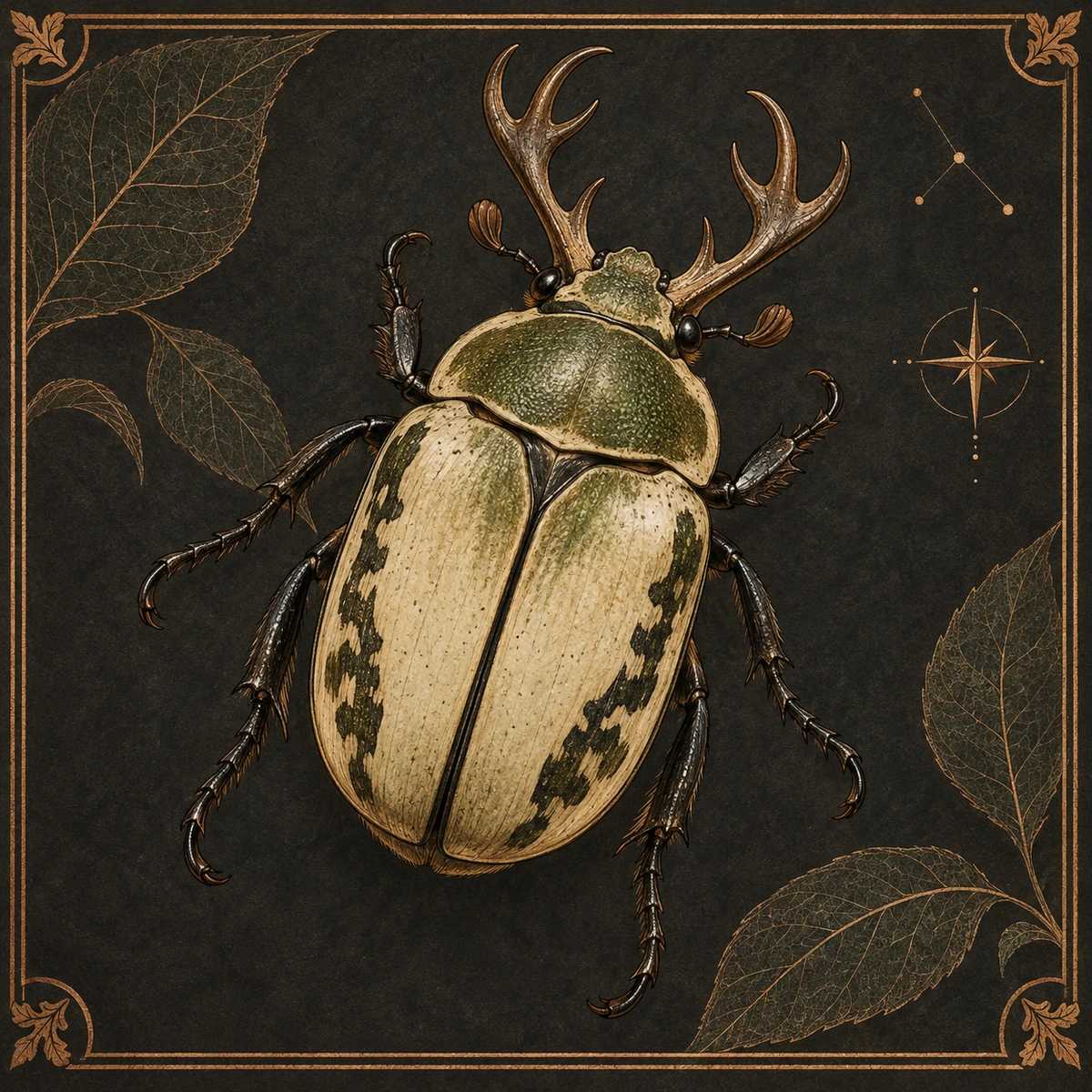
At a glance
- Remarkable care ↘
- Studied females provisioned leaf-lined nests. [4]
Meet the species
Dicronocephalus wallichi is an antler-horn flower beetle in Scarabaeidae, within the flower-chafer subfamily Cetoniinae. Its horns belong to the head, whereas a longhorn beetle’s familiar elongated feelers are antennae. The distinction matters when searching for natural-history records: this animal’s biological story belongs with flower beetles, including studies of male contests and leaf-lined nests. [2]
The Atlas uses the accepted Catalogue of Life spelling wallichi, displayed by GBIF. Wallichii appears in much of the research literature, and Dicranocephalus wallichii in supplier wording. Those alternative spellings are retained as search bridges. They do not authenticate a subspecies or a collection locality for the photographed specimen. [1]
Look closely
The male beetles in the Taiwanese competition study bear two prominent head horns and longer forelegs than females. These are separate structures, used in different phases of a contest. Notice the horn bases, the jointed front legs and the antennae individually rather than treating every long projection as the same anatomical feature. [3]
A beetle has two distinct wing pairs. The hardened front pair forms protective covers called elytra; the thinner hindwings provide flight. In an open-wing view, follow the boundary between these covers and the membranes behind them. A folded beetle can look compact and armored, while the same body with extended hindwings has a much broader silhouette. [6]
Range and habitat
Detailed field research cited here concerns beetles described as D. wallichii bourgoini in lowland Taiwanese forest. Adults gathered at feeding sites, including bamboo shoots, during daytime observations in late spring. This is a valuable account of one named population, rather than a complete distribution map for every taxon associated with wallichi. [3]
The name’s history reaches back to Hope’s 1831 account of Nepalese insects, listed in the current taxonomic bibliography. Historical material helps trace how a name began; a precise label on a modern specimen supplies different information. A seller’s location, an artwork’s palette and a photograph’s background cannot substitute for that specimen label. [1]
Life in stages
Beetles undergo complete metamorphosis: egg, larva, pupa and adult. The larva’s body and feeding environment can be very different from the adult’s. Pupation is a developmental stage, not simply an adult waiting underground. This four-stage sequence also distinguishes beetles from the cicadas in the Atlas, which develop through nymphal stages without a pupa. [6]
In the maternal-care study, newly hatched larvae remained in a provisioned nest for about 15–30 days before leaving it. That reported interval describes an early phase under the studied conditions. It is not a complete generation time, an adult lifespan, or a prediction for every wild population. [4]
Food and host plants
The Taiwanese studies describe adults feeding at sap and fruit sites. At bamboo shoots they could injure the surface and take sap; the same places brought potential mates and rivals together. An adult food source is different from the larval substrate, so a bamboo feeding record does not establish that a grub develops by eating living bamboo roots. [5]
The young larvae studied in the maternal-care experiment consumed leaf material placed in their nest. The researchers tested how that preparation affected performance under contrasting food conditions. Following what a female puts into the nest is therefore a more direct route to understanding early larval nutrition than assuming that the adult’s meals tell the whole life-cycle story. [4]
A living insect
Kojima and Lin watched encounters between males guarding females and approaching rivals. Early interactions involved the forelegs; when conflicts escalated, horns helped pull an opponent away from a female or the supporting surface. Larger bodies and weapons were associated with greater success in the studied contests. A mounted specimen preserves the equipment, while field observations reveal how it is used. [3]
A horn alone cannot reveal the intensity or result of an individual encounter. Body size, the opponent and the situation all matter. Nor does a dramatic pose in an artwork establish that the source insect was fighting. Treat the behavioral research as context for appreciating the shape, rather than as a biography of one photographed beetle.
A remarkable detail
A female prepares a small nest before laying an egg: she digs into the soil and brings in pieces of dead leaf. In experiments, this preparation improved early survival under low-nutrient conditions. When the surrounding food was already nutritious, the advantage was less pronounced. The important discovery is therefore conditional: maternal work can buffer young larvae against food stress. [4]
Care here precedes egg laying. It should not be confused with continuous guarding or feeding by a parent after hatching. The experiment compared outcomes, which is stronger evidence for a benefit than simply describing a beautifully built nest. It also shows a quieter side of the flower beetle, alongside the much more visible male weapons.
Connections in nature
Elongated legs invite a practical question: do they make movement more difficult? Kojima’s later account tested sprinting on bamboo branches and found no negative relationship between relative foreleg length and maximum sprint speed. Males with longer forelegs also had longer middle and hind legs, which might help compensate through balance. The compensatory explanation remains an interpretation of the observed pattern. [5]
These studies connect reproduction with a particular feeding surface and the structure of the animal moving across it. The forest is not just a backdrop for a colorful beetle; it contains the food, supports and nest materials through which its life proceeds. A full ecological account still requires observations from the population being discussed.
Names and discovery
A molecular study of Dicronocephalus compared mitochondrial sequences across several species and subspecies. It reported disagreement with some traditional boundaries, including the placement of bourgoini. That is why the Atlas keeps the research’s original taxon wording visible instead of silently treating every Taiwanese result as a universal fact about wallichi. [2]
Hope’s authorship and the date 1831 anchor the accepted species name. Older combinations and spellings can be encountered in catalogs, commerce and research. A useful name history helps a reader find those records while keeping a clear distinction between a change in nomenclature and new evidence about an individual artwork’s source specimen. [1]
Conservation context
The sources linked here establish identity and document particular biological studies. They do not provide a current global population trend or an assessment covering every population under this name. A striking appearance, a commercial listing and successful captive development each answer different questions; none alone establishes that wild populations are secure.
Keep any original specimen documentation with the artwork’s records. A dated locality, a source history and the name used at the time allow later research to be reconciled with the object. Preserving those details is especially helpful when taxonomic boundaries change.
Reading the specimen
A dorsal view looks down onto the back; a ventral view exposes the underside. An open-wing image is useful for distinguishing the elytra from the flight membranes and following how each joins the body. Shadows, mounting angle and artistic contrast can obscure joints, so the clearest composition is not automatically a diagnostic scientific photograph.
In the artwork
Take Flight / White Series 001 draws its composition from specimen photography. The open-wing arrangement gives the flight membranes room around the compact body and makes the long projections part of the work’s movement. The supplier identification supports its connection to Dicronocephalus wallichi; the artwork’s name describes the composition, not a collection locality or a biological subspecies.
Care for the artwork
Place a framed specimen where you can enjoy its details in indirect light. Keep it away from damp rooms, radiators and abrupt changes of temperature. Handle the frame by its edges and keep the case closed; a wing, antenna or leg is more vulnerable than the surrounding glass suggests. Clean only the exterior, following the frame maker’s instructions, and avoid spraying liquid toward seams. If you notice loose fragments, moisture inside the case or signs of insect activity, photograph the change and seek conservation advice instead of opening the mount or applying a household pesticide.
Questions worth asking
Are the long projections all antennae? Head horns, antennae and legs are separate structures. Is this a longhorn beetle? The identified species belongs to the flower-chafer lineage of scarabs. Do the adults and young eat the same things? The studies describe different adult feeding sites and early larval nest provisions. Does the research identify the artwork’s subspecies? It does not; the Taiwanese studies retain their original taxon scope.
Explore the sources
The linked records serve different purposes: taxonomy establishes the name used here, field observations describe a place and population, and experiments explain a tested mechanism. Read those scopes alongside the photographs. A locality in a scientific paper belongs to its study material, not automatically to the insect behind a particular artwork.
- Dicronocephalus wallichi Hope, 1831 ↗
Catalogue of Life via GBIF · Accessed 2026-10-09
Accepted spelling and historical bibliography.
- Molecular phylogeny of the genus Dicronocephalus based on mtCOI and 16S rRNA genes ↗
Lee and colleagues; ZooKeys (2015) · Accessed 2026-10-09
Scarabaeidae/Cetoniinae placement and genus/subspecies-boundary research.
- It takes two to tango: functional roles, sexual selection and allometry of multiple male weapons ↗
Kojima and Lin; Biological Journal of the Linnean Society (2017), author copy · Accessed 2026-10-09
Taiwanese material described as D. wallichii bourgoini; field contests and morphology.
- Pre-ovipositional maternal care alleviates food stress of offspring in the flower beetle Dicronocephalus wallichii ↗
Kojima and Lin; Journal of Ethology (2018) · Accessed 2026-10-09
Leaf-nest preparation and experimental early-larval performance under contrasting nutrition.
- Functional roles of multiple male weapons in the flower beetle Dicronocephalus wallichii ↗
Kojima; Japanese Journal of Ecology (2022) · Accessed 2026-10-09
Taiwanese bourgoini, feeding-site behavior and locomotor tests.
- Beetles: Order Coleoptera ↗
David Britton; Australian Museum · Accessed 2026-10-09
Order-level wing anatomy and complete metamorphosis; not species-specific development time.
Artworks in the collection
Explore the framed works and digital art connected with this insect. Etsy shows current availability, options and prices.
- Take Flight / White Series 001 ↗Framed work
Sources checked 2026-10-09. Artwork © Scott Schubr / Luminary Oddities.
Return to the Entomological Atlas ↑