

Luminary Oddities · Natural history & art
Striped jay butterfly
Graphium bathycles
Lepidoptera / Papilionidae
Pale segmented markings cross the dark wings of the striped jay. Its resemblance to the veined jay has a documented taxonomic history, making this butterfly an especially useful example of why a confident identification needs the right comparison.
Explore this insect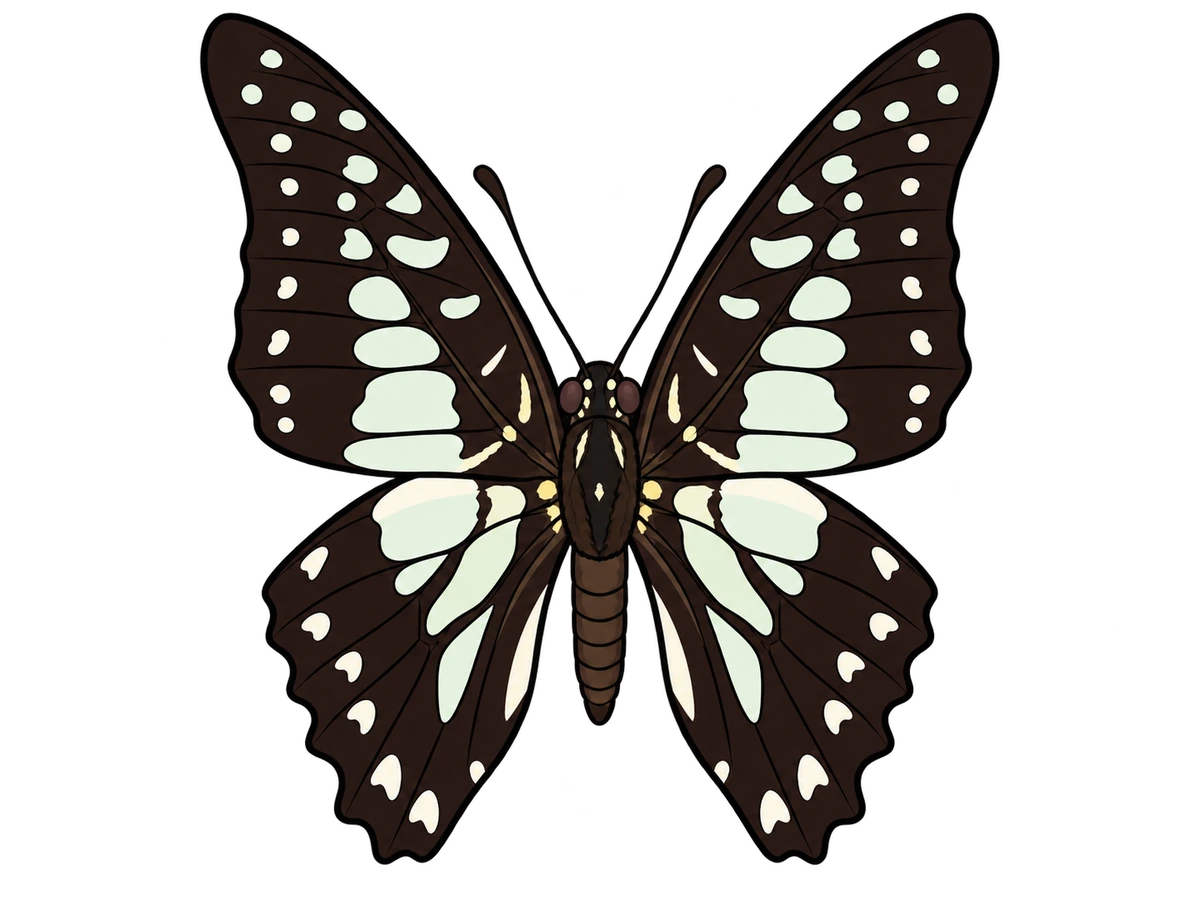
At a glance
- Regional form ↘
- Graphium bathycles bathycloides in Singapore’s account. [3]
- Distinct comparison ↘
- The 2024 study separates G. bathycles from G. chironides. [2]
The striped jay
Graphium bathycles is a valid swallowtail species. [1]
Singapore's photographed account uses the subspecies bathycloides. [3]
The 2024 revision explicitly distinguishes it from Graphium chironides, correcting earlier confusion rather than treating a superficially similar green-marked butterfly as the same taxon. [2]
Read the divided pale band
The museum adult has dark wings crossed by a row of pale greenish marks, with smaller pale marks farther outward. [1]
Individual segments and their dark separations matter.
The 2024 comparison distinguishes forewing shape and the relative width of discal markings when evaluating its close lookalike. [2]
A Singapore reference has a regional name
The original field photographs and local account show Graphium bathycles bathycloides in Singapore. [3]
That geographic context is important when comparing a northern mainland Graphium. A subspecies word should remain attached to its source; it should not be assigned to an unlocalized image simply because the colours seem similar.
Life-history evidence must follow the identified species
A correct adult identification is the starting point for a useful rearing record. Egg, caterpillar, pupa and adult need to remain linked through observations. Where two jay-like butterflies have been confused, a plant or development record under one name should be checked before being transferred to the other.
A close relative's plant is not a host record
The taxonomic comparison does not establish interchangeable caterpillar hosts. A botanical link for bathycles should name the plant and document feeding or successful rearing. This is particularly valuable where a record predates the corrected species comparison and may have inherited an ambiguous adult identification.
A field photograph adds posture
The Singapore field images show a living insect rather than only a spread preparation. [3]
Such a view contributes posture and surroundings, while a specimen image makes the full wing pattern easier to inspect. Neither alone reconstructs an individual's route or complete activity cycle.
The correction used several kinds of evidence
The 2024 study combined adult characters, male genitalia and mitochondrial COI evidence. [2]
Its correction is stronger than choosing the name attached to the most similar photograph. The case demonstrates the value of examining genuinely identified comparison material before proposing that two taxa are synonyms.
Taxonomy comes before combining ecological records
If observations from bathycles and chironides are merged under one name, apparent distribution and plant use can become misleading. Corrected identification is therefore ecologically useful, not merely a change in nomenclature. A reliable Atlas keeps locality, date and the original identification accessible when older records are reconciled.
Keep bathycloides as a regional alias
The spelling bathycloides belongs to the Singapore form in the source. Graphium bathycles remains the species heading. [3]
The recent research addresses its distinction from chironides; it does not turn each spelling variant, local nickname or differently coloured illustration into another species.
A clear species boundary improves assessment
Conservation records need a consistent subject. If a lookalike is wrongly included, counts and range estimates may describe two populations rather than one. Before interpreting a trend, check identification methods and study geography, especially for observations made before the published taxonomic correction.
Compare shape before shade
View the forewing outline and the pale discal segments together. Then compare the outer marks and hindwing outline. Do not use greener versus bluer rendering as the decisive difference: illumination, preservation and artistic colour can alter that impression while leaving the diagnostic arrangement more informative.
Segmented colour across a dark ground
The divided band provides a rhythmic structure for the artwork. Each pale patch can remain distinct, and the dark gaps become part of the composition. A precise drawing preserves that segmentation rather than smoothing it into a continuous stripe that makes comparison with related species more difficult.
Keep the small gaps visible
Inspect the work at its intended display size; reductions can merge neighbouring pale marks. Preserve a high-resolution labelled master and use web copies for display. A real specimen's wings and scaled surfaces are fragile, so detail inspection should use optical or photographic enlargement instead of handling the insect.
Lookalikes and labels
Is every pale-green Graphium a striped jay? Several related taxa need comparison. Can the subspecies name be inferred from artistic colour? Locality and a taxonomic reference are needed. Does the corrected distinction make every old observation worthless? It makes rechecking identity important before those records are combined.
Use the corrective study as the comparison
The 2024 original research controls the distinction from chironides. The Singapore account contributes regional images and naming, and the museum supplies the inspected adult view. Their evidence supports the identity and comparison; a future host or developmental account should come from an explicitly linked biological record.
- Graphium: museum specimen images and taxonomy ↗
University of Florida BioCosmos · Accessed 2026-10-09
Actual labelled Graphium bathycles adult image and species records.
- Taxonomic status of Graphium chironides malayanum and comparison with Graphium bathycles ↗
Phon, Kirton and Kuah; European Journal of Taxonomy 917, 2024 · Accessed 2026-10-09
Original corrective taxonomic study using morphology, genitalia and COI.
- Striped Jay: Graphium bathycles bathycloides ↗
ButterflyCircle, Singapore; original field photographs · Accessed 2026-10-09
Local field account and photographed Singapore form.
Sources checked 2026-10-09. Illustrations · Luminary Oddities.
Return to the Entomological Atlas ↑