

Luminary Oddities · Natural history & art
Small striped swordtail
Graphium policenes
Lepidoptera / Papilionidae
Mint-green lines, slender tails and a small red accent make this African swordtail immediately engaging. Its living story leads from warm forest edges to damp sand, then to the custard-apple relatives that support its caterpillars.
Explore this insect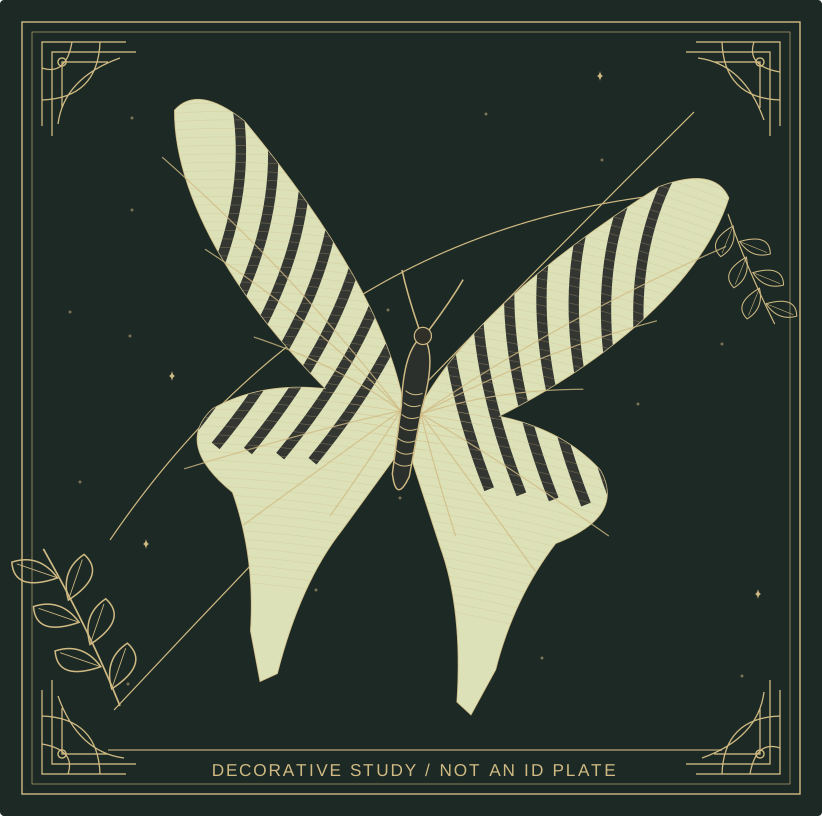
At a glance
- Wingspan ↘
- 55–65 mm in the Taita Hills field guide. [2]
- Larval plants ↘
- Annonaceae, including Artabotrys, Annona and Uvaria. [2]
A striped African swordtail
Graphium policenes belongs to the swallowtail family, Papilionidae, and to an African assemblage often written Graphium (Arisbe). Small striped swordtail, common striped swordtail and speckled swordtail are alternative English names. They point to one biological species rather than different editions of the artwork. The older combination Papilio policenes survives in historical publications. For comparisons, use the scientific name: common names alone can group unrelated insects or vary between field guides. [1]
Read the stripes, then the underside
Against the black wing ground, blue-green or green bars create a fine repeated rhythm. The National Museums of Kenya guide gives a wingspan of 55–65 millimetres, describes the sexes as similar, and notes tiny red inner-hindwing patches and long narrow tails. Related swordtails can be confusing. The specialist account compares the shape of forewing bars in Graphium antheus, the narrower bands and darker underside of G. polistratus, and the absent red underside spot in some other lookalikes. [2][1]
A practical comparison begins with a complete upper view and a complete underside, then checks the bars and red patch rather than just the elegant outline. A tail broken from a preserved insect is damage, not necessarily a naturally tailless form. A stylized painting can celebrate these characters, but a diagnostic reference photograph remains the better identification tool. [2][1]
Warm forests across sub-Saharan Africa
The specialist synthesis records this species across sub-Saharan Africa. Warm coastal forests and forest alongside rivers recur in its habitat account; it is also reported in more open cultivated settings. The South African account follows a coastal distribution into KwaZulu-Natal and the Eastern Cape. These examples show why a range is more informative when it includes habitat rather than a bare country list: forest structure, suitable plant growth and nearby feeding opportunities are part of the living setting. [1][3]
One butterfly, four different stages
Like other butterflies, this swordtail develops through egg, caterpillar, pupa and winged adult. Caterpillars feed and grow through successive molts; the pupa is the transformation stage, not a miniature butterfly waiting to enlarge. A South African account reports repeated broods during warmer months. That southern calendar is regional: it should not be projected onto every African population. A framed adult represents the final stage of this cycle, while much of its earlier life depended on vegetation. [5][3]
The custard-apple connection
The Kenyan field guide associates the caterpillars with Annonaceae, the custard-apple family, including Artabotrys, Annona and Uvaria. The important distinction is between a larval host and an adult food visit. Leaves that support growing caterpillars are not interchangeable with flowers supplying adult nectar. Likewise, a record for a named plant does not establish that every relative of that plant is acceptable everywhere. Host names provide a precise connection between the insect account and the plant world. [2]
A fast butterfly that sometimes gathers
Field accounts describe rapid flight with abrupt changes of direction. Males gather at mud or wet sand, while flower visits are recorded for both sexes. The image of a motionless spread specimen therefore captures only one aspect of an energetic animal. Puddling gatherings offer an opportunity to see individuals settled together and compare markings. The brief pause that makes a useful photograph should be read as part of a moving animal's life, rather than its normal fixed pose. [1]
An old locality that needed correction
The original locality wording retained in the taxonomic literature includes Surinamen. The modern specialist treatment explicitly identifies it as false: it is not evidence of a South American population. This is a useful piece of natural-history detective work. A historical label can preserve an important name while containing a mistake about place. Keeping the correction alongside the record is more informative than either repeating the error or erasing the history of how it was recognized. [1]
Plants, adults and a forest margin
The host account connects the caterpillar to particular plant genera. Adult observations add flowers, damp ground and river-associated movement. Together they reveal several resources within the same landscape rather than a butterfly supported by one attractive flower. For a reader observing butterflies locally, the transferable lesson is to record what an insect is doing: resting on a leaf, drinking at a flower and feeding as a caterpillar are different kinds of evidence. [2][1]
What swordtail describes
Swordtail is a descriptive English comparison for the narrow hindwing extensions. It does not assign a military role or cultural meaning to the insect. Historical combinations show how taxonomists have arranged the species among related butterflies. The Atlas keeps Graphium policenes as the main searchable name and retains Papilio policenes as a route into older literature. Neither a common-name variation nor a change in genus means that the artwork represents a new species. [1]
Protect the living setting
Regional field guides explain occurrence, but their dated status labels are not substituted here for a current global conservation assessment. The habitat and host records offer a concrete point of connection: this butterfly belongs to a landscape with warm forest vegetation and suitable caterpillar plants. Appreciating a specimen can lead back to appreciating that setting. The natural-history account does not establish where a particular framed individual was collected or document its supply chain. [3][2]
A short looking exercise
Begin with the whole insect: follow the forewing outline into the long hindwing tails. Next trace a single pale bar toward the body, then compare it with the corresponding bar on the opposite wing. Find the little red accent and note whether the photograph shows the upper or lower surface. This slow sequence makes a densely patterned insect easier to read. Use image enlargement to inspect details; the physical wings and tails do not need to be touched.
Fine stripes in the collection
The collection's framed interpretation uses the butterfly as the focus of a composed artwork. A romantic, celestial or tarot title belongs to that composition and its artist. The scientific account supplies a different kind of context: a name, a living landscape and documented behaviour. Read the two together by noticing which elements come from the specimen and which come from its surroundings. The mint and charcoal rhythm can carry the design without adding a biological story to every ornament.
Keep the fragile outline protected
Treat a framed insect as a fragile object. Support the frame when moving it and keep the enclosure closed. A position away from direct sun, persistent damp and strong heat is a sensible preventive choice for a mixed-material display. Examine it through the glazing and watch for loose fragments or signs of damage rather than attempting to clean the insect itself. The Canadian Conservation Institute identifies brittle insect material as particularly vulnerable to physical stresses. [4]
Questions that reward a closer look
Are the pale lines blue or green? Both descriptions occur in the Kenyan guide; lighting and photographic colour rendering should be kept in mind. Are the sexes wholly different? That guide describes them as similar, so one colour impression is a poor sex label. Does the old Surinamen wording place the butterfly in South America? No: the specialist treatment records it as erroneous. Is a flower its caterpillar host? A nectar visit alone cannot establish that relationship. [1][2]
Continue with regional guides
The African Graphium synthesis is the route into taxonomy and comparisons. The Kenyan museum guide supplies a visual portrait and host-family context, while SANBI supplies a clearly regional South African account. These sources answer different questions. When exploring them, keep locality and date beside the observation, especially for seasonal calendars and historical conservation labels. The links below make those distinctions available for further reading. [1][2][3]
- African Graphium genus and species account ↗
Lepidopterists Society of Africa / Metamorphosis · Accessed 2026-10-09
Exact URL retained. Taxonomic comparisons, false original Surinamen locality, forest behavior and African distribution.
- Fluttering Beauty with Benefits: The Butterflies of Taita Hills ↗
National Museums of Kenya · Accessed 2026-10-09
Printed p.18 confirms 55–65 mm, sexes similar, green stripes, tiny red inner hindwing patches, Annonaceae hosts and historic NE label.
- South African regional butterfly account, Biodiversity Series 16 ↗
South African National Biodiversity Institute · Accessed 2026-10-09
Exact URL retained. Coastal Eastern Cape to KwaZulu-Natal, repeated warm-month broods sometimes to May. Regional seasonal account only.
- Caring for natural history collections ↗
Canadian Conservation Institute · Accessed 2026-10-09
Preventive care of organic collections, including brittle insect material.
- About Butterflies ↗
Smithsonian Gardens · Accessed 2026-10-09
General butterfly metamorphosis, anatomy and stage distinctions; not species-specific timings.
Artworks in the collection
Explore the framed works and digital art connected with this insect. Etsy shows current availability, options and prices.
- The Lovers ↗Framed work
Continue exploring
Sources checked 2026-10-09. Artwork © Scott Schubr / Luminary Oddities.
Return to the Entomological Atlas ↑