
Luminary Oddities · Natural history & art
Tree nymph butterfly
Idea leuconoe
Lepidoptera / Nymphalidae
Black veins and spots cross the broad pale wings of the tree nymph. Behind that airy appearance lies a documented chemical relationship: host-plant compounds help egg-laying females recognize suitable plants, and related alkaloids have been isolated from adult bodies.
Explore this insect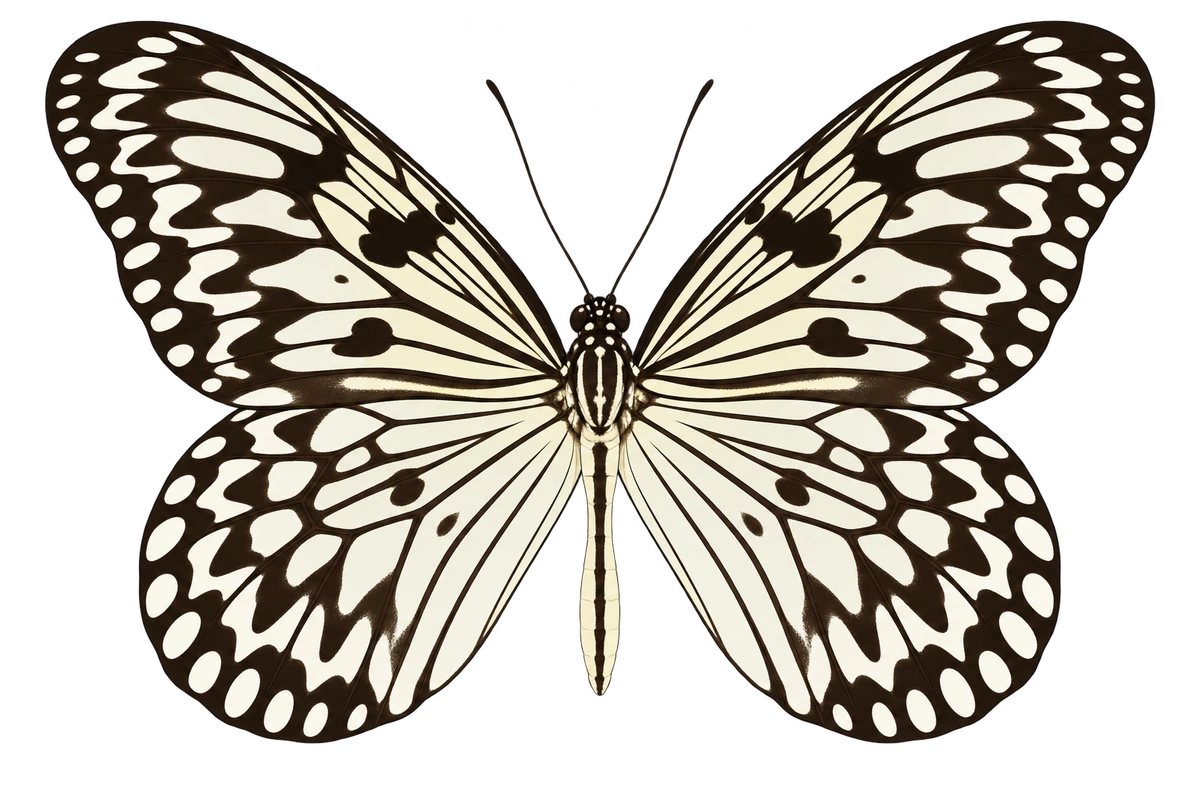
At a glance
- Regional host ↘
- Parsonsia laevigata in Japanese chemical-ecology studies. [3][4]
- Local status ↘
- Singapore lists chersonesia as Critically Endangered nationally. [5]
A tree nymph with several English names
Idea leuconoe is the tree nymph displayed in the Florida Museum's account. Paper kite and rice paper butterfly are useful English aliases. Singapore's natural-history account specifies chersonesia, a regional subspecies. [1][2]
Those names offer different ways to find the subject without implying that all pale Idea butterflies are leuconoe.
Black structure over pale wings
The inspected living adult shows pale wings divided by black veins and larger black marks, with an outer series of pale spaces surrounded by dark pattern. [1]
The combination of shape and pattern matters more than simply calling it black and white. The museum images provide real adults in different postures.
A local mangrove portrait
Singapore's chersonesia account associates the butterfly with seashore, mangrove and back-mangrove habitats and records Pulau Tekong. [2]
That is a precise regional portrait, not a habitat rule for every population throughout Southeast Asia. Keep the subspecies and location alongside a habitat description when comparing accounts.
Egg laying is experimentally observable
Honda and colleagues studied female egg-laying responses to extracts of Parsonsia laevigata. [3]
The experiment connects a reproductive decision to identifiable plant chemistry. It investigates host recognition rather than measuring the entire developmental cycle; eggs, caterpillars, pupae and adults remain distinct stages with different biological questions.
Parsonsia is more than a decorative vine
Japanese studies identify Parsonsia laevigata as a larval host in the Ryukyu context. The 1997 bioassays found particular pyrrolizidine alkaloids important in eliciting egg laying. [3][4]
This is stronger evidence than resemblance between leaves or an adult resting on a vine: the experimental response tests a specific host-recognition mechanism.
A gliding butterfly in the regional account
NParks describes graceful gliding at treetop level for the Singapore form. [2]
That movement complements the static open-wing view. The museum's living adults provide posture, while the regional account describes field behaviour; a posed or settled photograph does not by itself measure a flight path.
Plant compounds continue into the adult
Nishida and colleagues isolated ideamine N-oxides and related pyrrolizidine alkaloids from adult I. leuconoe bodies. This directly documents chemical sequestration. [4]
It should not be stretched into a universal numerical toxicity claim or an assertion that every visible wing mark demonstrates the amount of chemical defence in an individual.
Different chemicals can answer different questions
The adult-body isolation asks what substances are present in the butterfly. The egg-laying bioassay asks which plant substances stimulate a female's behaviour. These are related but distinct experiments. [3][4]
Together they connect larval feeding, reproduction and plant chemistry more precisely than a blanket statement that a host is poisonous.
Keep chersonesia in its regional context
The species heading is Idea leuconoe. The third word chersonesia belongs to the Singapore account and checklist. [2]
Tree nymph and paper kite refer to memorable aspects of appearance and movement; they are common names rather than alternate formal species designations.
Critically Endangered within Singapore
The current NParks checklist lists Idea leuconoe chersonesia as native and Critically Endangered in Singapore's RDB3. [5]
The category applies to that national context. A butterfly maintained in an exhibit or photographed in captivity does not establish that its wild population is secure at a particular locality.
Read the dark veins and enclosed spaces
Start with the complete outline, then trace the strongest veins across the pale field. Compare the outer marks and the larger interior patches. A close crop is easier to interpret when its location remains clear in the full view; black lines should retain their relation to the actual wing veins.
Airy wings with a firm dark framework
The pale fields can give the artwork a light, almost translucent quality, while the black structure provides definition. A clean drawing can make that relationship expressive without inventing a new species pattern. Keep the scale of the major marks coherent with the selected adult reference.
Preserve the pale wing edge
Inspect a display proof to ensure the light outline does not disappear against its background. Save a labelled master before simplifying for the web. If the subject is a real insect, its broad wings remain fragile despite their bold veins; handle the display enclosure and use photographs for close inspection.
Plants, chemicals and the national category
Does a black-and-white pattern identify every tree nymph as leuconoe? A detailed comparison is needed. Do the chemical studies measure all populations? They retain their studied host and regional context. Is Singapore's category global? It is a national entry for chersonesia.
A visual portrait and two experimental questions
The museum supplies actual living-adult views. Singapore's account supplies a local ecological portrait and the checklist supplies the current national category. The two original chemical studies provide host-recognition and sequestration evidence. Reading each for its purpose keeps the species guide both visually clear and biologically specific.
- Tree Nymph: Idea leuconoe ↗
Florida Museum of Natural History · Accessed 2026-10-09
Institutional identification and actual living-adult photographs by Ryan Fessenden.
- Idea leuconoe chersonesia ↗
National Parks Board, Singapore · Accessed 2026-10-09
Regional habitat, appearance and gliding behaviour; old status checked against current checklist.
- Pyrrolizidine alkaloids mediate host-plant recognition by ovipositing females of Idea leuconoe ↗
Honda, Hayashi, Abe and Yamauchi; Journal of Chemical Ecology, 1997 · Accessed 2026-10-09
Primary egg-laying bioassays with Parsonsia laevigata extracts and isolated compounds.
- Ideamine N-oxides: pyrrolizidine alkaloids sequestered by Idea leuconoe ↗
Nishida, Kim, Fukami and Irie; Agricultural and Biological Chemistry 55, 1991 · Accessed 2026-10-09
Primary adult-body chemical isolation; regional host context in the Ryukyu Islands.
- Singapore butterfly checklist ↗
National Parks Board, Singapore · Accessed 2026-10-09
National RDB3 categories for explicitly named regional taxa, not global assessments.
Sources checked 2026-10-09. Illustrations · Luminary Oddities.
Return to the Entomological Atlas ↑