

Luminary Oddities · Natural history & art
Schrenck’s emperor butterfly
Mimathyma schrenckii
Lepidoptera / Nymphalidae
A broad pale hindwing band and smaller forewing marks give Schrenck’s emperor a distinct pattern. Korean specimen records and regional natural-history observations connect the adult to woodland food plants, seasonal development and behaviour that differs between sexes.
Explore this insect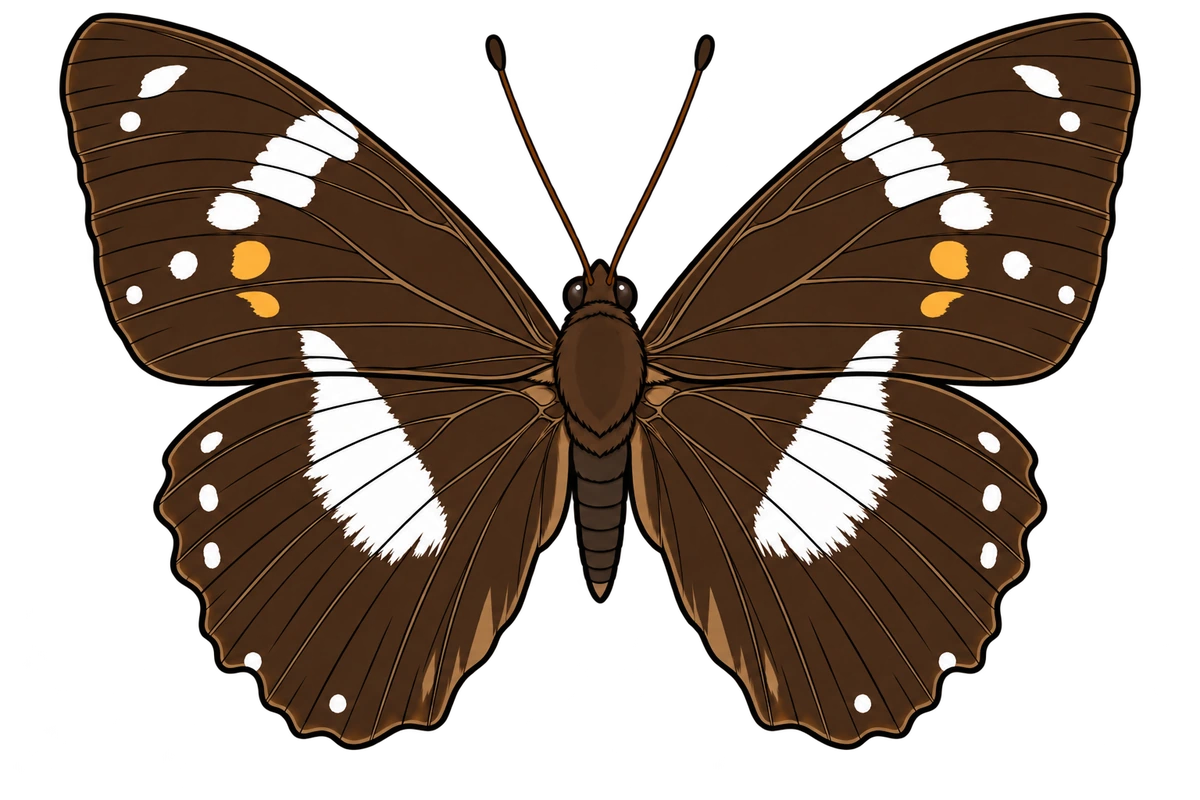
At a glance
- Regional season ↘
- Mid-June to early September, one brood, in the Korean treatment. [2]
- Specimen record ↘
- A male from Mt. Bangtae, Gangwon, 29 June 1998. [3]
Schrenck’s emperor in Mimathyma
Mimathyma schrenckii is an apaturine butterfly treated by Lee in 2009; historical combinations include Apatura schrenckii and Adolias schrenckii. [2]
Shared pale bands or a dark ground are not enough to replace that comparison.
A broad rear-wing band
The inspected museum adult has a broad pale hindwing band, separate white forewing marks and orange accents near the forewing's inner region. Read the whole pattern and the labelled specimen together. [1]
Compare the same surface and sex before assigning significance to a colour change.
An examined male in Gangwon
Kyungpook National University's record KNUH-10002132 documents a male collected and identified on Mt. Bangtae, Gangwon Province, on 29 June 1998, at 400 metres. [3][2]
The Korean treatment also places the species in China and the Amur–Ussuri region. A specimen's elevation records that occurrence, not its full ecological range.
One Korean brood and an overwintering larva
Lee's regional treatment reports adults from mid-June to early September, with one brood. It describes solitary larvae and usually third-instar overwintering at protected positions on or near food plants. [2]
These are Korean life-history statements, not dates that should automatically be imposed on every distant population.
Named woodland plants in the treatment
The Korean treatment lists Ulmus davidiana var. japonica, Ulmus parvifolia and Zelkova serrata among hosts, and cites Russian records of Carpinus cordata and Ulmus laciniata. [2]
The associations should keep their geographic attribution. A familiar elm or hornbeam name does not establish that every species of those genera is equally suitable.
Males and females are encountered differently
Lee describes males near streams or forest paths, visiting fermenting fluids and rapidly circling above trees in the afternoon. Females are less often seen at those feeding situations. The account specifically does not describe male hilltopping, an important distinction from a generic emperor-butterfly behaviour summary. [2]
Shimmer and pattern are not the same character
The broad hindwing band and separate forewing marks occupy distinct positions on the inspected museum adult. [1]
A band remains in a defined location, while sheen may depend on the view. This makes the butterfly a good subject for learning to distinguish pigment-pattern geometry from the changing appearance produced by reflected light.
A woodland relationship spans several stages
Larval hosts connect development to trees, while adult observations connect activity to paths, streams and fermenting resources. These are complementary uses of a landscape. An adult feeding site does not have to be its larval food plant, and a butterfly above a tree does not prove egg laying there.
Historical names are a trail to older evidence
Historical Apatura and Adolias combinations support literature searches; the current heading is Mimathyma schrenckii. [2]
Preserve the original determination on a record rather than rewriting its history; then add the current interpretation so later researchers can reconstruct the change.
Detection can differ by sex and resource
A survey focused on fermenting fluids may encounter many more males than females. That difference in visibility is not automatically a population sex ratio. Conservation work should use a sampling design appropriate to the question and compare like habitats and seasons before drawing conclusions from apparent rarity.
Read the wide band against the small marks
Begin at the hindwing band, then compare the forewing's separate pale marks and coloured accents. An underside view answers a different visual question from the upper surface. Do not replace the full pattern with a resemblance to another dark-and-white emperor merely because one broad band seems similar.
The band gives the composition its centre
The broad pale rear-wing field can balance the smaller forewing marks in a drawing. A restrained treatment of sheen preserves that hierarchy. The result can emphasize the butterfly's visual character while keeping its major pattern and outline coherent with an identified adult.
Keep white and iridescence separate in display
A proof should preserve the broad pale band without clipping the smaller accents or turning every light area blue. Retain the labelled master before screen-specific changes. A real insect's reflective surface should be viewed at different angles through its enclosure, rather than touched or brushed to change its appearance.
Records with different evidential roles
Does the 400-metre specimen establish an elevation limit? It is one collecting record. Are adult feeding sites necessarily caterpillar hosts? They are different resources. Does a male-biased encounter prove fewer females exist? Sexes can differ in detectability and behaviour.
A specimen and a regional natural-history treatment
The university and MCZ specimens anchor identified adults and precise collecting records. Lee's original treatment supplies Korean biology and attributed plant records. Their regional boundaries remain visible so a useful account does not become an unsupported universal timetable.
- Mimathyma schrenckii specimen MCZ:Ent:169451 ↗
Museum of Comparative Zoology, Harvard University · Accessed 2026-10-09
Primary identified adult specimen and its dorsal photograph; North Korea, Ryanggang Province, Kambosan.
- Apaturinae from the Korean Peninsula: Mimathyma schrenckii treatment ↗
Young June Lee; Zootaxa2169,2009; digitized species treatment in Plazi · Accessed 2026-10-09
Original taxonomic treatment with regional adult behaviour, host records and developmental summary.
- Mimathyma schrenckii specimen KNUH-10002132 ↗
Kyungpook National University Natural History Museum · Accessed 2026-10-09
Primary male specimen, Mt. Bangtae, Gangwon Province, 29 June 1998, elevation 400 m.
Sources checked 2026-10-09. Illustrations · Luminary Oddities.
Return to the Entomological Atlas ↑