
Luminary Oddities · Natural history & art
Deidamia Morpho
Morpho deidamia
Lepidoptera / Nymphalidae
A blue-banded forest morpho whose intricate underside and regional activity rhythms offer a quieter story behind the dramatic dorsal flash.
Explore this insect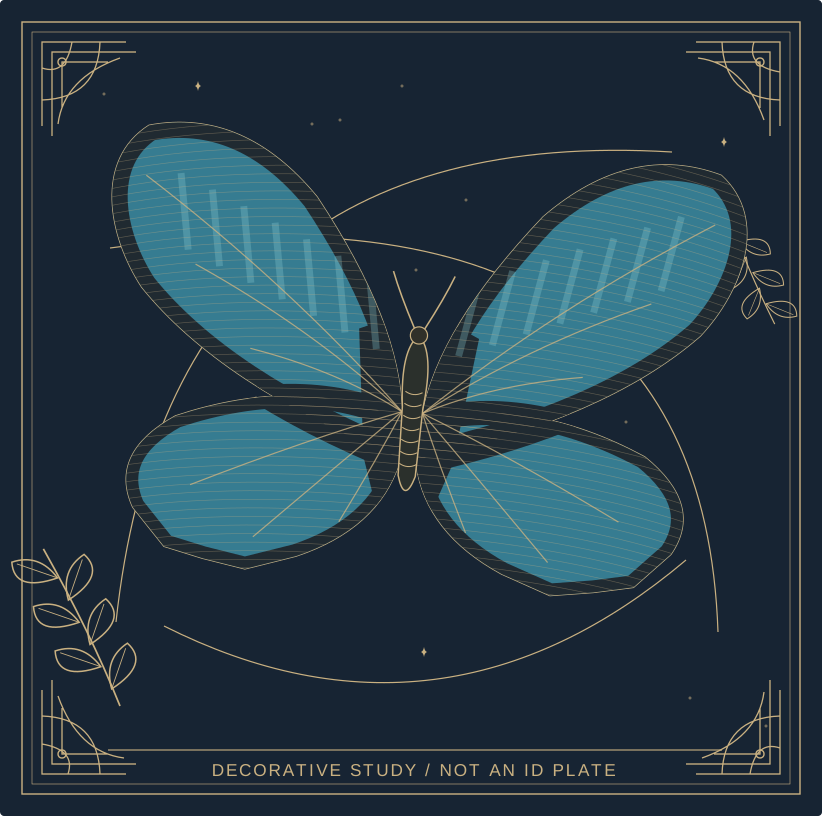
At a glance
- Adult food ↘
- Fermented or rotten fruit [2]
- Research setting ↘
- Coexistence studied at a Peruvian Amazon site [4]
Identity and close relatives
Morpho deidamia is a nymphalid butterfly. This guide follows the broad treatment in Butterflies of America, which includes Central American forms such as polybaptus as well as South American populations. Amazonian research examines more specific local material within that broader treatment. Deidamia Morpho is a useful English heading because Scarce Morpho is a common name, not a measured assessment of global rarity. A supplier-level identification supports the association of Azure Nocturne with this guide, without establishing a subspecies or collecting locality. [1][2]
How to look at the wings
Blue banding on the upper wings contrasts with a complex brown underside. The Amazonian museum guide illustrates variation in the ventral drawings and gives both dorsal and ventral views of identified material. Similar-looking achilles and helenor morphos are a reason to value the reverse and the whole pattern, rather than identify an insect solely as a blue morpho. A gallery image should state the wing surface so the two sides can be compared fairly. [2]
Range and living habitat
The museum field guide places the species in forest understory and provides a country list extending across portions of Central and South America. The broad catalogue includes named regional forms; a Peruvian behavioural study, by contrast, worked at a single Amazonian site. These accounts serve different geographic purposes. A continent-wide summary is an introduction, while local records supply the precise setting for claims about activity, food or interactions. [1][2][4]
A life in four stages
Like other butterflies, this species develops through an egg, a feeding caterpillar, a pupa and a winged adult. The pupa is a living developmental stage, not a resting adult wrapped in a case. A framed butterfly represents the adult stage. Its wing pattern cannot stand in for a photograph of the caterpillar or establish how long the individual spent developing. Local studies are most informative when their climate, host plant and observation conditions accompany the measurements. [7]
Compiled host associations in the museum guide concern the leaf-feeding young. They connect the species with plants such as Inga laurina and Zygia latifolia, under the guide’s broad taxonomic treatment. The adult’s mature wing pattern records a later stage of the same cycle. The sources reviewed here do not provide one universal egg-to-adult schedule, and a captive duration from another Morpho would not replace species-specific evidence. [2]
Leaves for larvae, food for adults
The Amazonian guide reports adults of both sexes visiting fermented or rotten fruit. Its larval host compilation includes Inga, Zygia and other named plants from several botanical groups. Fruit attraction and leaf feeding are separate records at separate stages. The compiled hosts preserve their research scope; they do not establish that every regional population accepts every plant or that the photographed specimen was raised on one particular host. [2]
Behaviour in the living landscape
At a studied site in Amazonian Peru, Morpho deidamia occurred with M. achilles and M. helenor in a system of male patrolling activity along a river bed. Researchers used moving butterfly models and mark–recapture observations to investigate interactions and activity patterns. Keeping the site visible is essential: local hours or frequencies are not an automatic daily schedule for every population. A still dorsal photograph provides the pattern that those behavioural experiments helped interpret. [4]
A closer scientific story
The 2021 study found that similar blue-banded patterns could produce interactions among the coexisting species, while genomic evidence indicated genetic isolation. Differences in the timing of male activity helped explain how behavioural interference could be reduced. The result joins similarity and difference in one ecological story: species can look alike and share habitat, yet use time differently. It is a specific studied system rather than a claim that color pattern alone determines which species can coexist. [4]
Connections in the ecosystem
A 2023 genome study assembled reference genomes for M. deidamia, M. achilles and M. helenor, and examined rearrangements involving the Z chromosome. It opens ways to study divergence among closely related butterflies that live together. The chromosome findings are potential contributors within an evolutionary explanation, not a single proven cause of speciation. Alongside the field study, the work shows how living observations and genomic comparisons can ask different parts of the same question. [3]
Names and natural-history records
Butterflies of America preserves a detailed trail of regional and historic names, including the nominate deidamia form and Central American polybaptus and granadensis treatments. The museum field guide also records the historical combination Leonte deidamia. A dated Museums Victoria object, LEP 59155, provides another kind of history: Peru, 20 May 1971, in the David Holmes collection. That museum label documents that object; its date and place do not transfer to Luminary’s specimen because the species name matches. [1][2][5]
Habitat and conservation context
The English name Scarce Morpho should not be turned into a rarity badge. Natural-history names, regional encounter rates and formal threat assessments answer different questions. The reviewed understory and coexistence accounts provide a real ecological setting, but they do not measure current population trends across the guide’s broad geographic treatment. Preserving that taxonomic and regional context is the useful conservation foundation here, alongside accurate records for the individual object.
Reading the specimen views
Dorsal means the upper surfaces of the wings; ventral means their undersides. Start with the whole silhouette, then follow the boundary between the forewing and hindwing and inspect the inner and outer margins. A closely cropped detail is most useful beside a complete view, where its position is clear. Comparing equivalent surfaces prevents an underside pattern from being mistaken for a color variant of the upper wing. A digital enlargement is a way to examine the artwork; it does not supply a microscopic scale or a measurement of the original insect.
From specimen photograph to artwork
Azure Nocturne is associated with Morpho deidamia using the owner-provided supplier record. This preserves the artwork’s name while placing it beside the biological account for the species. The record is identification evidence for the collection association; it does not establish the insect’s subspecies, sex, collecting locality or a link to the museum specimens cited here. Its celestial atmosphere remains the artists’ interpretation of a photographed specimen.
Luminary Oddities’ artwork begins with photography of a living or formerly living specimen, as documented by the artists. The resulting digital treatment can emphasize color, symmetry, movement or atmosphere while retaining that photographic starting point. Read each gallery caption for the named work and the view being presented. An artwork title describes an edition or composition; it is not an additional biological species. The natural-history account identifies the taxon represented, while the art invites a more personal response to its shape and pattern.
Caring for a framed specimen
Display a framed insect in an interior location away from direct daylight, dampness and frequent temperature or humidity changes. Handle the enclosure rather than the specimen, and inspect it periodically for loose parts, pest activity or moisture. Preventive conservation guidance treats physical damage, pests and light as important risks for organic natural-history collections. A glazed frame reduces handling and dust exposure but does not make delicate material immune to deterioration. Follow the maker’s instructions for the enclosure; concerns inside it are best addressed without touching the wings. [6]
Questions worth asking
Are all blue morphos Morpho deidamia? Several Morpho species are blue, and the complete upper and lower pattern matters. Is Scarce Morpho a conservation category? It is a common name. Does the Peruvian activity study describe every population? It describes one researched Amazonian system. Why include the underside? Its intricate drawings and variations add identification context concealed by the bright dorsal band. [1][2][3][4][5]
Sources and further reading
The linked sources combine taxonomic records, natural-history observations and scientific studies. Regional results are identified in the text because a single population does not describe every butterfly carrying the same name. Historical collection records document those museum objects, and are not provenance records for the artwork’s photographed specimen. Scientific source images are linked for study; their citation does not transfer image rights to this gallery.
- Morpho deidamia taxonomic and specimen index ↗
Butterflies of America · Accessed 2026-10-09
Exact URL retained. Broad concept includes polybaptus; selected authorship [1819].
- Morpho deidamia Amazonian field-guide account ↗
State Museum of Natural History Karlsruhe / Amazonian Butterflies · Accessed 2026-10-09
Exact URL retained. Understory, fermenting fruit, compiled hosts and underside comparison; host and range depend on broad taxonomic concept.
- Convergent morphology and divergent phenology promote the coexistence of Morpho butterfly species ↗
Nature Communications, 2021 · Accessed 2026-10-09
Includes co-occurring deidamia in Amazonian Peru. Principal temporal-segregation result concerns helenor/achilles, not deidamia.
- Genome assembly of 3 Amazonian Morpho butterfly species reveals Z-chromosome rearrangements between closely related species living in sympatry ↗
GigaScience, 2023 · Accessed 2026-10-09
Comparative genomes include deidamia. Possible contribution of Z inversions to reproductive isolation, not demonstrated single cause.
- Specimen LEP 59155 Morpho deidamia ↗
Museums Victoria · Accessed 2026-10-04
Peru, Tingo Maria, 20 May 1971; David Holmes Collection. Actual collector Jose Schunke. Museum provenance does not transfer to shop specimens.
- Caring for natural history collections ↗
Canadian Conservation Institute · Accessed 2026-10-09
Preventive care of organic natural-history specimens; not a guarantee about a particular frame.
- About Butterflies ↗
Smithsonian Gardens · Accessed 2026-10-09
Butterfly development, caterpillars, pupae and adult mouthparts; general butterfly context.
Artworks in the collection
Explore the framed works and digital art connected with this insect. Etsy shows current availability, options and prices.
- The Hermit Midnight ↗Framed work
- Azure Nocturne ↗Framed work
Continue exploring
Sources checked 2026-10-09. Artwork © Scott Schubr / Luminary Oddities.
Return to the Entomological Atlas ↑