
Luminary Oddities · Natural history & art
Narrow-banded swallowtail
Papilio gallienus
Lepidoptera / Papilionidae
A narrow pale-yellow band crosses the dark wings of this African swallowtail. Its museum portrait rewards careful comparison with other tailless Papilio, while original collecting history and an explicit absence of published early-stage information keep the biological account precise.
Explore this insect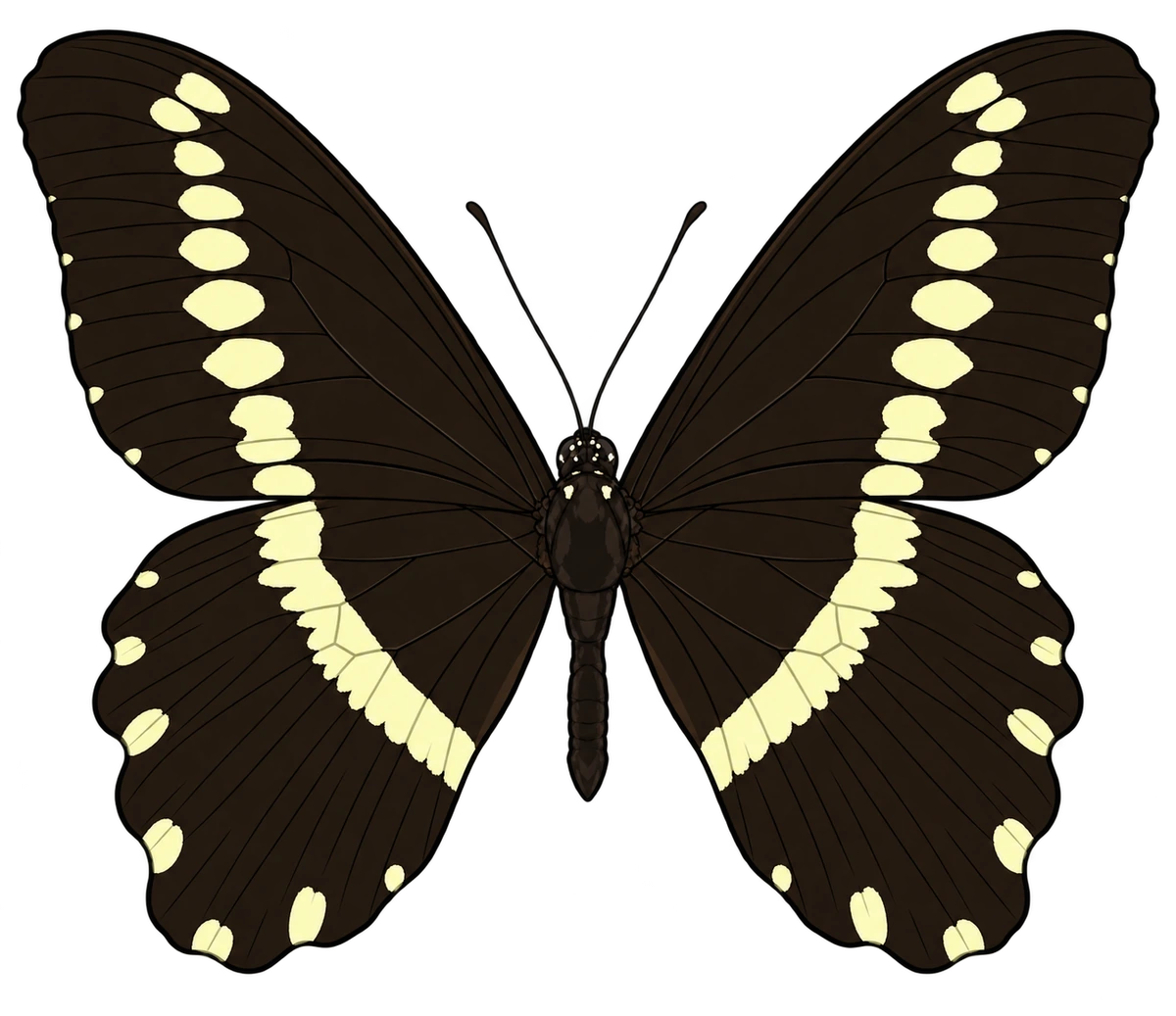
At a glance
- Historical authority ↘
- Distant, 1879. [1]
A distinct African Papilio
Papilio gallienus is a valid species in the swallowtail family. The Afrotropical account places it among the zenobia group and uses Big Sash as an English name. Museum Koenig calls it a narrow-banded swallowtail. [3][1][2]
These descriptive names refer to one scientific identity.
A narrow yellow band on the upper surface
Museum Koenig's male has dark upper wings crossed by a narrow pale-yellow band, divided into oval marks on the forewing. The Afrotropical comparison distinguishes it from cyproeofila through yellower bands and a narrower, curved hindwing band. [2][1]
Check the detailed band geometry rather than the general dark-and-pale impression.
Rain forest with geographic boundaries
The museum places it in African rain forests from Nigeria southeastward to the Democratic Republic of Congo. The Afrotropical account adds named localities and describes an association with wetter forest in good condition. [2][1]
These accounts supply regional context without implying uniform abundance across that broad area.
The early stages remain a separate question
The Afrotropical treatment explicitly records no published early-stage account. [1]
A butterfly still follows egg, larva, pupa and adult, but a species profile should not fill the gap with another Papilio's caterpillar or developmental calendar. Directly linked rearing would be especially valuable here.
A host needs an observed relationship
The same treatment does not supply a published larval food plant. [1]
This is a useful boundary on the guide rather than a reason to assign citrus or another familiar swallowtail host. A future plant record should connect feeding or successful rearing to an identified gallienus adult.
Historical observations describe persistent flight
The Afrotropical treatment cites Schultze's historical description of faster, persistent flight and early-morning activity. [1]
Keep that observation attached to its source and period. It adds a living dimension to the museum view without establishing a measured universal flight speed or timetable.
The underside carries another comparison
Museum Koenig interprets the different underside as resembling protected Acraea butterflies. [2]
This is an institutional mimicry account, distinct from the upper-wing diagnostic band. The appearance is worth comparing, but a resemblance should not be converted into an experimental measurement of predator avoidance in the illustrated individual.
Good forest and good evidence belong together
The habitat account suggests why records should include forest condition as well as a location. An adult occurrence in a landscape does not independently establish where larvae develop. Recording the wing view, observation date and habitat context helps future ecological work separate an encounter from a breeding-site claim.
Distant’s name remains the anchor
The Afrotropical account traces gallienus to Distant in 1879 and retains historical names and aberration labels in the nomenclatural trail. [1]
Those old form names are not treated as extra Atlas species. Scientific identity is consolidated while the historical wording remains available to recover older evidence.
Localized records require careful interpretation
A species described as localized in an old account needs modern survey evidence before a trend or formal risk category can be inferred. Forest condition, access and collecting effort all affect what can be found. A museum specimen confirms a historical occurrence; it does not by itself measure a present population.
Compare the whole band across both wings
Start with the full upper surface. Follow the forewing's separate ovals into the hindwing band and inspect its inner curvature. The Afrotropical paired specimens show upper and lower surfaces of identified individuals. A living closed-wing image offers a different surface and should retain its own view label.
A narrow band can carry the composition
The pale sequence creates a strong direction across a dark field. A precise artwork can emphasize that flow while keeping the band narrow and divided in the front wing. Broadening it for visual impact would weaken the comparison that gives the species its distinctive portrait.
Preserve the width of the markings
A reduced web image can make a thin band seem either continuous or indistinct. Keep a labelled full-resolution master and examine a proof at its actual display size. If displaying an insect, preserve its supporting locality labels with the specimen rather than separating biological evidence from the object.
Three different kinds of claim
Does the English name distinguish it from every dark Papilio? Detailed pattern comparison is needed. Is the mimicry account a host-plant record? It concerns adult resemblance. Does a gap in published early stages mean there is no caterpillar? It means the species-specific account needs direct observation.
Museum images and an explicit research boundary
Harvard provides the valid-name and specimen trail. Museum Koenig supplies an institutional adult portrait. The Afrotropical treatment supplies paired specimens, comparison, attributed observations and explicit host and early-stage gaps. Their combination supports a precise guide without filling those gaps with an unrelated swallowtail's biology.
- Papilio gallienus: Afrotropical Papilio account, pp.61–62 ↗
Mark C. Williams; Afrotropical Butterflies; African Butterfly Research Institute/Dobson collections · Accessed 2026-10-09
Actual paired museum specimens, attributed diagnosis, range and historical observations; early-stage and host gaps explicitly stated.
- Narrow-banded swallowtail: Papilio gallienus ↗
Museum Koenig Bonn, Leibniz Institute for the Analysis of Biodiversity Change · Accessed 2026-10-09
Institutional male specimen description, rain-forest distribution and attributed mimicry interpretation.
- Papilio gallienus ↗
Museum of Comparative Zoology, Harvard University · Accessed 2026-10-09
Accepted name and museum specimens/media.
Sources checked 2026-10-09. Illustrations · Luminary Oddities.
Return to the Entomological Atlas ↑