
Luminary Oddities · Natural history & art
Old World swallowtail
Papilio machaon
Lepidoptera / Papilionidae
Yellow wings, dark veins, blue hindwing marks and a red anal spot make the Old World swallowtail familiar. Its broad name hides significant regional differences in host use and conservation, including a distinct British lineage investigated with whole-genome data in 2026.
Explore this insect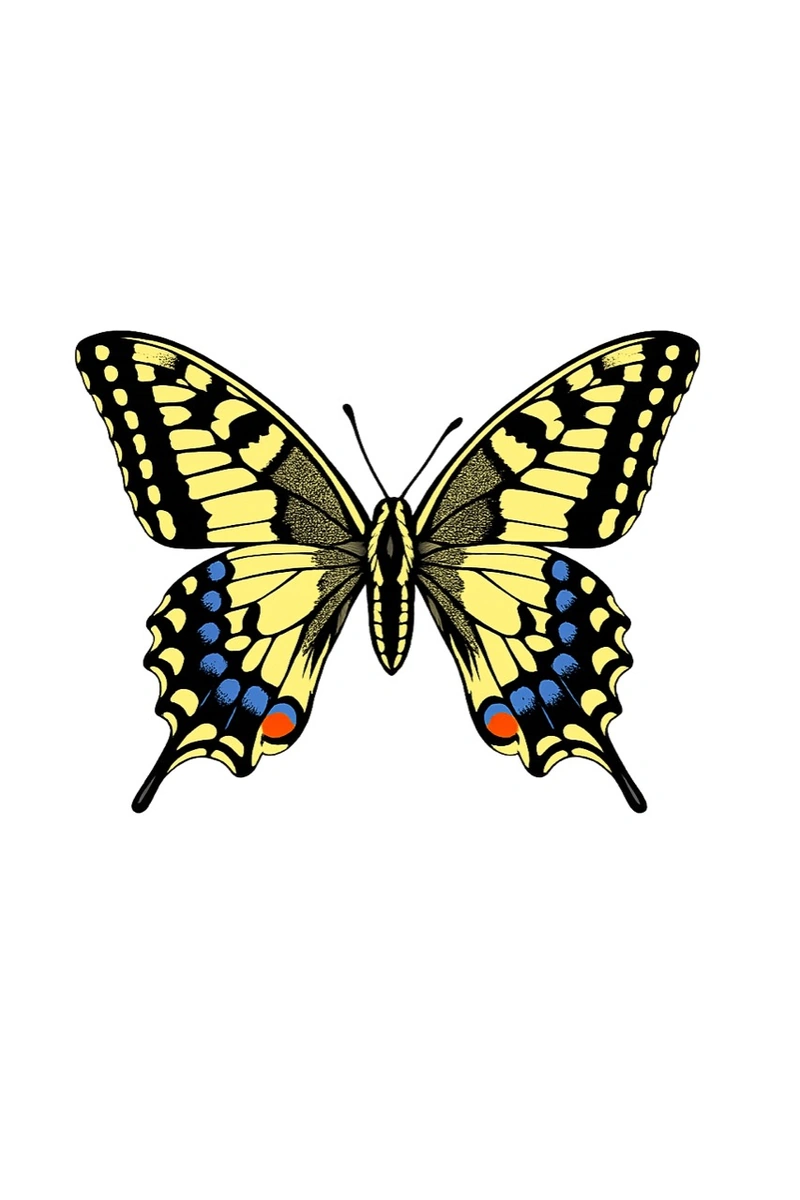
At a glance
- Regional plants ↘
- Apiaceae hosts include fennel and wild carrot in the museum account. [1]
- Research detail ↘
- The 2026 genomic study distinguishes the British britannicus lineage. [4]
The Old World swallowtail
Papilio machaon is the Old World swallowtail, a valid Papilio species. The museum's Japanese example is identified as hippocrates, while the recent genomic study investigates European populations including britannicus. [1][4][2]
These longer names are regional taxonomic context, not separate species headings inferred from an artwork's yellow colour.
Yellow, black and a small red landmark
The inspected museum adult has yellow wings with a dark basal area and dark marginal pattern. Blue marks curve around the hindwing, with a red mark near the inner rear corner and short tails. [2][1]
Use the complete arrangement to compare it with other yellow swallowtails rather than relying on the palette alone.
A broad species with local populations
The institutional account describes a broad northern distribution. Clark's 1932 Smithsonian paper documents the history of material from Alaska and the James Bay–Hudson Bay region. [1][3]
Its historical names and limits should not substitute for a modern North American revision, but the collecting trail shows why Old World is an incomplete geographic description.
Seasonal forms are a regional pattern
The museum describes smaller spring and larger summer forms for its regional portrait, using May–June and July–August. [1]
Those are not a universal flight calendar. Spring and summer differences can be important when comparing two adults, but geographical origin and the source's seasonal context should remain visible.
Apiaceae with local specialization
The museum lists Apiaceae hosts including fennel, wild carrot and Angelica. The British genomic paper describes britannicus as closely associated with milk-parsley in Norfolk. [1][4]
These accounts complement one another: broad species-level host use can coexist with much narrower observed use in a regional population.
An adult view is not a movement record
The open-wing image supports comparison of outline and markings. A migration, dispersal or hilltop-territory claim would require field observations of identified adults. The regional genetic study addresses population separation, not a directly photographed route taken by the individual represented in an artwork.
Genomes reveal a regional distinction
Nabholz and colleagues found britannicus genetically distinct and isolated in their European whole-genome sample. The sampled continental gorganus and nominate machaon were not genomically separable in the same way. [4]
This is a subspecies-level research result and does not justify adding a second species page for the British form.
A local host connects a local habitat
The Norfolk portrait joins a regional lineage with a particular fenland setting and host resource. [4]
Elsewhere, Apiaceae associations need their own documented plants and locations. A habitat summary becomes more informative when those regional differences are retained than when all populations are assigned one landscape type.
A collecting history beyond the common name
Clark records Drexler's 1860 James Bay collecting expedition and the later movement of the specimens through institutional collections. [3]
This is a historical narrative tied to real material. It explains how remote populations entered scientific comparison, while reminding us that the familiar English name does not determine range.
Isolation and genetic erosion are different
The 2026 study found higher inbreeding in the British sample, yet did not detect an elevated burden of deleterious mutations. [4]
Those results ask a more precise conservation question than simply calling an isolated population genetically ruined. The study's scope is British and comparative European material, not a global status category.
Read the inner hindwing corner
Begin with the yellow-and-black full outline, then locate the blue curved marks and red inner hindwing spot. Compare the tails and the dark basal field. A detail crop is useful only when its location remains clear; several swallowtails share much of the same colour vocabulary.
Familiar colour with precise landmarks
The artwork can use the bright yellow field as its visual centre while preserving the dark framework. Blue and red accents work best when kept in their biological positions rather than multiplied as ornament. This lets the piece remain recognisable through its pattern as well as its colour.
Keep the red and blue accents resolved
At small display sizes, the blue band and red corner can merge with a dark edge. Preserve a labelled master and inspect a proof before printing. If the object is a real specimen, the tails and scaled surfaces require careful enclosure handling; use a photograph to inspect the landmarks.
Regional forms do not automatically mean extra species
Does Old World exclude North America? The historical collecting record says otherwise. Is britannicus simply identified by a yellow-and-black image? Regional taxonomic evidence matters. Does higher inbreeding prove an elevated mutation load? The 2026 study distinguished those measured outcomes.
Historical specimens and contemporary genomics
The museum account supplies the regional visual and host portrait. Clark supplies public-domain collecting history. The 2026 original genomic study supplies the European lineage comparison and its measured conservation results. Their distinct roles prevent a broad familiar name from erasing biologically significant regional variation.
- Papilio machaon: collection feature ↗
National Museum of Natural Science, Taiwan · Accessed 2026-10-09
Adult pattern, Apiaceae hosts and seasonally variable regional portrait; illustrated specimen is Japanese hippocrates.
- Papilio: museum specimen images ↗
University of Florida BioCosmos · Accessed 2026-10-09
Actual labelled P. machaon adult image; dorsal visual reference.
- The forms of Papilio machaon in North America ↗
Austin H. Clark; Proceedings of the United States National Museum 81, 1932 · Accessed 2026-10-09
Public-domain primary historical collecting and taxonomic account; historical combinations do not define modern subspecies limits.
- Endemic but not eroded: genomic distinctiveness of the British swallowtail ↗
Nabholz and collaborators; Insect Conservation and Diversity, 2026 · Accessed 2026-10-09
Original whole-genome study; distinct British lineage, continental comparison and conservation-genetic results.
Sources checked 2026-10-09. Illustrations · Luminary Oddities.
Return to the Entomological Atlas ↑