

Luminary Oddities · Natural history & art
Spotted sawtooth butterfly
Prioneris thestylis
Lepidoptera / Pieridae
White upper wings with dark venation can hide the spotted sawtooth's stronger underside pattern. Its resemblance to some Delias makes it a useful subject for checking view, sex and genus carefully before relying on an appealing common-name label.
Explore this insect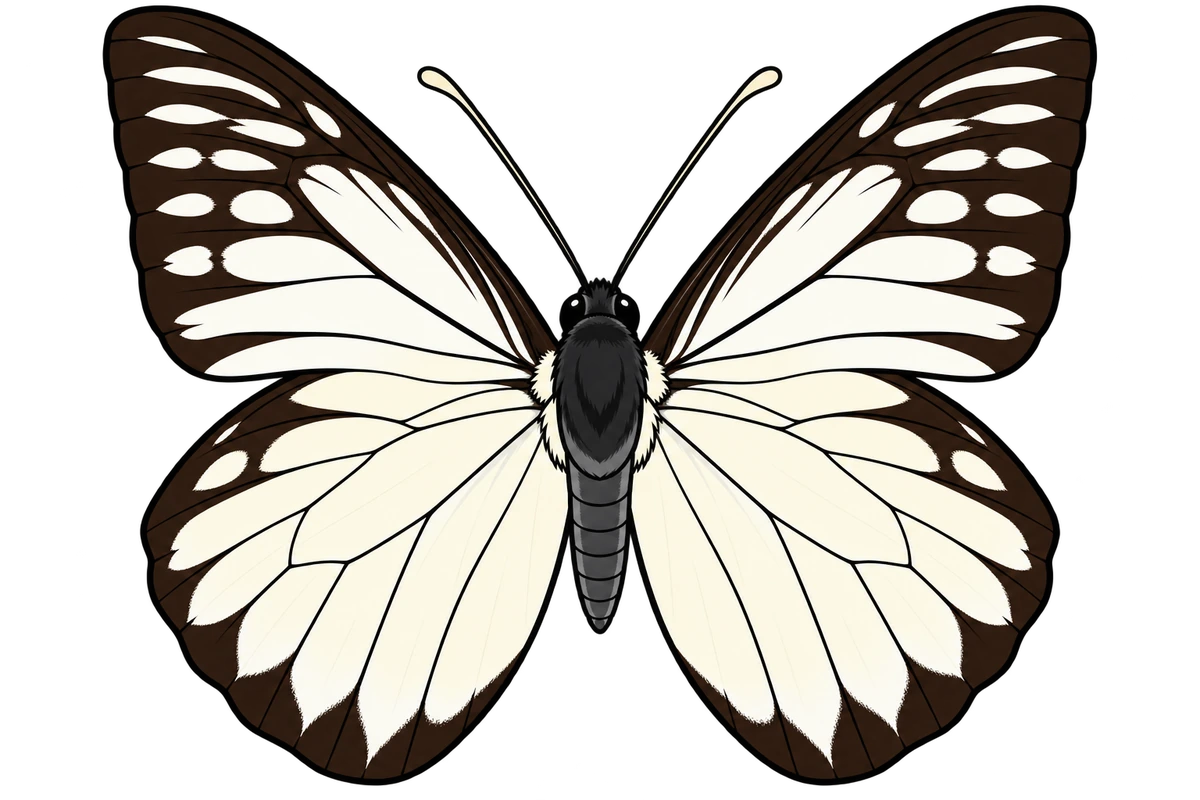
At a glance
- Regional host ↘
- Capparis sabiaefolia in the Taiwan monograph. [3]
The spotted sawtooth belongs to Prioneris
Prioneris thestylis is a valid pierid species, commonly called the spotted sawtooth. Bingham's historical treatment traces the name to Pieris thestylis, Doubleday's original combination. It is not treated here as Delias thestylis: resemblance to a jezebel does not make that genus substitution valid. [1][2]
Upper and lower surfaces tell different stories
The inspected dorsal specimen has a white ground with dark veins and a dark forewing apex enclosing pale elongated marks. Bingham describes the upper pattern in detail. The Taiwan monograph describes more extensive dark pattern below, with yellow areas, and stronger dark markings in females. [1][2][3]
A regional elevation comparison
The Taiwan fauna places the species mainly at low to moderate elevations and notes that it is seldom seen in northern Taiwan. Its account contrasts this distribution with similar-looking higher-elevation Delias. [3]
That local comparison is more useful than assigning every dark-veined white butterfly the same habitat.
Several generations in the Taiwan account
The regional monograph describes multiple generations. [3]
This supplies a local seasonal framework without giving an exact development interval for every population. Eggs, caterpillars, pupae and adults remain different stages; a larval photograph should be linked to a documented rearing or identification before entering a species gallery.
Use the named Capparis record
Capparis sabiaefolia is the host named in the Taiwan monograph. DearLep preserves additional regional host records with their own identifications. [3][4]
Keep the plant's recorded species name and source together: caper-family resemblance alone is insufficient to assign all plants in the family as equivalent larval food.
Flight is part of the Taiwan comparison
The monograph describes thestylis as a faster, more powerful flyer than the similar Delias in its comparison. [3]
That is a regional natural-history observation, not a measured universal speed. It is most useful alongside a settled pattern view and the local elevational context.
A sawtooth name needs a close view
The Taiwanese diagnosis notes teeth along the male forewing's leading edge and their absence in the female. [3]
Such a structural detail helps explain why the common name cannot be read merely as a jagged painted border. Compare the correctly sexed wing edge in an identified specimen.
Host, elevation and appearance are complementary
A similar adult pattern can occur in butterflies with different local habitats or plant relationships. The Taiwan comparison supplies one way to investigate that resemblance without collapsing the taxa together. A plant-host record and an elevation record answer different questions and should each retain their locality.
An old Pieris name, a current Prioneris heading
The historical combination Pieris thestylis leads to older descriptions. Prioneris thestylis is the consolidated species heading. The third word formosana belongs to Taiwan's regional form. [2][4]
Use those names to retrieve evidence without creating duplicate species pages or replacing the genus through a superficial resemblance.
Regional occurrence is not a global category
The monograph's account of elevation and northern scarcity does not by itself assign global conservation status. Survey timing, identification and effort matter when interpreting an absence. Records should distinguish a genuine local decline from a butterfly being difficult to identify in flight or surveyed outside its local activity period.
Begin with the surface shown
Read a dorsal image as the upper surface: its white hindwings should not be recoloured from an unrelated underside. A lower-surface view may show stronger yellow and dark pattern. Keep paired views linked to the same insect where possible and compare the forewing apex and venation at full size.
Dark veins over an open pale field
The upper surface offers a linear composition defined by dark veins and the forewing's apical pattern. An underside subject creates a different visual emphasis. Each view can support its own artwork, while an accurate caption makes clear which anatomical surface the viewer is seeing.
Fine venation needs room in a print
Inspect the final-sized work so dark veins remain separate from nearby marks. Preserve a labelled master before shrinking for a web gallery. If handling a real specimen, use its enclosure and photographs; an exposed wing's leading-edge detail should not be touched to test the sawtooth description.
A jezebel resemblance does not change the genus
Is thestylis a Delias because its underside resembles one? The valid name is Prioneris thestylis. Are white hindwings inconsistent with a colourful underside? Upper and lower surfaces differ. Does formosana identify an unlocalized image? It is a regional subspecies assignment requiring evidence.
Read the old diagnosis beside a modern regional account
Bingham supplies public-domain historical description and the name trail. The Taiwan monograph supplies regional sexes, hosts, generations and lookalike comparisons. DearLep retains documented local observations, and the museum image supplies the inspected dorsal adult. The sources complement one another without mixing surfaces or geographic forms.
- Prioneris: museum specimen images and taxonomy ↗
University of Florida BioCosmos · Accessed 2026-10-09
Accepted species records and actual P. thestylis dorsal adult photograph.
- The Fauna of British India: Butterflies, Volume II, p.151 ↗
C. T. Bingham, 1907; public-domain original monograph · Accessed 2026-10-09
Primary historical adult description, name trail and venation illustration.
- Butterfly Fauna of Taiwan, Volume II: Pieridae; Prioneris account ↗
Hsu, Huang and Liang; Taiwan Forestry Bureau · Accessed 2026-10-09
Primary regional monograph: sexes, named Capparis host, multiple generations, low/moderate elevation and comparison with Delias.
- Prioneris thestylis formosana: documented host records ↗
DearLep Taiwan · Accessed 2026-10-09
Regional photographic species and host records; subspecies scope retained.
Sources checked 2026-10-09. Illustrations · Luminary Oddities.
Return to the Entomological Atlas ↑