

Luminary Oddities · Natural history & art
Sulphur-patterned cicada
Sulphogaeana sulphurea
Hemiptera / Cicadidae
Yellow and dark wing fields give this cicada a striking pattern, while a field photograph from Bhutan shows a natural encounter. Its modern genus name differs from the one used in the nineteenth-century description.
Explore this insect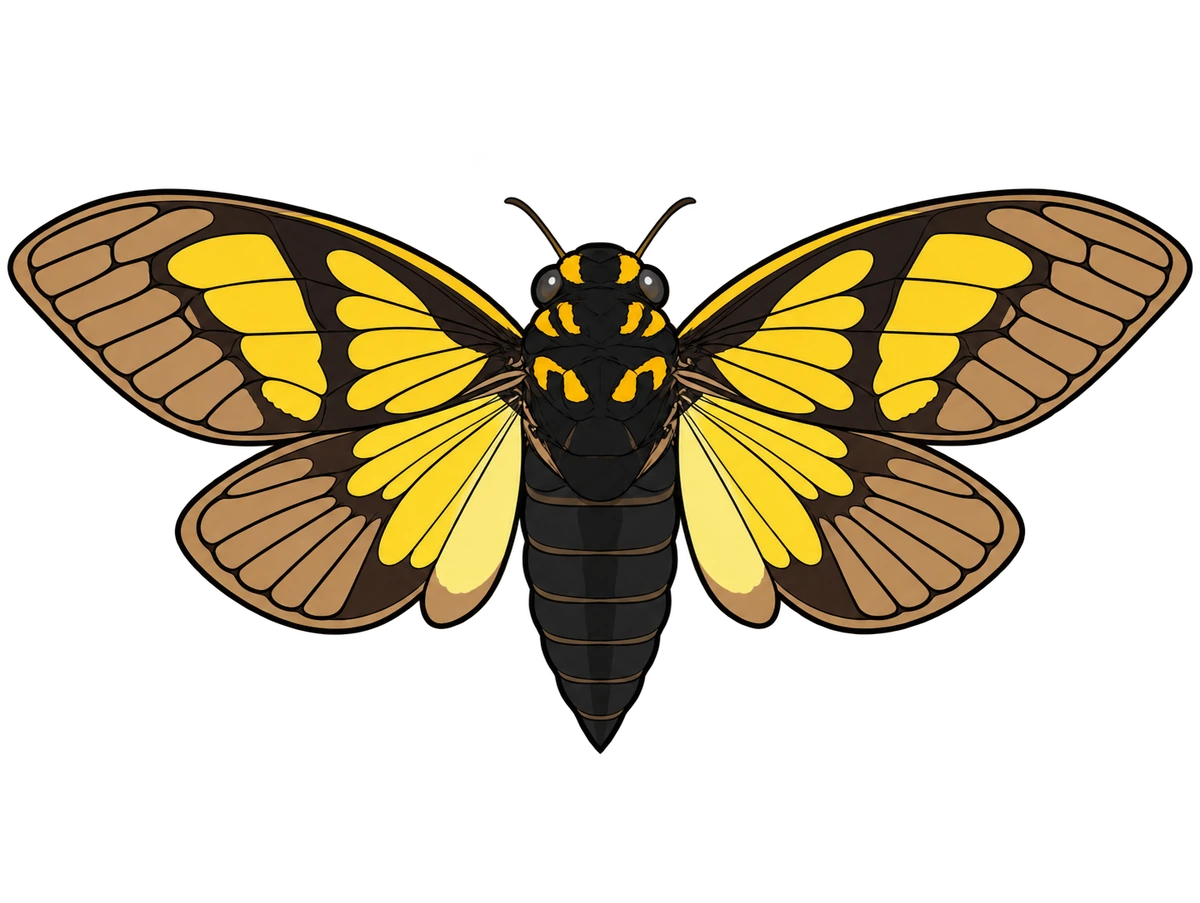
At a glance
- Current genus ↘
- Sulphogaeana. [1]
- Historical description ↘
- Distant treated the species as Gaeana sulphurea. [2]
- Field reference ↘
- A mating pair photographed in Bhutan by Jeff Blincow. [3]
A modern combination for an old species
Sulphogaeana sulphurea is retained in the 2025 systematic treatment. Gaeana sulphurea is the older combination used in Distant's monograph. [1][2]
The two names should resolve to one species, allowing historical descriptions to remain accessible while the Atlas follows the current generic placement.
Yellow fields and dark boundaries
The Bhutan field photograph shows yellow wing areas against a dark outer network, with yellow-and-dark body markings. An oblique natural view reveals a different arrangement from a flat spread specimen. [3]
Compare the boundaries of the colour fields, not just their apparent brightness in outdoor light.
Historical Himalayan records
Distant's account places the historical material in the Himalayan region. [2]
That nineteenth-century record should be read with its original locality wording rather than expanded into an unsupported complete distribution.
The independent Bhutan photograph provides a modern field locality for the particular pair depicted. [3]
Development beneath the adult portrait
The basic cicada sequence has no pupa: eggs lead to nymphs, and the mature nymph becomes a winged adult. [4]
Measuring the underground duration needs evidence beyond the adult view. A mating photograph records reproductive activity, but it cannot date the nymphal development that preceded it.
Investigate the feeding relationship
A useful plant record would name the host and distinguish root feeding, oviposition and adult feeding. Neither stones beneath the photographed pair nor vegetation elsewhere in the frame can establish a host. This keeps the Atlas's botanical connections based on biological observations rather than the setting of an image.
A pair observed in the field
Jeff Blincow's photograph records a mating pair in Bhutan. [3]
It therefore contributes an observed behaviour as well as adult appearance. The position is specific to that encounter; it should not be generalized into the species' usual resting posture, preferred substrate or daily schedule.
An old description with a modern label
An observer's record of an avoided insect asks a different question from a photograph of its yellow pattern. Connecting the two through controlled comparisons could test whether appearance predicts a predator's response, instead of assuming that conspicuous colour alone explains the encounter.
The ground is part of the encounter
Kafley and Smetacek reported that birds ignored dead and dying adult sulphurea even where the cicada was conspicuous during April and May in the western Himalaya. They interpreted this avoidance as suggesting distastefulness. [5]
This is a field observation and an interpretation, rather than a controlled feeding assay. It supplies a worthwhile ecological question about the conspicuous adult pattern without proving a chemical defence or a predator response in every population.
Sulphurea and its historical combination
The specific epithet remains sulphurea when the genus changes from Gaeana to Sulphogaeana. [2]
Keep that spelling consistent in the caption, archive and source search. An older label is useful historical metadata; it should not be treated as a second species or silently discarded from the record.
From occurrence to conservation evidence
The Bhutan encounter confirms the photographed insects' presence at one place and time. Population assessment would require a wider sampling design and repeat records. A visually spectacular species can attract photography without its abundance being measured, so frequency of images should not stand in for conservation evidence.
Read a natural view before flattening it
Locate the body first, then follow each wing outward. The pairing and oblique angle can conceal or overlap parts of the outline. Compare details with a correctly identified full view before assuming that an unseen region lacks a marking. The viewpoint is part of the evidence.
Yellow against a dark lattice
The visual pattern invites attention to light spaces enclosed by darker structure. The artwork can emphasize that relationship through clear line and restrained yellow tones. Keep the insect's major colour fields coherent while allowing the surrounding composition to express an atmosphere beyond the field photograph.
Avoid losing the wing network
Examine a print at its final size to ensure fine dark divisions remain visible in the yellow field. Save the highest-quality master with its scientific caption. For physical specimens, enlargement should come from photography; repositioning fragile wings merely to inspect a pattern can damage the object.
What the pair can tell us
Does the photograph prove mating behaviour? Its original caption identifies that encounter. Does it prove stones are a larval host? A substrate is not a food plant. Is Gaeana sulphurea another species? It is the historical combination linked to the current Sulphogaeana heading.
Keep observation and classification separate
The field photographer contributes an actual encounter and view. Distant contributes historical description and locality context. The recent phylogeny provides the current generic framework. The guide joins those records without converting a photograph into a complete biological study or an old locality list into a modern survey.
- Phylogeny, diversification and biogeography of charming moth-like cicadas in Gaeanini ↗
Wang, Zhou, Zhang and Wei; Systematic Entomology, 2025 · Accessed 2026-10-09
Primary phylogenetic and systematic study; current generic and tribal placements.
- A monograph of Oriental Cicadidae, pp.105–107 ↗
W. L. Distant, 1889–1892; University of Toronto copy · Accessed 2026-10-09
Public-domain original species descriptions, historical specimen localities and plates. Historical classification is superseded.
- The butterfly cicadas: original photographs ↗
Photographs by Michel Chantraine and Jeff Blincow, hosted by Cicada Mania · Accessed 2026-10-09
Actual adult images and their individual locality captions; visual reference, not a complete life-history study.
- Rearing Cicadas ↗
Smithsonian Tropical Research Institute · Accessed 2026-10-09
General cicada developmental framework and why species-specific root hosts and durations need direct rearing evidence.
- Individual variation of Balinta octonotata and a comparative note on Sulphogaeana sulphurea ↗
Parixit Kafley and Peter Smetacek; Bionotes23(1), 2021, p.3 · Accessed 2026-10-09
Original comparative field observation that birds avoided adult S.sulphurea in western Himalaya; no controlled palatability test.
Sources checked 2026-10-09. Illustrations · Luminary Oddities.
Return to the Entomological Atlas ↑