
Luminary Oddities · Natural history & art
Hill Jezebel
Delias belladonna
Lepidoptera / Pieridae
A dark Asian jezebel with yellow and pale markings, documented in Indian field observations around forest tracks, flowers and damp ground.
Explore this insect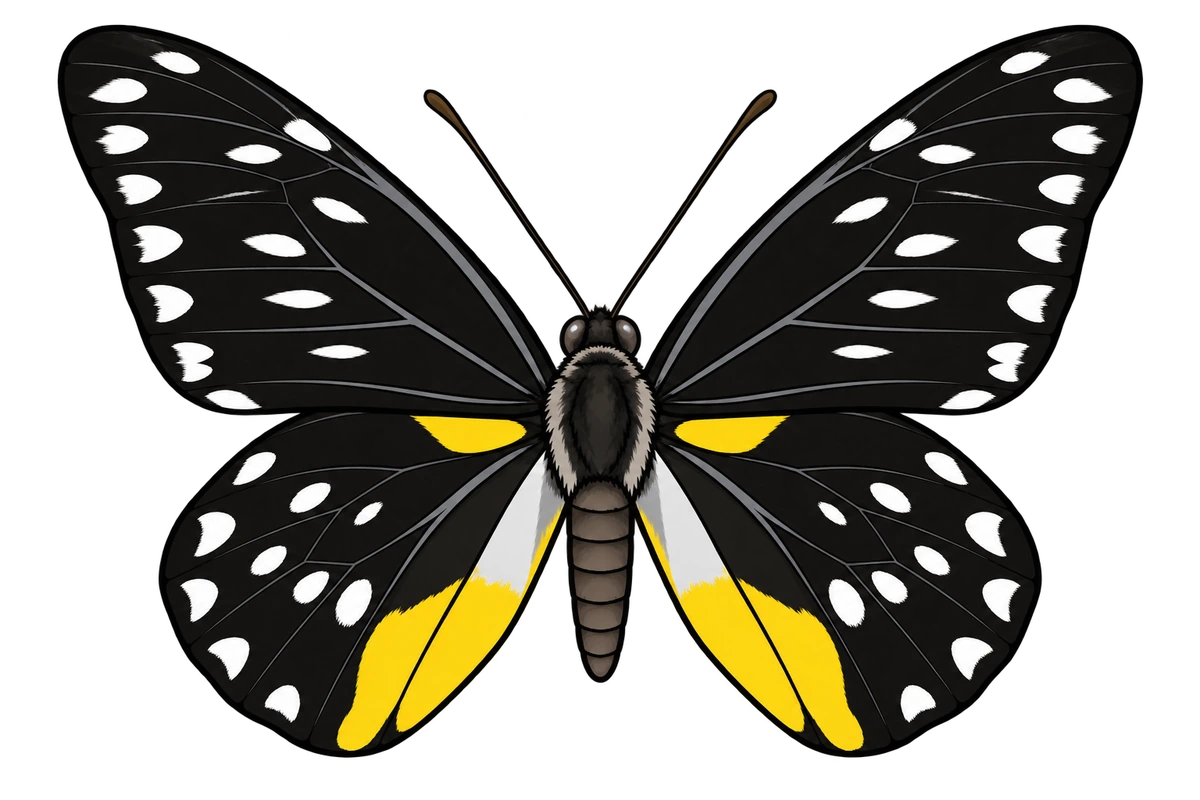
At a glance
- Range context ↘
- Broad Asian regional range [2]
- Identification detail ↘
- Yellow underside hindwing cell patch [2]
- Biological reference ↘
- Indian guide records nectar visits and male puddling [3]
Identity and close relatives
How to look at the wings
Range and living habitat
The specialist synthesis spans Himalayan and mainland Asian regions through China and Southeast Asia, with Malaysian and Sumatran forms. The Indian field guide records stream margins and open-forest tracks from 600 to 3,000 metres. That habitat and elevation statement retains its Indian source scope. [2][3]
A life in four stages
The checked field guide lists a host but does not supply an egg-to-adult timetable for every regional form. A complete developmental account should retain locality, plant determination and rearing conditions. The species' broad geography makes a single universal duration particularly unhelpful.
Leaves for larvae, food for adults
The Indian guide identifies Dendrophthoe as a larval food source. It also describes adult flower feeding. The parasite used by larvae and the flowers visited by adults are separate resources; a tree hosting a mistletoe should not automatically become the caterpillar's food plant. [3]
Behaviour in the living landscape
The same guide records gatherings on flowering trees and thistles and males visiting damp soil, sometimes together. These are regional natural-history observations. They provide behaviours to look for, but do not establish an obligatory daily routine or identical activity at every Asian site. [3]
A closer scientific story
The remarkable contrast is between an adult gathering at a visible flower or puddle and the less conspicuous plant supporting larvae. A complete observation series would connect those resources within one population, helping explain why adults appear where they do.
Connections in the ecosystem
The larval mistletoe, its supporting tree and adult feeding sites form a set of relationships worth recording separately. A survey that photographs only adult congregations could miss changes in breeding resources. Botanical identification would make that ecological account substantially more precise.
Names and natural-history records
The specialist page organizes geographically named forms within belladonna. Those captions are important when comparing the pattern of the yellow hindwing patch. Common name, subspecies name and species name serve different purposes and should not be counted as independent species.
Habitat and conservation context
The Indian guide's description of belladonna as common is a regional field-guide statement, not a current global conservation category. A modern assessment needs locality-level survey data and defined effort. Widespread occurrence does not establish that every named regional population is stable.
Reading the specimen views
Begin with the underside hindwing cell, then compare adjacent pale spots and the forewing pattern. A dorsal spread and a closed-wing field photograph show different information. The Sikkim living reference should keep its locality and source form identification beside the image.
From biological reference to artwork
Keep the yellow areas in their observed compartments and preserve the spacing of pale spots. A reference from one regional form should be identified as such. A readable standard pose can aid comparison without averaging geographically different adults into an imaginary pattern.
Caring for a framed specimen
Keep the frame out of direct sun. Preserve the regional form and field-reference details in its catalogue record. If a display mentions commonness or an elevation band, keep the Indian source context and date attached to that statement. [4]
Questions worth asking
Which regional forms have confirmed rearing records on Dendrophthoe? How do adult flower gatherings relate to local breeding sites? Which wing characters distinguish belladonna from its closest spotted relatives? These questions connect a recognizable adult with a locally documented ecology.
Sources and further reading
The Indian government guide supplies the regional habitat, host and behavioural account. The specialist synthesis supplies wider comparisons and attributed living references. Use each at its proper geographic scale; the current catalogue supports the species classification rather than the ecological claims.
- Delias classification and museum-image catalogue ↗
University of Florida Lepiverse; Catalogue of Life 2026-08-26 XR · Accessed 2026-10-09
Indexed genus classification lists the named taxon at species rank; this supports catalogue status, not a resolved species boundary.
- Delias belladonna: specialist records and comparison plates ↗
Delias of the World; international Delias specialists · Accessed 2026-10-09
Specialist localized living photograph from Sikkim, geographic subspecies catalogue and published genitalia-comparison plates.
- Titli — The Dancing Wings: Hill Jezebel ↗
Directorate of Forest Education, India; species contribution Ashutosh Mallik · Accessed 2026-10-09
Government field guide, Hill Jezebel page; regional morphology, habitat, behaviour and Dendrophthoe host account examined through indexed page text.
- Caring for natural history collections ↗
Canadian Conservation Institute; Fiona Graham · Accessed 2026-10-09
Preventive care of fragile biological collections; the brief enclosure-handling and environment recommendations are general collection practice. Species-label recordkeeping recommendations are editorial.
Continue exploring
Sources checked 2026-10-09. Illustrations · Luminary Oddities.
Return to the Entomological Atlas ↑