

Luminary Oddities · Natural history & art
Red-base Jezebel
Delias pasithoe
Lepidoptera / Pieridae
A dark Asian jezebel whose vivid red hindwing base is revealed on the underside, with a regional life history that begins in company.
Explore this insect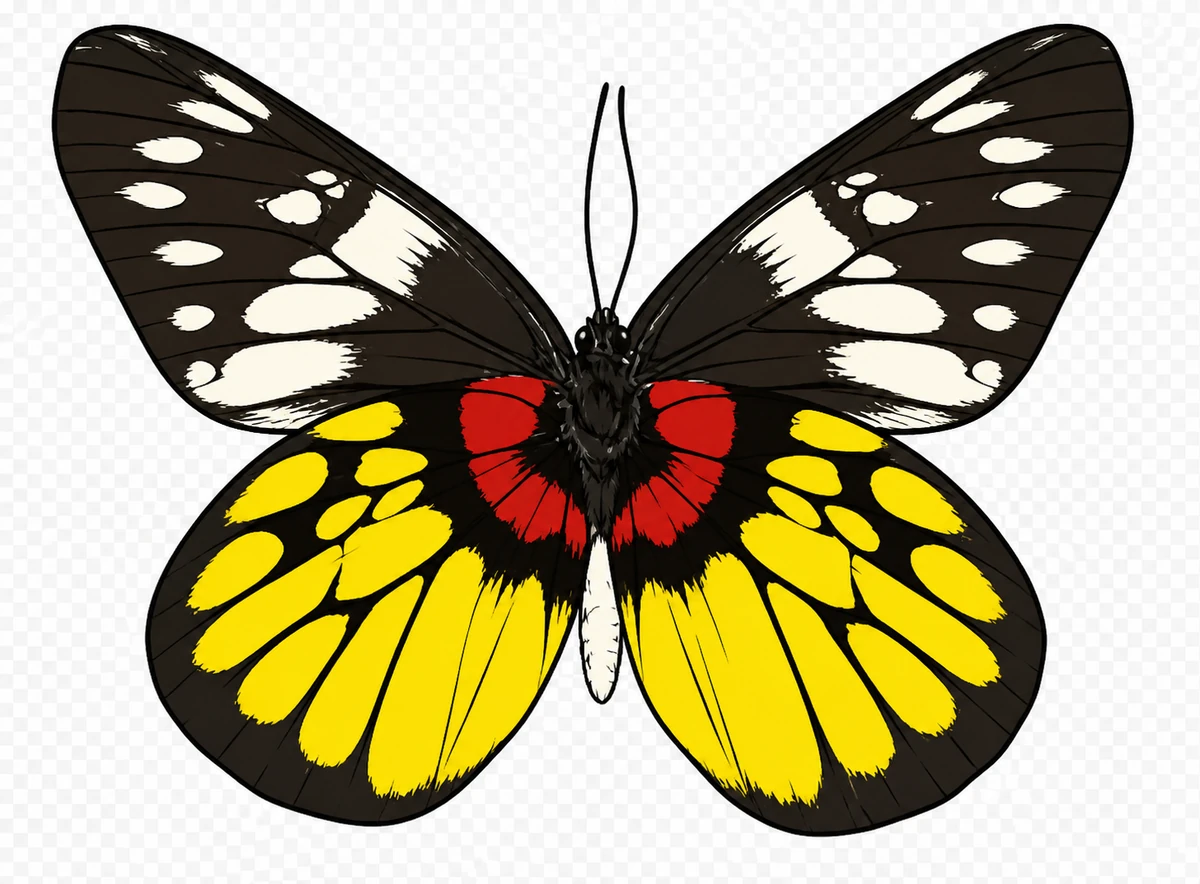
At a glance
- Distinguishing view ↘
- Red patch at hindwing underside base [3]
- Early stages ↘
- Clustered eggs and gregarious larvae in Taiwan [3]
- Host context ↘
- Mistletoe-family plants in the Taiwan account [3]
Identity and close relatives
Delias pasithoe is a pierid butterfly. Its English name points to a conspicuous red patch near the base of the hindwing underside, making the direction of the view unusually important. This guide treats the species as a whole, and identifies subspecies when a source does. The Taiwan account concerns curasena, the Singapore checklist uses parthenope, and the 2026 Yunnan treatment describes the nominate subspecies pasithoe. Those names do not identify the photographed artwork’s specimen by themselves. [2][3][7]
How to look at the wings
Pale and yellow markings contrast with dark wings, with the red accent close to the body on the lower hindwing. The National Taiwan Museum describes the male curasena as darker than the female and with clear pale spots or stripes. The museum specimen has its own sex identification, but that label belongs to that object. For another specimen, the appropriate approach is to compare the full pattern and its records rather than assign a sex from an isolated patch of red. [3]
Range and living habitat
Published records anchor an Asian distribution at particular places. The University of Tokyo holds specimens documented from Hainan and Guangdong, and a Nepal specimen from Godavari near Kathmandu in 1963. The Yunnan revision places nominate pasithoe in low-altitude parts of that province. These are useful points in a distribution story, but they do not make an uninterrupted map between the points, and the collection dates do not establish the butterfly’s present abundance at those sites. [2][5][6]
A life in four stages
Like other butterflies, this species develops through an egg, a feeding caterpillar, a pupa and a winged adult. The pupa is a living developmental stage, not a resting adult wrapped in a case. A framed butterfly represents the adult stage. Its wing pattern cannot stand in for a photograph of the caterpillar or establish how long the individual spent developing. Local studies are most informative when their climate, host plant and observation conditions accompany the measurements. [8]
In the Taiwanese curasena account, females lay eggs in groups and the caterpillars remain together. The museum describes several generations in a year and occurrence from hilly country into mountains below about 2,000 metres. Keeping the Taiwan setting beside those details makes them informative: they describe one regional cycle and do not impose its number of generations, elevation limit or calendar on every Delias pasithoe population. [3]
Leaves for larvae, food for adults
The Taiwan museum associates larvae with mistletoe-family plants and adults with flower nectar. These are distinct resources for different life stages. A caterpillar’s food relationship leads into the vegetation supporting the next generation; an adult flower visit records liquid feeding by a mobile insect. The museum account is not an exhaustive species-wide list of larval plants. It is better to preserve the documented family-level association than add precise plant names drawn from a different Delias species. [3]
Behaviour in the living landscape
The museum describes slowly flying, nectar-feeding adults in Taiwan and territorial behaviour by males. That gives a living counterpoint to the still, symmetrical view in a frame. Territorial activity and clustered early stages are also different phenomena: an adult’s interaction with other butterflies cannot explain, by itself, why larvae feed together. Their coexistence in the same regional account makes this a species worth observing at more than one stage. [3]
A closer scientific story
The feature behind the English name can disappear from the most dramatic photograph. A spread upper view may emphasize the dark silhouette and pale wing markings, while an underside view brings the red base into sight. This is a useful lesson in looking at natural-history objects: the familiar presentation is one perspective, not a complete description. When comparing works in the gallery, first identify the photographed wing surface before interpreting differences in color.
Connections in the ecosystem
A historical Bangladesh survey describes the butterfly mainly in forest country, including Srimangal and the Chittagong Hill Tracts, with additional observations at Bhairab and Bhawal. This regional evidence connects the adult to wooded landscapes rather than only to a decorative garden image. Combined with the Taiwan larval association, it invites attention to plants within those landscapes. It does not establish an experimentally measured pollination service or a specific chemical defence for the species. [4][3]
Names and natural-history records
The 2026 checklist traces names including Papilio dione and an older Papilio aglaja usage complicated by homonymy, in which the same name was used for another butterfly. It adopts the authorship Linnaeus, 1767 for pasithoe. This history explains why searching old literature may require more than the current binomial. Historical names belong in the research trail, while one clearly stated modern heading helps readers connect the accounts without creating duplicate species pages. [2]
Habitat and conservation context
The current NParks checklist gives Delias pasithoe parthenope a Data Deficient category in Singapore’s third Red Data Book, while recording an earlier national extinction category in the second edition. The change must be read as a Singapore assessment for that regional taxon. It is not a global threat category and does not turn Taiwan or Nepal collection records into present population surveys. A checklist can reveal that local knowledge has changed without supplying a conclusion about every part of the species’ range. [7]
Reading the specimen views
Dorsal means the upper surfaces of the wings; ventral means their undersides. Start with the whole silhouette, then follow the boundary between the forewing and hindwing and inspect the inner and outer margins. A closely cropped detail is most useful beside a complete view, where its position is clear. Comparing equivalent surfaces prevents an underside pattern from being mistaken for a color variant of the upper wing. A digital enlargement is a way to examine the artwork; it does not supply a microscopic scale or a measurement of the original insect.
From specimen photograph to artwork
Luminary Oddities’ artwork begins with photography of a living or formerly living specimen, as documented by the artists. The resulting digital treatment can emphasize color, symmetry, movement or atmosphere while retaining that photographic starting point. Read each gallery caption for the named work and the view being presented. An artwork title describes an edition or composition; it is not an additional biological species. The natural-history account identifies the taxon represented, while the art invites a more personal response to its shape and pattern.
Caring for a framed specimen
Display a framed insect in an interior location away from direct daylight, dampness and frequent temperature or humidity changes. Handle the enclosure rather than the specimen, and inspect it periodically for loose parts, pest activity or moisture. Preventive conservation guidance treats physical damage, pests and light as important risks for organic natural-history collections. A glazed frame reduces handling and dust exposure but does not make delicate material immune to deterioration. Follow the maker’s instructions for the enclosure; concerns inside it are best addressed without touching the wings. [1]
Questions worth asking
Why is there little red in a dorsal image? The named red patch lies on the hindwing underside. Does curasena identify every Red-base Jezebel? It is a regional subspecies name used by the Taiwan source, not the heading for all populations. Does a historic specimen prove the species still lives at that precise site? It proves a documented occurrence at the recorded time; present occupancy requires newer observations. [2][3][4][5][6][7]
Sources and further reading
The linked sources combine taxonomic records, natural-history observations and scientific studies. Regional results are identified in the text because a single population does not describe every butterfly carrying the same name. Historical collection records document those museum objects, and are not provenance records for the artwork’s photographed specimen. Scientific source images are linked for study; their citation does not transfer image rights to this gallery.
- Caring for natural history collections ↗
Canadian Conservation Institute · Accessed 2026-10-09
Preventive care of organic natural-history specimens; not a guarantee about a particular frame.
- Delias pasithoe pasithoe taxonomic treatment, Hu et al. 2026 ↗
Zootaxa / Biodiversity Literature Repository · Accessed 2026-10-09
Linnaeus 1767 authorship, historical names and low-altitude Yunnan distribution
- National Taiwan Museum specimen TMIN1592-004 ↗
National Taiwan Museum · Accessed 2026-10-09
Regional curasena appearance, nectar feeding, clustered eggs and larvae, mistletoe-family hosts and Taiwan habitat
- Butterflies of Bangladesh, Delias pasithoe account ↗
IUCN library · Accessed 2026-10-04
Forest observations in Srimangal, Chittagong Hill Tracts, Bhairab and Bhawal; historical aglaja name
- Yoshida butterfly collection, cabinet YY051 ↗
University Museum, University of Tokyo · Accessed 2026-10-04
Documented D. pasithoe specimens from Hainan and Guangdong
- Igarashi butterfly collection, cabinet 2079 ↗
University Museum, University of Tokyo · Accessed 2026-10-04
D. pasithoe specimen from Godavari, Kathmandu, Nepal, 1963
- Singapore butterfly species list ↗
NParks Singapore · Accessed 2026-10-09
Regional name D. pasithoe parthenope and Red Base Jezebel
- About Butterflies ↗
Smithsonian Gardens · Accessed 2026-10-09
Butterfly development, caterpillars, pupae and adult mouthparts; general butterfly context.
Artworks in the collection
Explore the framed works and digital art connected with this insect. Etsy shows current availability, options and prices.
- Gold Edition 001 / Gold Edition 002 / Ruby Edition 001 ↗Framed work
- Midnight ↗Framed work
Continue exploring
Sources checked 2026-10-09. Artwork © Scott Schubr / Luminary Oddities.
Return to the Entomological Atlas ↑