
Luminary Oddities · Natural history & art
Common gull butterfly
Cepora nerissa
Lepidoptera / Pieridae
Creamy wings crossed by dark veins give the common gull a crisp graphic structure. Seasonal variation and its connection to caper relatives add depth to a butterfly that is often associated with open landscapes, edges and cultivated ground.
Explore this insect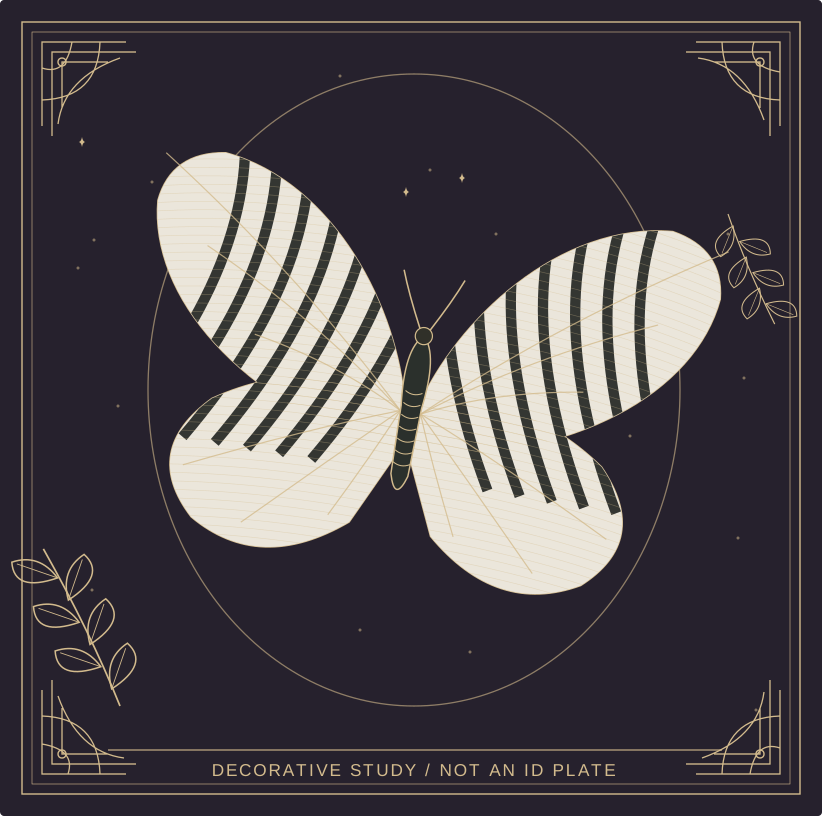
At a glance
- Wingspan ↘
- 40–65 mm in the Indian CSIR–NEERI account. [1]
- Larval plants ↘
- Capparaceae and Cleomaceae in the Naturalis trait account. [2]
A gull that is a butterfly
Cepora nerissa is a butterfly in Pieridae, the whites and yellows. Common gull is an English butterfly name, not a relationship to birds. Keeping the scientific name alongside it avoids confusion and connects the collection with regional accounts and host records. The Atlas treats the framed specimen as the visual starting point, then follows the species into its plants and places. It does not assign a sex, seasonal form or collecting locality solely from the composition surrounding the insect. [1][2]
White, dark veins and a yellow reverse
The Indian CSIR–NEERI account describes a black, white and yellow butterfly and gives a wingspan of 40–65 millimetres. The upper surface is creamy pale with dark margins and venation, while the lower surface has a yellow cast. The account also notes seasonal variation, with wet-season forms darker and somewhat larger. Those differences are a reason to read photographs as examples rather than as a rigid colour key. A darker individual is not automatically another species. [1]
Open country and useful edges
CSIR–NEERI places the species in India and Southeast Asia and describes Indian dry plains, cultivated farms and scrub. Naturalis's trait account adds a strong association with edges and disturbed settings, within the scope of the dataset it presents. These are complementary ecological descriptions rather than proof that the butterfly thrives equally in every altered landscape. The living context includes vegetation and suitable larval resources, not only an open space where an adult happens to pass. [1][2]
A caterpillar before the pale wings
The complete butterfly cycle moves from egg to feeding caterpillar, then pupa and adult. The caterpillar grows through molts and depends on its host plants. Its needs differ from those of the flying adult. For Cepora nerissa, the verified host-family account anchors that early feeding relationship. Seasonal adult appearance adds another dimension to the story but does not provide a universal developmental timetable. This guide therefore distinguishes stages without attaching an unsupported number of days to each one. [5][2]
Caper relatives and spider-flower relatives
Naturalis lists Capparaceae and Cleomaceae as host families. The Indian host compilation includes plants in genera such as Capparis, Cadaba, Crateva and Maerua. These names connect the butterfly to a botanical world beyond nectar flowers. They are records of caterpillar plant use, not a claim that every species within those genera is acceptable. When following a host list, retain the plant identity and the source's geographic scope, especially where botanical family arrangements or names have changed. [2][3]
A strong low flyer with flower visits
The Indian account describes strong flight near the ground and resting after flight on exposed leaves or bushes. It lists nectar visits to Tridax procumbens, Sida rhombifolia, Alternanthera and Lantana. These observations add a living rhythm to the spread adult in a frame: movement, rest and food visits. The flowers are adult resources in this account. They should not be relabelled as caterpillar hosts simply because the butterfly has been photographed drinking there. [1]
The season can change the appearance
The wet-season and dry-season differences described in the Indian account make this butterfly a useful introduction to seasonal variation. An identification guide must allow more than one appearance within a species. The apparent darkness of a shop photograph also depends on illumination, surface view and photographic processing. A season label belongs with a documented specimen record or an appropriately identified regional example. It should not be assigned to a decorative artwork merely because the colours look especially pale or dark. [1]
Two plant relationships worth separating
The host-family records and the named adult flower visits tell different ecological stories. Caterpillar food supports growth before metamorphosis. Adult nectar is taken with a different feeding apparatus and can be supplied by different plants. A flower-rich display or planting therefore does not automatically contain a complete butterfly habitat. In the account, keeping both kinds of record visible gives a reader a more useful picture than one undifferentiated list of plants associated with the adult. [1][2]
Common gull as an entry point
The English name offers a memorable doorway into Cepora nerissa, but scientific names and source titles remain useful for finding the relevant evidence. A regional host list, a trait dataset and a specimen caption can use different levels of detail. The Atlas keeps them connected while retaining their individual scope. An artwork title adds another name for the piece, not another taxonomic identity. Neither the common name nor the artwork title establishes a traditional symbolic meaning for the butterfly. [1][2]
Read occurrence and status differently
A regional account calling a butterfly common describes local encounter frequency. A trait account describing disturbance affinity summarizes a kind of ecological association. Neither statement supplies a current global conservation assessment or proves that every population is secure. The guide therefore emphasizes the plants and settings documented in its sources. A species account also cannot establish the source of the individual in a frame; that information belongs to its collection and supplier records. [1][2]
Let veins organize the view
Start with the whole upper surface, then choose one dark vein and follow it toward the wing edge. Compare how the dark border changes between forewing and hindwing. Look next at a complete underside and note the change in the pale ground colour. This sequence helps separate the stable structure of the insect from lighting or processing differences between images. Detail crops are useful when they remain connected to a full view of the same specimen.
Crisp lines in a composed piece
The common gull can lend a framed composition a clear, graphic rhythm. Pale ground, dark boundaries and a quieter yellow surface offer the artist several possible points of emphasis. Surrounding botanical motifs, metallic accents or celestial symbols belong to that artwork's interpretation. They do not become verified folklore about Cepora nerissa. The guide and gallery let the viewer move between biological context and a composed image, noticing how framing changes which parts of the specimen stand out.
Keep the pale surfaces protected
View the insect through its enclosure and handle only the frame. A location away from direct sunlight, persistent damp and strong heat supports preventive care of a mixed-material object. Brittle insect wings should not be brushed or wiped. Watch for loose fragments, a displaced mount or changes inside the frame, and document anything unusual before seeking help. The Canadian Conservation Institute's natural-history guidance provides the broader basis for reducing physical stresses and monitoring environmental and pest risks. [4]
Seasonal forms and plant lists
Are every individual's wings identical? The Indian account describes seasonal variation, so one specimen is an example rather than the entire species. Are all listed flowers caterpillar hosts? No: the nectar records and larval-host families represent different stages. Does edge affinity prove that every urban planting is suitable? It is a dataset description, not a guarantee. Can colour alone establish a mounted specimen’s season or sex? The complete identification and its supporting records are needed. [1][2]
A regional account and a trait account
The CSIR–NEERI page supplies an Indian natural-history portrait with adult appearance, seasonality, habitat and nectar observations. Naturalis provides host-family and habitat-affinity information with a linked trait-data source. The Indian host compilation adds named larval plants. Read the plant records by stage and keep local descriptions local. The general Smithsonian account provides the framework of metamorphosis, while the conservation reference concerns the care of the displayed object. [1][2][3]
- CSIR-NEERI: Common Gull ↗
CSIR National Environmental Engineering Research Institute · Accessed 2026-10-09
Creamy-white upperwing, yellow below, dark veins and borders; female and seasonal differences; dry plains, farms, scrub and puddling.
- Naturalis: Cepora nerissa ↗
Naturalis Biodiversity Center · Accessed 2026-10-09
Larval plant families Capparaceae and Cleomaceae; affinity for forest edges and disturbed habitats.
- Butterflies of India: larval host plants ↗
Indian Foundation for Butterflies · Accessed 2026-10-09
Cepora nerissa records include Capparis, Cadaba, Crateva and Maerua. Host records remain plant- and population-specific.
- Caring for natural history collections ↗
Canadian Conservation Institute · Accessed 2026-10-09
Preventive care of organic collections, including brittle insect material.
- About Butterflies ↗
Smithsonian Gardens · Accessed 2026-10-09
General butterfly metamorphosis, anatomy and stage distinctions; not species-specific timings.
Artworks in the collection
Explore the framed works and digital art connected with this insect. Etsy shows current availability, options and prices.
- The Lovers ↗Framed work
- The Star ↗Framed work
- The Moon ↗Framed work
Continue exploring
Sources checked 2026-10-09. Artwork © Scott Schubr / Luminary Oddities.
Return to the Entomological Atlas ↑