
Luminary Oddities · Natural history & art
Little Yellow
Pyrisitia lisa
Lepidoptera / Pieridae
A small American yellow butterfly whose warm-season travels, low flight and legume-feeding caterpillars make an ordinary-looking field a busy habitat.
Explore this insect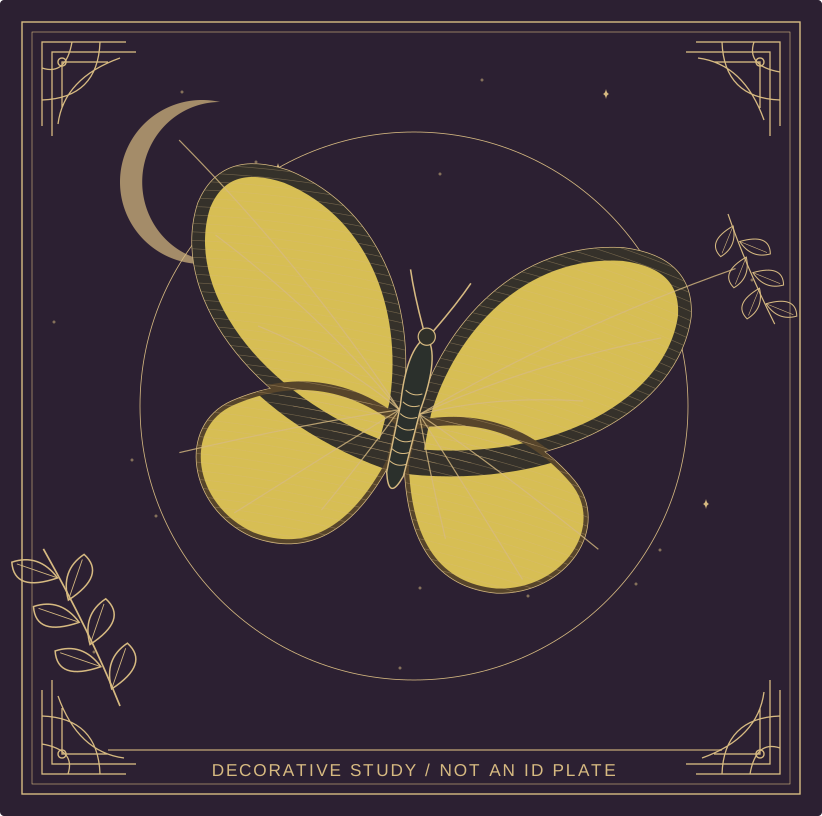
At a glance
- Host context ↘
- Documented Alabama hosts include partridge pea [5]
- Seasonal pattern ↘
- Warm-season recolonization in Missouri [3]
Identity and close relatives
Pyrisitia lisa is a pierid butterfly also encountered under the combination Eurema lisa. Little Yellow, Little Sulphur and Lisa Yellow refer to this species, but the common name alone is not enough to distinguish every small yellow butterfly. It is a separate subject from the Old World Common Grass Yellow, Eurema hecabe. The American field accounts provide identification details and regional seasonal context rather than a reason to merge those two yellow butterflies. [3][6]
How to look at the wings
Yellow upper wings carry dark outer edging and forewing tips. The underside offers finer clues, especially two tiny dark marks near the base of the hindwing in the Alabama atlas. Seasonal and sex-related variation affect color and markings, so the underside is worth comparing even when the familiar yellow silhouette seems straightforward. A pale or white individual should receive the form identification supported by its record, rather than an automatically assigned albino label from a photograph. [5][3]
Range and living habitat
The species has a southern resident range and expands northward in warm seasons. In Missouri, the conservation department describes annual recolonization and death with freezing weather. A statewide warm-season occurrence map therefore tells a different story from a winter-survival map. Illinois places it in open grassy fields and disturbed sites, including dry settings. This combination of movement and open habitat helps explain why a small butterfly may be familiar one year and less numerous the next. [3][4][6]
A life in four stages
Like other butterflies, this species develops through an egg, a feeding caterpillar, a pupa and a winged adult. The pupa is a living developmental stage, not a resting adult wrapped in a case. A framed butterfly represents the adult stage. Its wing pattern cannot stand in for a photograph of the caterpillar or establish how long the individual spent developing. Local studies are most informative when their climate, host plant and observation conditions accompany the measurements. [2]
Alabama’s atlas documents cream, spindle-shaped eggs laid singly, green caterpillars with thin pale side markings, and a green chrysalis. Its seasonal account distinguishes summer forms from darker winter forms and notes that adults sometimes overwinter in coastal counties when winter conditions permit. This is a southern regional example, while the Missouri account describes recolonization farther north. The two accounts can coexist because local climate changes the opportunity for survival. [5]
Leaves for larvae, food for adults
The Alabama atlas separates documented in-state hosts from records in neighbouring states. Its direct Alabama examples include common partridge pea, common sensitive plant, yellow puff and powder puff mimosa, all legumes. Adult feeding is another chapter: the Missouri account records nectar use and moisture or mineral intake from damp ground. A plant offered for conservation gardening should be identified and appropriate to the location, rather than chosen from a worldwide list without regard to local conditions. [5][3]
Behaviour in the living landscape
Illinois describes a low, slow and bouncing flight close to vegetation. That observation suggests where to watch a living Little Yellow, while the Missouri account adds flower visits and gatherings at mud. Neither behaviour is represented by the still spread pose in a frame. A useful field photograph includes enough surroundings to show whether the butterfly is feeding, resting or moving among plants, rather than interpreting a pose from the wing pattern alone. [4][3]
A closer scientific story
The Illinois account notes ultraviolet reflection from male wings. The optical character of the living insect is therefore broader than the colors available in an ordinary screen photograph. That statement does not by itself demonstrate the function of each UV-reflecting patch or reveal precisely what another butterfly perceives. It does provide a reason to distinguish a human-visible image from a complete measurement of the wing’s light-reflecting properties. [4]
Connections in the ecosystem
Late-season flowers place the Little Yellow in a wider food web. Missouri’s account describes nectar resources such as asters and goldenrods, and notes predators waiting among those plants. The same flower patch can offer food to a butterfly and a hunting place to spiders or predatory insects. Its ecological contribution includes being prey, alongside its larval consumption of foliage. An account of nature need not treat every interaction as a service provided to people. [3]
Names and natural-history records
The alternate combinations Pyrisitia lisa and Eurema lisa appear in authoritative American accounts. Preserving both makes older field observations easier to find without counting them as two species. The English names focus on size and yellow color, but the tiny underside marks provide a more useful starting point for comparison. A name becomes a stronger guide when it leads to those observed characters and a clearly identified geographic account. [3][6]
Habitat and conservation context
The southern-to-northern seasonal pattern is central to interpreting local occurrence. A butterfly seen farther north in September is not evidence of a stable resident population there, and a hard winter can interrupt that local presence without implying that the species has vanished throughout its range. The practical natural-history question is which life stages the local habitat and climate can support. This guide avoids converting descriptions such as common in a regional field account into a worldwide formal threat category.
Reading the specimen views
Dorsal means the upper surfaces of the wings; ventral means their undersides. Start with the whole silhouette, then follow the boundary between the forewing and hindwing and inspect the inner and outer margins. A closely cropped detail is most useful beside a complete view, where its position is clear. Comparing equivalent surfaces prevents an underside pattern from being mistaken for a color variant of the upper wing. A digital enlargement is a way to examine the artwork; it does not supply a microscopic scale or a measurement of the original insect.
From specimen photograph to artwork
Luminary Oddities’ artwork begins with photography of a living or formerly living specimen, as documented by the artists. The resulting digital treatment can emphasize color, symmetry, movement or atmosphere while retaining that photographic starting point. Read each gallery caption for the named work and the view being presented. An artwork title describes an edition or composition; it is not an additional biological species. The natural-history account identifies the taxon represented, while the art invites a more personal response to its shape and pattern.
Caring for a framed specimen
Display a framed insect in an interior location away from direct daylight, dampness and frequent temperature or humidity changes. Handle the enclosure rather than the specimen, and inspect it periodically for loose parts, pest activity or moisture. Preventive conservation guidance treats physical damage, pests and light as important risks for organic natural-history collections. A glazed frame reduces handling and dust exposure but does not make delicate material immune to deterioration. Follow the maker’s instructions for the enclosure; concerns inside it are best addressed without touching the wings. [1]
Questions worth asking
Does a Little Yellow sighting mean it survives winter locally? The Missouri account describes annual return and loss with freezing weather, while coastal Alabama can be different. Which underside detail is helpful? The Alabama atlas emphasizes two small basal hindwing dots. Why do different photographs vary? Seasonal forms, sex, wing surface and lighting can all change the recorded appearance; a precise form label needs supporting evidence. [3][4][5][6]
Sources and further reading
The linked sources combine taxonomic records, natural-history observations and scientific studies. Regional results are identified in the text because a single population does not describe every butterfly carrying the same name. Historical collection records document those museum objects, and are not provenance records for the artwork’s photographed specimen. Scientific source images are linked for study; their citation does not transfer image rights to this gallery.
- Caring for natural history collections ↗
Canadian Conservation Institute · Accessed 2026-10-09
Preventive care of organic natural-history specimens; not a guarantee about a particular frame.
- About Butterflies ↗
Smithsonian Gardens · Accessed 2026-10-09
Butterfly development, caterpillars, pupae and adult mouthparts; general butterfly context.
- Little Yellow ↗
Missouri Department of Conservation · Accessed 2026-10-09
Wing spotting and variation, nectar/mineral feeding, Missouri seasonal arrivals and food-web role
- Little Yellow butterfly ↗
Illinois Department of Natural Resources · Accessed 2026-10-09
Dry open habitat, low bouncing flight and male ultraviolet reflectance
- Little Yellow species detail ↗
Alabama Butterfly Atlas / University of South Florida · Accessed 2026-10-09
Documented regional hosts including partridge pea and other legumes
- Pyrisitia lisa ↗
Butterflies and Moths of North America · Accessed 2026-10-09
Resident southern range, northward seasonal occurrence, solitary eggs and taxonomy
Artworks in the collection
Explore the framed works and digital art connected with this insect. Etsy shows current availability, options and prices.
- Amethyst Edition 001 ↗Framed work
Continue exploring
Sources checked 2026-10-09. Artwork © Scott Schubr / Luminary Oddities.
Return to the Entomological Atlas ↑