

Luminary Oddities · Natural history & art
Delias crithoe
Delias crithoe
Lepidoptera / Pieridae
An Indonesian jezebel whose yellow hindwing underside and broad red basal band invite comparison among localized island and mountain populations.
Explore this insect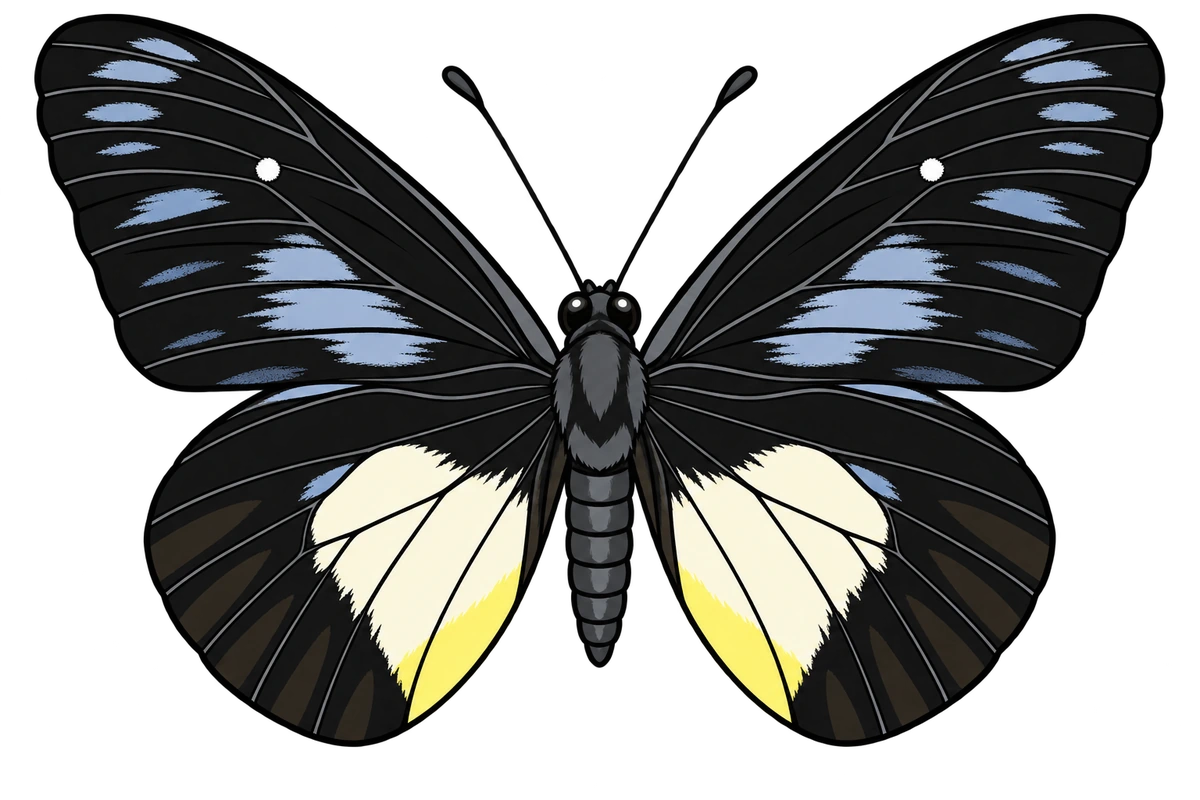
At a glance
- Range context ↘
- Java, Sumatra, Sumba and Sumbawa in the specialist account [2]
- Identification detail ↘
- Yellow hindwing underside with a red subbasal band [2]
- Biological reference ↘
- Mating photographed in Sumatra in January 2023 [2]
Identity and close relatives
How to look at the wings
The underside hindwing is described as largely yellow with a substantial red band near its base. Read that band in relation to the veins, outer border and forewing marks. The same colours placed elsewhere would produce a different pattern and cannot stand in for this arrangement. [2]
Range and living habitat
The account includes Java, Sumatra, Sumba and Sumbawa, with localized mountain forms. That list is a regional synthesis, not evidence of continuous distribution between sites. Keep a finer mountain locality when available, especially when comparing two geographically named forms. [2]
A life in four stages
The specialist page includes a mating pair photographed in Sumatra in January 2023 by Yi Kai Tea. It documents reproduction-related adult activity, but does not connect eggs and larvae to that pair. A reared developmental series would extend the evidence rather than duplicate another adult view. [2]
Leaves for larvae, food for adults
A particular crithoe host was not established in the sources checked. The photographed pair could inspire a geographically focused search, but neither mating nor proximity to a plant demonstrates larval feeding. Food records should identify the plant and the immature butterfly independently.
Behaviour in the living landscape
The mating photograph is a direct observation with a place and month. It should remain a dated encounter, not become a claim that the species breeds only in January. Repeated observations would be needed to describe seasonality or differences among its island populations.
A closer scientific story
The localized mountain forms make crithoe a useful biogeographic comparison. The question is how much variation follows island separation and how much follows local mountain populations. A series with consistent surface photography can test that relationship more effectively than isolated colourful images.
Connections in the ecosystem
The known adult pattern and mating record identify different parts of the ecological story. Plant associations, immature survival and movement remain additional evidence to collect. Keeping those topics separate allows a later account to distinguish a breeding population from a place where adults are occasionally seen.
Names and natural-history records
Geographic form names in the specialist synthesis preserve earlier taxonomic decisions. Cite a form when the source determines it, and retain the locality used for that determination. An unlocalized picture should not be assigned to one form simply because its hue appears similar.
Habitat and conservation context
This article does not assign a current global threat category. A regional study could begin by revisiting named mountains and documenting effort, adult encounters and breeding evidence. Distribution among multiple islands does not establish the condition of any particular local population.
Reading the specimen views
A closed-wing view is useful for the red-and-yellow underside; a dorsal spread provides complementary evidence. Compare the width and continuity of the red band under similar lighting. Keep paired adults' sexes and their shared observation event explicit in a mating photograph.
From biological reference to artwork
Preserve the observed subbasal band and its boundaries rather than spreading red into adjoining compartments. An illustration based on one local form should name that reference when known. A consistent pose helps comparison without pretending to represent every island population at once.
Caring for a framed specimen
Keep direct sun off the frame. Link the image to its island or mountain locality and the precise observation date. A mating photograph deserves an event record joining the two adults, rather than two unrelated catalogue entries with lost context. [3]
Questions worth asking
Which hosts support the island populations? Are mountain forms distinguishable in both sexes and immature stages? Does mating occur across a longer annual period than the January photograph records? These questions would connect visual variation with reproductive ecology.
Sources and further reading
The specialist account supplies the pattern description, geographic synthesis and attributed mating photograph. The catalogue establishes the species treatment. The single living event supports a narrow behavioural statement; it should be cited at that scale rather than inflated into a complete breeding calendar.
- Delias classification and museum-image catalogue ↗
University of Florida Lepiverse; Catalogue of Life 2026-08-26 XR · Accessed 2026-10-09
Indexed genus classification lists the named taxon at species rank; this supports catalogue status, not a resolved species boundary.
- Delias crithoe: specialist records and comparison plates ↗
Delias of the World; international Delias specialists · Accessed 2026-10-09
Localized specimen account and original photographed mating pair from Sumatra; hindwing underside comparison.
- Caring for natural history collections ↗
Canadian Conservation Institute; Fiona Graham · Accessed 2026-10-09
Preventive care of fragile biological collections; the brief enclosure-handling and environment recommendations are general collection practice. Species-label recordkeeping recommendations are editorial.
Continue exploring
Sources checked 2026-10-09. Illustrations · Luminary Oddities.
Return to the Entomological Atlas ↑