Luminary Oddities · Natural history & art
Atala
Eumaeus atala
Lepidoptera / Lycaenidae
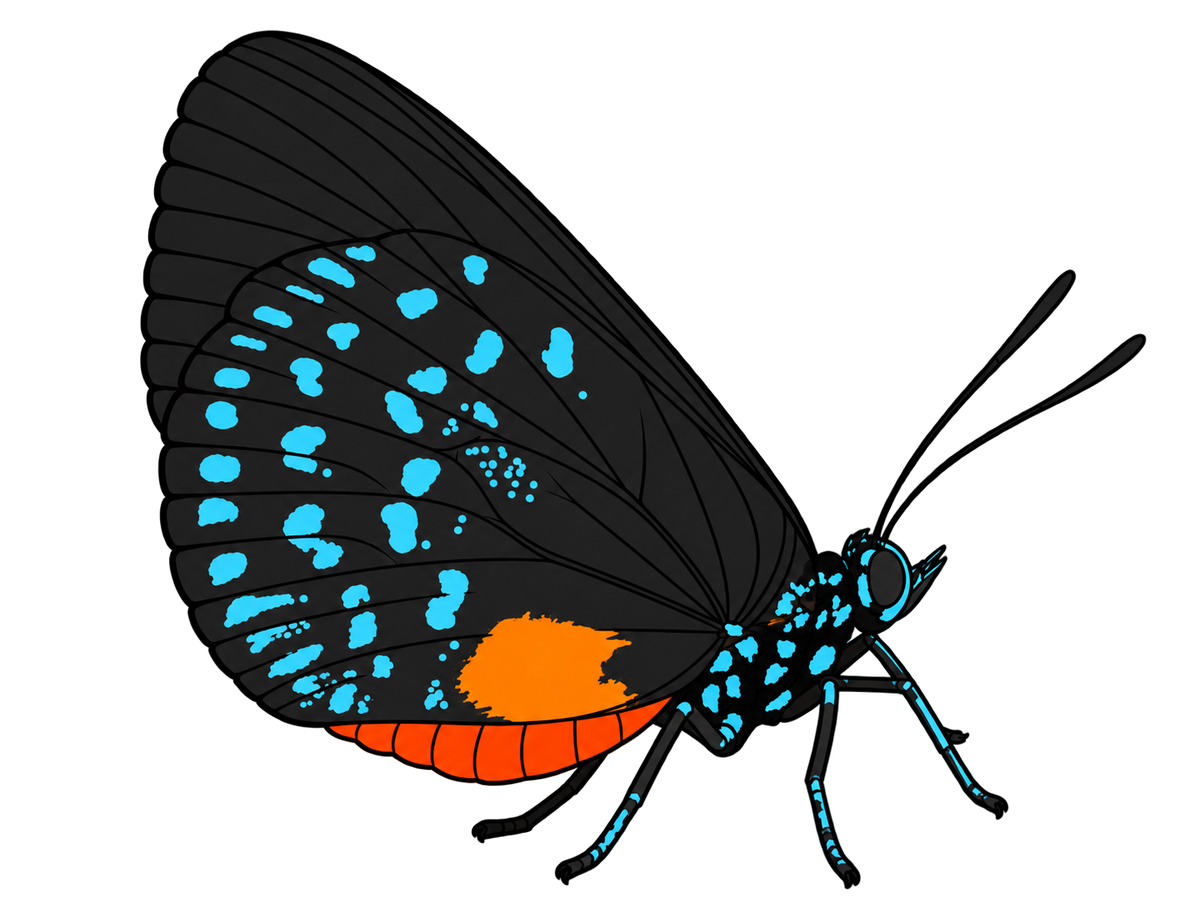
The atala combines rounded black wings, blue iridescent spots and a scarlet abdomen with a larval diet of chemically defended cycads.
Read the species account
Please wait while the next page arrives.
Please wait while the next page arrives.

 Mila'sExotic Plants & CuriositiesA living collection by Luminary Oddities
Luminary Oddities · Natural history & art
Eumaeus atala
Lepidoptera / Lycaenidae
The atala combines rounded black wings, blue iridescent spots and a scarlet abdomen with a larval diet of chemically defended cycads.
Read the species accountEumaeus atala is a hairstreak in the family Lycaenidae. Genomic analysis places Eumaeus close to Theorema and Mithras within the Neotropical hairstreak radiation. [2]
Three curved rows of blue spots cross the black wing undersides. An orange-red hindwing patch accompanies the red abdomen; blue scales also mark the head, thorax and legs. Males have more extensive blue or blue-green upperwing colour than females, whose blue is concentrated on the forewings. [1]
Southern Florida and Caribbean populations, including Cuba and the Bahamas, inhabit sites supporting cycads and nectar flowers. [1]
Females deposit clustered eggs on young cycad growth. The conspicuous red-and-yellow caterpillars feed together when young, and several generations can develop through the year in southern Florida. [1]
Florida larvae feed on coontie, Zamia integrifolia, and can use other cultivated cycads. Adults visit flowers for nectar. [1]
Males display scent-dispersing abdominal hair pencils during courtship. [1]
Cycad-feeding Eumaeus larvae sequester cycasin, retaining a plant chemical that discourages some predators. Comparative genomics links the origin of cycad feeding with the evolution of conspicuous colour and communal larval behaviour. [2]
The 2021 genomic study found accelerated changes in overlapping sets of proteins in two Eumaeus lineages. Their functions implicate cellular maintenance and repair in toxin tolerance, including removal of damaged cells. These are candidate mechanisms inferred from comparative sequences, rather than experimentally demonstrated detoxification pathways. [2]
Industrial harvesting of coontie contributed to the atala's historical decline in Florida. Its subsequent recovery has been associated with renewed availability of the host in gardens and managed landscapes. [1]
University of Florida IFAS · Accessed 2026-10-13
PNAS / Smithsonian and collaborating institutions · Accessed 2026-10-13
Sources checked 2026-10-13. Illustrations · Luminary Oddities.
Return to the Entomological Atlas ↑