

Luminary Oddities · Natural history & art
Clipper
Parthenos sylvia
Lepidoptera / Nymphalidae
A broad-winged Asian butterfly whose pale forewing windows and dark, banded design remain recognizable through blue, green and warmer regional palettes. Its varied host records and changing Singapore status reward a closer reading.
Explore this insect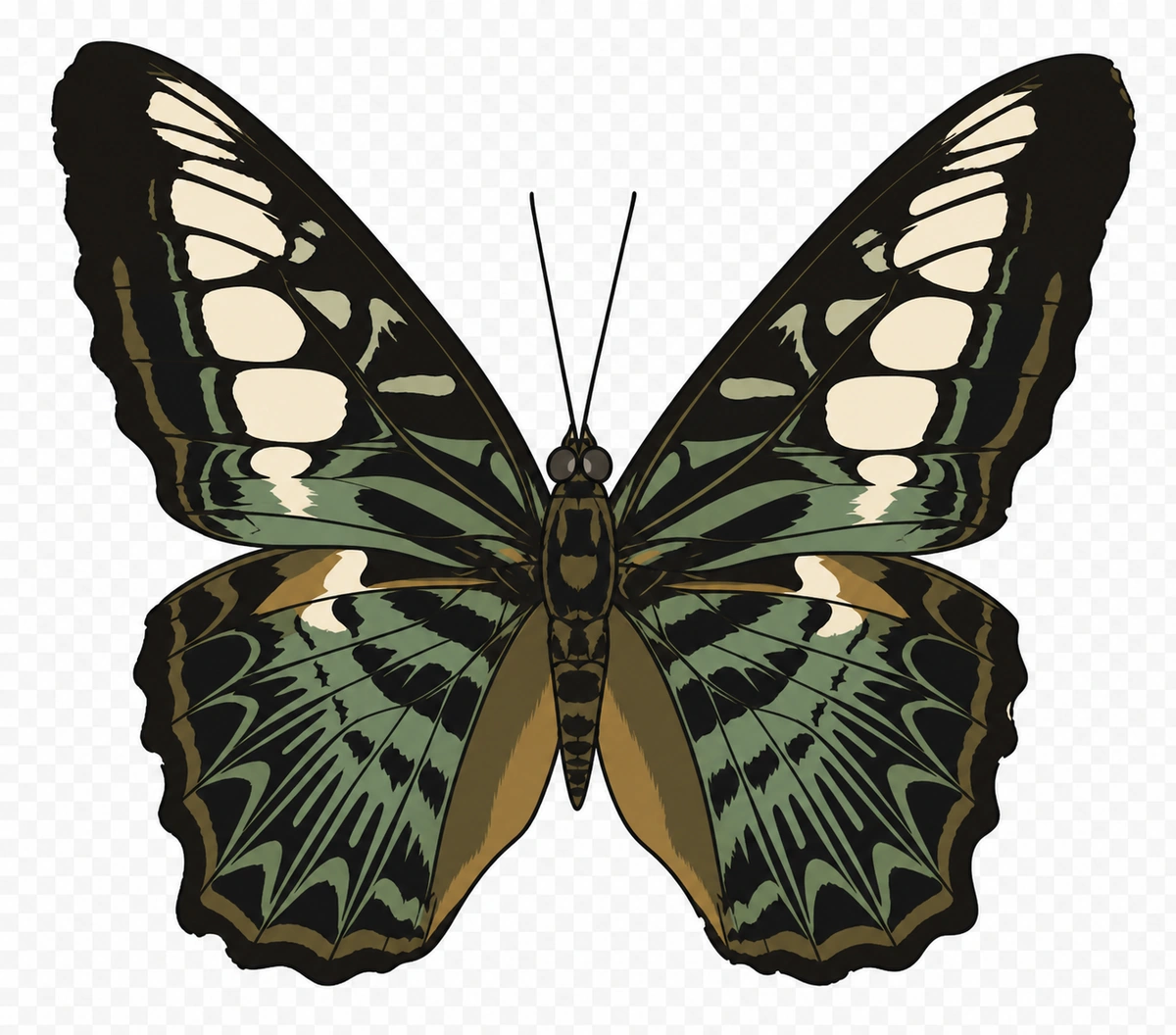
At a glance
- Appearance ↘
- Distinct pale forewing patches within a dark banded design [2]
- Larval food ↘
- Regional hosts include Zanonia, Tinospora and Adenia [3]
- Singapore status ↘
- P. sylvia lilacinus is Data Deficient in the third national Red Data Book [4]
Identity and close relatives
Parthenos sylvia is the Clipper, a nymphalid butterfly placed by the Florida Museum in Limenitidinae and Parthenini. The name covers a geographically variable subject rather than one universal blue form. Museum photographs are especially helpful because the guide labels different regional forms within the same species account. This Atlas heading keeps those comparisons together, while leaving a regional assignment to an identified specimen record. [1]
The important comparison is the complete wing design. Large pale patches near the outer forewing sit within a dark framework, with repeated lines and bands across the wings. A commercial color name alone is a poor guide to identity because several butterflies are described informally as blue, green or cruising through forest. Shape and placement provide the more stable visual connection.
How to look at the wings
In ButterflyCircle’s account of lilacinus, the upper wings combine dark ground color, blue and green stripes, and conspicuous white forewing patches. The underside repeats the broad design in a paler treatment. The author describes adults stopping with their wings open flat, a posture that exposes the recognizable arrangement. This description concerns that regional form rather than every named subspecies. [2]
The Florida Museum lists an approximate wingspan of 3.0–4.2 inches, about 7.6–10.7 centimetres, and photographs both lilacinus and a Philippine form. These images offer a comparison of different palettes without multiplying the species. For a careful inspection, begin with the pale forewing areas, then follow the dark cross-wing markings and hindwing margin. A complete view helps distinguish the pattern from a close crop of color. [1]
The Chicago Botanic Garden also notes blue, green and red color variation in its exhibit account. The range of appearances makes the Clipper rewarding to collect in art: the design can remain coherent while a color treatment changes its atmosphere. That observation does not identify the mechanism producing every color or establish which regional form appears in an image. [5]
Range and living habitat
Taxonomic literature summarized in the referenced nomenclatural catalogue records Parthenos sylvia across South and Southeast Asian regions and onward to New Guinea, with many named regional forms. These historical locality and taxonomic records add detail to the Florida Museum’s broad Southeast Asian origin statement. They should not be read as a map of uninterrupted occupancy or as a current count of populations. [6]
Singapore offers a more specific story. ButterflyCircle’s 2013 historical account describes the Clipper from earlier forest records and discusses its long absence from reliable wild observations at that time, while noting its presence in an airport butterfly aviary. The current NParks checklist assigns lilacinus Data Deficient rather than retaining the earlier national extinction category. A living exhibit, a historic record and a current assessment are distinct kinds of evidence. [2][4]
A life in four stages
Zhou and colleagues’ 2009 study in Xishuangbanna, southern Yunnan, observed females laying individual eggs and caterpillars passing through five instars. The experimental population had six generations in a year and overwintered as adults under the study conditions. This is a valuable regional developmental account. The number of generations does not supply a calendar for all Clipper populations across their large geographic range. [7]
An instar is a phase between larval moults; five instars therefore describes successive caterpillar stages, not five different larvae. In the artwork gallery, the adult pattern represents one stage of a longer story. An informative early-stage series keeps host, locality and dates alongside photographs so that the reader can connect the growing caterpillar, pupa and adult without inventing a uniform species-wide schedule.
Leaves for larvae, food for adults
The Western Ghats compilation by Nitin and colleagues records Zanonia indica, Tinospora sinensis and Adenia hondala for virens. The plants represent Cucurbitaceae, Menispermaceae and Passifloraceae respectively. Its Zanonia entry is attributed to a named observer’s 2017 record, while other associations cite earlier literature. The evidence trail is useful because a host list is more than a collection of plant names: it documents how and where the relationship became known. [3]
India’s National Bureau of Agricultural Insect Resources separately lists Tinospora cordifolia and Adenia at genus level as hosts. This corroborates the importance of vine relationships without requiring every regional list to be identical. Preserve the botanical identification supplied by each source, rather than expanding an Adenia record to every member of the genus. An adult resting on a vine is also less specific evidence than a documented feeding caterpillar. [8]
The Chicago Botanic Garden describes adults feeding at Lantana in its exhibit context. Adult liquid resources and larval leaves belong to different stages. A flower display can make the butterfly visible to visitors, while its breeding requirements must be understood through the relevant host records. [5]
Behaviour in the living landscape
ButterflyCircle describes strong flight and rapid gliding between perches, followed by open-wing pauses. Zhou’s Yunnan study records adult feeding at rotting fruit and wounds on tree trunks. Together these accounts show a mobile butterfly using more than one kind of adult feeding resource; they do not prove identical behavior at every site. [2][7]
When observing a Clipper, note the interval between flight and perching, the surface of a feeding site and the view of the wings. This is more informative than treating a still image as a flight study. A photograph of an adult on fruit demonstrates that visit; a broader claim about preference needs repeated observations and a comparison of available resources.
A closer scientific story
The Clipper’s color variation is most revealing when equivalent wing surfaces are placed beside one another. The museum’s regional photographs make that comparison possible: pale forewing areas and the dark framework remain useful landmarks while the surrounding colors differ. The scientific interest lies in maintaining identity through variation, rather than naming every palette as a separate species. A drawing can emphasize one set of colors, but its species association should rest on the combined pattern.
Connections in the ecosystem
The documented Western Ghats hosts connect the larva with climbing plants from more than one botanical family. The Yunnan study adds a locally documented Passiflora siamica association. This is a regional host network, not evidence that the caterpillars feed indiscriminately on all vines. Adult fruit or flower feeding answers a separate ecological question. Keeping the two stages distinct helps explain why the resources required to sustain a butterfly can extend beyond the flower where an observer first notices it. [3][7]
Names and natural-history records
The nomenclatural catalogue traces sylvia to Cramer’s Papilio description and preserves historical combinations involving Minetra and Kallima. Names and dates in old literature can differ from a modern field-guide heading, particularly when authors apply different combinations or regional treatments. Searching the current Parthenos name together with its older combinations helps reconnect those records. Historical literature supplies a research trail, not a reason to create several modern Atlas pages for the same Clipper subject. [6]
Habitat and conservation context
NParks currently lists Parthenos sylvia lilacinus as native and Data Deficient in Singapore’s third Red Data Book; its second-edition column records national extinction. The updated category indicates a different current assessment, not a guarantee of a secure population. It is a national category for that regional taxon rather than a global IUCN designation. The contrast with older accounts illustrates why conservation wording needs the place, edition and date beside it. [4]
Reading the specimen views
Dorsal views show the upper wings; ventral views show their undersides. For the Clipper, compare the pale forewing windows and the repeated bands on the same surface before interpreting a color difference. Keep the outline visible around any enlarged detail. A dorsal work emphasizes the broad patterned planes, while an oblique composition can change the apparent size of a pale patch through perspective. Neither a digital crop nor a rotated flight composition measures the living butterfly’s wingspan.
From specimen to artwork
Scott Schubr’s Luminary Oddities artwork interprets the Clipper through a deliberate combination of line and color. The species association rests on the whole wing arrangement, while the artwork’s palette and visual rhythm belong to the composition. A more blue or more green edition may invite a different response without creating another biological subject. Institutional photographs remain useful companions for readers who want to compare natural pattern placement with the artist’s treatment.
Caring for the display
Physical insect displays need preventive attention to light, moisture, pests and handling. Inspect the enclosure and handle it rather than touching the wings. [9]
Care for a print or digital edition according to its medium and maker’s instructions. A complete silhouette alongside a closer view of the pale forewing patches gives the display a natural point of visual comparison. Retain the scientific heading and edition information together.
Questions worth asking
Is a Blue Clipper a different species from a green Clipper? A color description does not by itself establish a separate taxon; compare the complete design and regional record. Do fruit-feeding adults imply fruit-feeding caterpillars? Adult and larval food relationships are different. Does the Singapore assessment apply throughout Asia? It is a national assessment of lilacinus. Why do old accounts use other genus names? Taxonomic combinations change, and historical names help trace the same subject through earlier literature.
Sources and further reading
The museum photographs and regional observer account support appearance and behavior. Host compilations preserve botanical names and evidence attribution. The Yunnan study is used at the level of its accessible original abstract. NParks supplies the current national assessment, which remains separate from historical observations and global conservation claims.
- Clipper — Butterfly Rainforest guide ↗
Florida Museum of Natural History · Accessed 2026-10-09
Family, regional photographs and approximate exhibit wingspan.
- Down Memory Lane — Clipper ↗
ButterflyCircle, 2013 · Accessed 2026-10-09
Original regional account of lilacinus appearance and behavior, historical Singapore records and exhibit context.
- Larval host plants of the butterflies of the Western Ghats ↗
Nitin et al., Journal of Threatened Taxa, 2018 · Accessed 2026-10-09
Regional virens host relationships with evidence attribution; indexed relevant entry checked.
- Singapore butterfly species list ↗
NParks Singapore · Accessed 2026-10-09
RDB2/RDB3 national assessment for Parthenos sylvia lilacinus.
- Clipper ↗
Chicago Botanic Garden · Accessed 2026-10-09
Exhibit account of color variation and adult Lantana feeding.
- Parthenos nomenclatural catalogue ↗
Markku Savela / Finnish University and Research Network · Accessed 2026-10-09
Original combinations, historical literature and regional treatments, with cited taxonomic references.
- Morphological Records and Biology of Parthenos sylvia, Vindula erota and Acraea violae ↗
Zhou et al., 2009 · Accessed 2026-10-09
Original abstract inspected: Xishuangbanna egg laying, instars, experimental generations, adult feeding and Passiflora siamica association.
- Parthenos sylvia ↗
ICAR National Bureau of Agricultural Insect Resources · Accessed 2026-10-09
Institutional taxonomic and Tinospora/Adenia host record.
- Caring for natural history collections ↗
Canadian Conservation Institute · Accessed 2026-10-09
General preventive care for physical natural-history collections.
Continue exploring
Sources checked 2026-10-09. Illustrations · Luminary Oddities.
Return to the Entomological Atlas ↑