

Luminary Oddities · Natural history & art
Malachite
Siproeta stelenes
Lepidoptera / Nymphalidae
A Neotropical brushfoot with luminous green windows in dark wings. Its color has an unusual physical basis: researchers found green liquid held inside parts of the wing membrane.
Explore this insect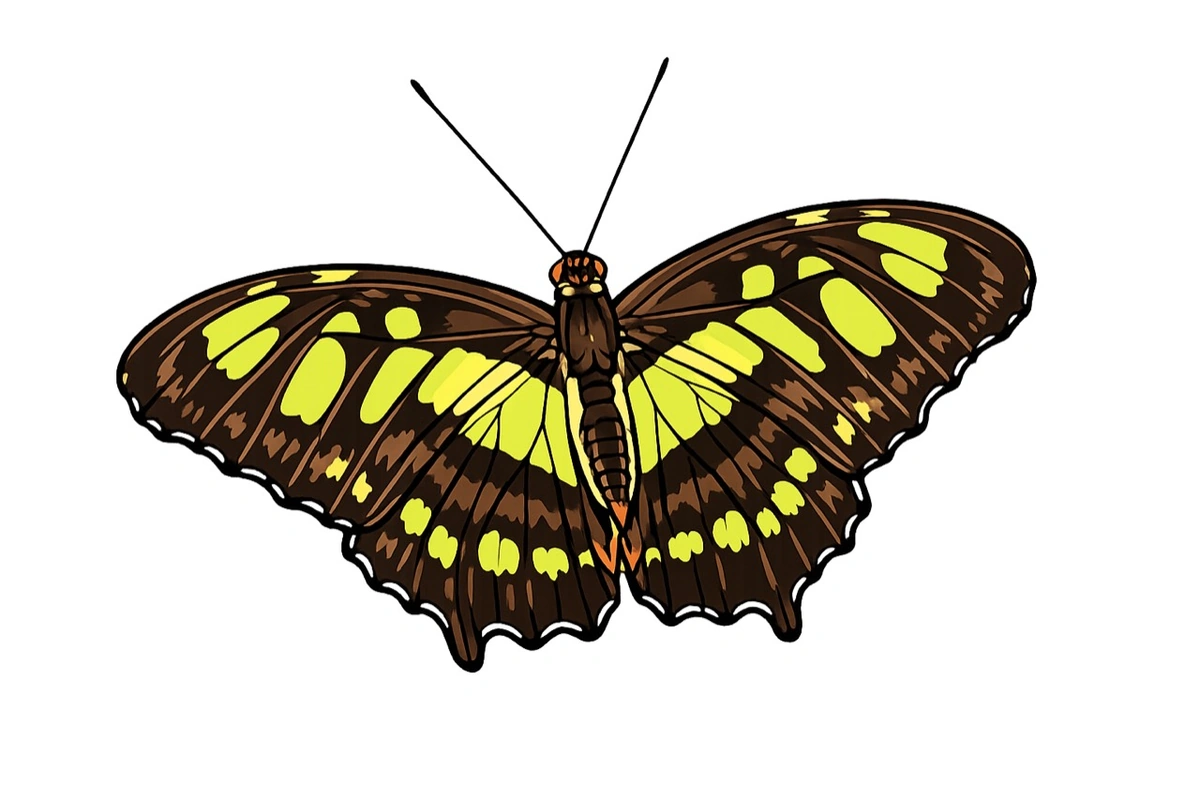
At a glance
- Wingspan ↘
- Approximately 8.3–10.1 centimetres in the North American account [2]
- Larval hosts ↘
- Documented plants belong to Acanthaceae [5][6]
- Color mechanism ↘
- A 2023 experiment traced green to liquid retained within the wing membrane [7]
Identity and close relatives
Siproeta stelenes is the Malachite butterfly, placed by the Florida Museum in Nymphalinae and the tribe Victorinini. Its common name refers to the striking green appearance, while the scientific heading makes comparison with other green butterflies unambiguous. The Florida guide includes an adult and a chrysalis photograph, placing the familiar wings alongside a less familiar stage of the same animal. [1]
Green areas occur in very different butterfly groups, so green alone is not a diagnosis. For this subject, the visual comparison combines the wide wing outline, the large pale-green areas surrounded by dark ground color and the placement of markings across both pairs of wings. A taxonomic label should follow that complete comparison. The Atlas keeps artistic palettes together under the subject rather than naming additional species from a change in shade.
How to look at the wings
The North American identification account describes dark upper wings with translucent pale-green to yellow-green patches. Below, orange-brown and green areas create a different arrangement of contrast. It also describes seasonal forms in its regional account, including differences in dark marks within the marginal band. Its wingspan range is 8.3–10.1 centimetres. Those details help compare real wing surfaces, but they do not measure a butterfly from a digital picture or establish a universal seasonal pattern across the whole tropical range. [2]
The light-looking patches are especially useful visual landmarks. Compare their boundaries against the dark framework and keep the complete hindwing visible. An enlarged crop can make green and blue tones seem more dominant than they do in the whole composition. Begin with patch placement, continue to the wing contour and only then compare color. This order preserves the connection between a natural pattern and an artistic interpretation.
Range and living habitat
The Chicago Botanic Garden describes a native range extending from Brazil through Central America and Mexico, through the West Indies and into southern Florida and South Texas. NatureServe identifies orchard, riparian and subtropical deciduous-forest habitats. These regional descriptions show a butterfly using wooded settings that can include cultivated landscapes; they do not imply that every orchard sustains a breeding population. [3][4]
At the northern edge, an occurrence can be a traveller. The original New Mexico field guide records the first substantiated state occurrence in 2002 at Rattlesnake Springs in Carlsbad Caverns National Park and places such observations within a broader history of rare southwestern strays. A dated observation extends the occurrence record. Establishing residence would require additional evidence such as repeated local breeding and early stages. [9]
A life in four stages
Berry Nall’s 2017 original rearing account follows offspring of a captured female through caterpillar, pupa and adult. The female laid eggs on two plants provided in a greenhouse. Photographs document a late caterpillar on November 7, 2016, a pupa on November 9 and an adult on November 18. Nall describes head horns becoming visible in the second instar and additional projections in the next. This small captive record is a useful illustrated sequence, rather than a species-wide timetable. [5]
An early-stage series adds information that an adult portrait cannot. Keep the plant identification, dates and observation conditions beside each stage. A pupa photographed in a rearing sequence and a chrysalis in a museum guide answer different questions: the sequence documents an individual progression, while the guide makes the appearance available for comparison. Neither should silently become a claim about the duration of every Malachite generation.
Leaves for larvae, food for adults
In Nall’s account, the plants offered were Green Shrimp Plant, identified as Ruellia blechum, and Runyon’s Violet Wild Petunia, Ruellia nudiflora. The female laid on both, and the author reports successful development from the collected eggs. The record links named plants, observed eggs and subsequent early stages, a stronger association than an adult simply resting on foliage. [5]
The University of Nevada, Reno caterpillar project preserves a Costa Rican record from La Selva involving Bravaisia in Acanthaceae. The entry identifies a local record and a voucher rather than reporting a universal host list. Different recorded acanthaceous plants can therefore be compared without assuming that every member of the family will support the larvae. [6]
The Chicago Botanic Garden describes adults taking rotten fruit, bird droppings and flower nectar. Adult liquid feeding and larval leaf feeding are separate relationships. A garden designed to attract visiting adults addresses one part of the life history; its value for breeding depends on appropriate local larval food plants and verified use. [4]
Behaviour in the living landscape
The North American account describes males perching or patrolling at forest and orchard openings, and adults roosting together under leaves of low shrubs. A slow, floating flight can make the broad patterned wings visible between feeding or resting visits. Such regional observations restore movement and posture to a still portrait without deciding what every population does at every site. [2]
For an observation record, distinguish a feeding visit, a patrol, a resting posture and a roost. Note whether one butterfly or several are present and whether the wings are open or closed. These simple details make a photograph more useful to a later reader. A beautiful pause can represent one moment without demonstrating an entire daily activity pattern.
A closer scientific story
Nishida and colleagues’ 2023 Cell Reports experiment found a distinctive basis for the green in Siproeta stelenes and the distantly related Philaethria diatonica. In green areas, the upper and lower wing membranes enclose a narrow space containing liquid and living cells. The researchers traced components of the green pigment to hemolymph, including bilin and carotenoids. The mechanism differs from the familiar explanation that all butterfly color lies in solid pigments or optical structures in scales. [7]
This result makes the apparent green windows worth a second look, while keeping the experiment within its limits. It concerns the species studied and the anatomical areas examined. It does not mean that every green butterfly uses the same mechanism, that every color in the wing is liquid-based or that a print reproduces the natural optical system. The artist can evoke luminosity through color and contrast without reconstructing the wing’s living anatomy.
Connections in the ecosystem
The Costa Rican caterpillar record and the rearing account connect Malachite early stages with particular acanthaceous plants. Adult feeding observations add fruit, flowers and other liquid resources to the ecological picture. These relationships are complementary rather than interchangeable. A local survey that records both larvae and adults can distinguish an attractive feeding site from the vegetation actually supporting development. [4][5][6]
The unusually detailed wing-color experiment also demonstrates why visual resemblance is an incomplete ecological explanation. Two butterflies can look green while arriving at that appearance through different physical mechanisms. Pattern, feeding, habitat and anatomy are useful lines of inquiry, each with its own evidence. None alone supplies the entire life history.
Names and natural-history records
NatureServe credits stelenes to Linnaeus, 1758. Historical literature may place the name in Papilio, whereas the modern heading here uses Siproeta. The original combination is a search aid for older records. The name Malachite remains a familiar guide to its appearance, but it is the binomial that connects the scientific experiment, regional field observations and the museum account to the same butterfly. [3]
Habitat and conservation context
NatureServe reports the global rank G5, describing a taxon considered secure overall while acknowledging possible rarity near its range edge. This is a ranking system distinct from IUCN categories and does not guarantee security at every locality. The New Mexico account illustrates the separate question of regional presence: a rare visitor need not imply a threatened resident population. [3][9]
For local conservation decisions, keep the geographical question precise. Repeated records of appropriate hosts and developing larvae are more informative about breeding habitat than a single adult sighting. Changes in a place can matter even when a broad global ranking is reassuring. The Atlas uses a documented rank as context and leaves population trends to evidence collected at the relevant scale.
Reading the specimen views
Use a complete dorsal view to inspect the large pale-green areas and the dark wing framework. A ventral view adds the orange-brown underside, so it should be compared with another underside before judging differences in color. The words dorsal and ventral refer to surfaces, not separate species. Perspective can foreshorten a wing in flight; an isolated spread view makes the arrangement easier to read but supplies no measured wingspan.
From specimen to artwork
Scott Schubr’s Luminary Oddities artwork interprets the Malachite’s broad planes and luminous pattern through line, color and composition. The biological subject rests on the combined wing design. Edition names and color choices describe the artwork’s treatment, while the species heading provides a consistent point of reference. The liquid-color research enriches the natural-history story without turning an artistic green into a laboratory observation.
Caring for the display
Physical insect displays benefit from preventive attention to light, moisture, pests and handling. Inspect the enclosure and hold the enclosure rather than the wings. [10]
For a print or digital edition, follow instructions appropriate to its medium. Keep the scientific label and edition information with the work. A full silhouette beside a closer view of the pale patches creates a useful comparison without losing the place of the detail within the whole butterfly.
Questions worth asking
Does the green name alone identify the butterfly? Compare the entire pattern and wing outline. Is a leaf underneath a resting adult necessarily its larval food plant? A host relationship requires better evidence. Does the liquid-pigment experiment apply to every green butterfly? It studied two named species. Is a southwestern sighting proof of residence? An occurrence record and a documented breeding population answer different questions. These distinctions keep the gallery connected to evidence without reducing the visual pleasure of the subject.
Sources and further reading
Museum and institutional exhibit accounts establish comparable appearance and adult resources. Original regional observations document northern occurrences and an early-stage sequence. The university caterpillar database preserves a local voucher record. The Cell Reports paper supplies the distinctive experimental color mechanism; its bibliographic correction is linked for completeness. Conservation rank language retains the system and geographical limits of the source.
- Malachite — Butterfly Rainforest guide ↗
Florida Museum of Natural History · Accessed 2026-10-09
Taxonomic placement, adult and chrysalis photographs.
- Malachite: Siproeta stelenes ↗
Butterflies and Moths of North America · Accessed 2026-10-09
Regional identification, behavior, authorship and G5 rank; the rank is not an IUCN category.
- Siproeta stelenes species record ↗
NatureServe Explorer · Accessed 2026-10-09
Primary indexed NatureServe classification, synonyms, habitat and G5 global status checked; site requires JavaScript for the full record.
- Malachite ↗
Chicago Botanic Garden · Accessed 2026-10-09
Native-range and adult-feeding account.
- Life history of Siproeta stelenes biplagiata ↗
Berry Nall, Southern Lepidopterists’ News 42(1), 2017 · Accessed 2026-10-09
Original small captive rearing account, named plants and dated early-stage photographs.
- Siproeta stelenes biplagiata caterpillar record ↗
University of Nevada, Reno caterpillar project · Accessed 2026-10-09
La Selva, Costa Rica record, Bravaisia host and voucher; narrow local scope.
- Liquid-based color in the wings of butterflies ↗
Nishida et al., Cell Reports 42(8), 112917, 2023 · Accessed 2026-10-09
Original abstract checked; experimental liquid pigment mechanism in Siproeta stelenes and Philaethria diatonica.
- Correction: Liquid-based color in the wings of butterflies ↗
Cell Reports, 2023 · Accessed 2026-10-09
Bibliographic correction record; linked to keep the publication trail complete.
- Butterflies of New Mexico: True Brushfoots ↗
Steve Cary / Pajarito Environmental Education Center · Accessed 2026-10-09
Original regional field guide; rare-stray context and 2002 New Mexico occurrence.
- Caring for natural history collections ↗
Canadian Conservation Institute · Accessed 2026-10-09
General preventive care for physical natural-history collections.
Continue exploring
Sources checked 2026-10-09. Illustrations · Luminary Oddities.
Return to the Entomological Atlas ↑