
Luminary Oddities · Natural history & art
Common Nawab — the athamas group
Polyura athamas
Lepidoptera / Nymphalidae
A green-banded nawab whose familiar collection label opens a fascinating taxonomic story: genus placement and species boundaries are two different questions.
Explore this insect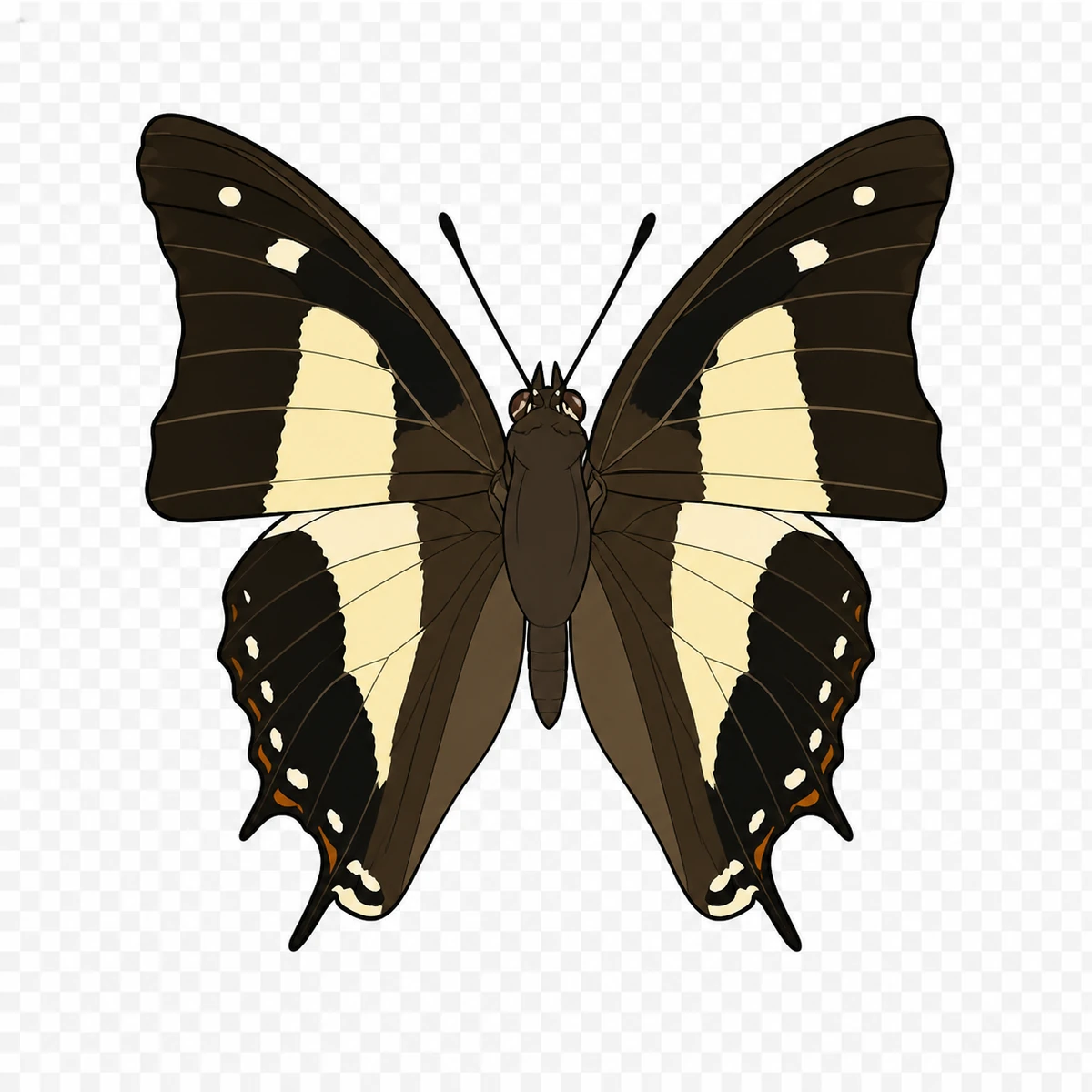
At a glance
- Identity scope ↘
- Historical athamas-group collection label [1]
- Regional setting ↘
- Low- and middle-elevation forest in the Southeast Asian checklist [4]
- Name distinction ↘
- A genus change and a species split are different events [1][2]
Identity and close relatives
The collection name Polyura athamas identifies the subject of this guide, a green-banded nawab in Nymphalidae. Some authorities use Charaxes athamas under a different generic treatment. Modern revisions also separate closely similar butterflies that older accounts grouped under athamas. Those are two different questions: choosing a genus is not the same as determining which species in the group an individual represents. This account keeps the original collection heading visible without pretending that a modern group-wide identification has been made for every artwork specimen. [1][2]
How to look at the wings
Dark upper wings with pale green discal banding give the nawab its strong graphic presence. The molecular revision describes a green species complex whose members can be morphologically cryptic, sharing a similar broad appearance. That makes a dark-and-green photograph an incomplete identification test. A complete comparison should include both surfaces, wing shape, relevant diagnostic characters and locality documentation. An artistic treatment can celebrate the band beautifully while leaving the precise taxonomic evidence with the original specimen records. [1]
Range and living habitat
The Southeast Asian checklist retains Polyura athamas athamas across mainland Southeast Asian and southern Chinese settings, including western Malaysia. It also warns that some historical Indochina records may concern paulettae. The geographic list is therefore part of that checklist’s treatment, not a license to copy every older athamas locality into a single present-day range. The individual art specimen has no established locality in the supplied record, so the guide does not use a regional account to invent one. [4]
A life in four stages
Like other butterflies, this species develops through an egg, a feeding caterpillar, a pupa and a winged adult. The pupa is a living developmental stage, not a resting adult wrapped in a case. A framed butterfly represents the adult stage. Its wing pattern cannot stand in for a photograph of the caterpillar or establish how long the individual spent developing. Local studies are most informative when their climate, host plant and observation conditions accompany the measurements. [7]
The four-stage butterfly cycle gives a sound framework for reading egg, caterpillar, pupa and adult records. For the athamas group, however, a full species-specific early-stage account must identify which post-revision taxon was observed. A historical caterpillar record under a broad athamas name is an informative natural-history record, but it cannot be reassigned merely because a modern adult resembles the illustrated butterfly. This guide describes the developmental framework and the scope of those records without supplying an unsupported universal timetable.
Leaves for larvae, food for adults
Historical Hong Kong material lists hosts under the name Polyura athamas, including Albizia, Leucaena and Abarema. These records were made under older usage and retain that context. They are not presented here as a verified post-revision host menu for modern athamas. The botanical associations remain useful in tracing the research history, provided the reader can see that the plant record and the insect identity must be evaluated together. [5]
Behaviour in the living landscape
The regional Southeast Asian checklist associates the named taxon with low- and middle-elevation forest and describes territorial males. Such an observation gives a living woodland context to a green-banded specimen. It remains attached to the taxonomic treatment and region of the source. An artwork’s spread-wing pose cannot establish a territory, flight height or feeding event, and a behaviour reported for another green nawab is not automatically a species-specific athamas finding. [4]
A closer scientific story
The 2016 phylogenetic study followed earlier work that had revealed cryptic diversity within Polyura. Its denser sampling proposed further taxonomic changes, including restoring attalus to species rank. The broader research history also includes the recognition of bharata and paulettae as distinct from the older wide athamas grouping. A familiar drawer label can therefore conceal diversity later brought into focus by comparative morphology and molecular evidence. This is why the name history is central to the natural-history account. [1]
Connections in the ecosystem
For this group, ecological interpretation begins with an accurate boundary around the biological subject. If two similar-looking taxa were historically combined, copying their hosts and localities into one profile can create an animal with a mixture of ecological properties. The useful reading strategy is to keep the source’s named taxon, date and region beside its observation. That preserves what the record genuinely contributes while leaving a modern reassignment to evidence that actually tests it.
Names and natural-history records
The checklist traces Papilio athamas as a historical combination, while contemporary resources may choose Polyura or Charaxes for generic placement. Butterflies of India uses Charaxes bharata for the Indian Nawab, demonstrating why older Indian athamas accounts need re-evaluation. Bharata is not simply an alternate spelling or genus combination of athamas. Searchable historic names help readers find the records, but the page does not merge separately recognised species into an undifferentiated synonym list. [1][2][3][4]
Habitat and conservation context
A regional legal list or threat category is only meaningful if it refers to the same taxon and geographic scope as the object being discussed. The taxonomic revisions make that especially important for these green nawabs. This guide does not assign Indian bharata protection wording to an undocumented athamas-labeled specimen, or convert historical host records into a sourcing statement. The supported conservation context is the woodland setting of the regional account and the need to preserve accurate identification evidence.
Reading the specimen views
For a modern comparison, retain an uncropped dorsal image, an uncropped ventral image and any original specimen-label record. A locality can narrow the taxonomic question, while the full insect permits characters to be compared with a revision. Those records are more informative than a decorative title alone. When the evidence stops at a supplied broad collection name, the gallery can still show the artwork honestly without assigning a newly recognised species from a guess.
Dorsal means the upper surfaces of the wings; ventral means their undersides. Start with the whole silhouette, then follow the boundary between the forewing and hindwing and inspect the inner and outer margins. A closely cropped detail is most useful beside a complete view, where its position is clear. Comparing equivalent surfaces prevents an underside pattern from being mistaken for a color variant of the upper wing. A digital enlargement is a way to examine the artwork; it does not supply a microscopic scale or a measurement of the original insect.
From specimen photograph to artwork
The Common Nawab artworks retain their supplied Polyura athamas association and sit within a group-aware guide. Their dark setting and pale green banding are part of the composition. Royal, midnight or celestial language describes the artwork’s atmosphere; it does not authenticate a post-revision species identity or establish a historical cultural tradition for the insect. A future supported identification can refine the association while preserving the artwork names and original catalogue trail.
Luminary Oddities’ artwork begins with photography of a living or formerly living specimen, as documented by the artists. The resulting digital treatment can emphasize color, symmetry, movement or atmosphere while retaining that photographic starting point. Read each gallery caption for the named work and the view being presented. An artwork title describes an edition or composition; it is not an additional biological species. The natural-history account identifies the taxon represented, while the art invites a more personal response to its shape and pattern.
Caring for a framed specimen
Display a framed insect in an interior location away from direct daylight, dampness and frequent temperature or humidity changes. Handle the enclosure rather than the specimen, and inspect it periodically for loose parts, pest activity or moisture. Preventive conservation guidance treats physical damage, pests and light as important risks for organic natural-history collections. A glazed frame reduces handling and dust exposure but does not make delicate material immune to deterioration. Follow the maker’s instructions for the enclosure; concerns inside it are best addressed without touching the wings. [6]
Questions worth asking
Are Charaxes athamas and Polyura athamas always two species? They can be generic combinations for the same named taxon. Is Charaxes bharata just another combination of athamas? No: the cited revision and Indian resource distinguish it as a separate species. Why avoid a long definitive host list? Historical athamas usage can include more than one modern taxon, so the identity scope of each plant record must be checked. [1][2][3][4][5]
Sources and further reading
The linked sources combine taxonomic records, natural-history observations and scientific studies. Regional results are identified in the text because a single population does not describe every butterfly carrying the same name. Historical collection records document those museum objects, and are not provenance records for the artwork’s photographed specimen. Scientific source images are linked for study; their citation does not transfer image rights to this gallery.
- New insights into the systematics of Polyura, with emphasis on the P. athamas group ↗
Toussaint and colleagues, Journal of the Lepidopterists’ Society, 2016 · Accessed 2026-10-09
Exact URL retained. Cryptic green-group diversity, bharata separation and attalus elevation.
- Current Indian butterfly species list ↗
Butterflies of India / Indian Foundation for Butterflies · Accessed 2026-10-04
Exact URL retained. Indian Nawab treated as Charaxes bharata; generic placement and species splitting are separate questions.
- Charaxes bharata species account ↗
Butterflies of India / Indian Foundation for Butterflies · Accessed 2026-10-04
Exact URL retained. Indian material formerly called athamas cannot automatically establish modern athamas biology.
- Polyura athamas athamas regional checklist ↗
Yutaka Inayoshi, Butterflies of Indochina · Accessed 2026-10-09
Exact URL retained. Retains Polyura athamas athamas; warns old Indochina records may include paulettae; low/mid-elevation forest and male territorial behavior.
- Project profile: Table 3.1e, food plants of butterfly species of conservation interests ↗
Environmental Protection Department, Hong Kong · Accessed 2026-10-04
Historical Polyura athamas record lists Abarema clypearia, Albizia lebbek [as printed] and Leucaena leucocephala. Do not transfer uncritically after species splitting.
- Caring for natural history collections ↗
Canadian Conservation Institute · Accessed 2026-10-09
Preventive care of organic natural-history specimens; not a guarantee about a particular frame.
- About Butterflies ↗
Smithsonian Gardens · Accessed 2026-10-09
Butterfly development, caterpillars, pupae and adult mouthparts; general butterfly context.
Artworks in the collection
Explore the framed works and digital art connected with this insect. Etsy shows current availability, options and prices.
- Midnight Black ↗Framed work
- Midnight Silver ↗Framed work
Continue exploring
Sources checked 2026-10-09. Artwork © Scott Schubr / Luminary Oddities.
Return to the Entomological Atlas ↑