
Luminary Oddities · Natural history & art
Prioneris hypsipyle
Prioneris hypsipyle
Lepidoptera / Pieridae
A Sumatran sawtooth whose original description and surviving museum labels reveal a continuing question about its rank relative to Prioneris autothisbe.
Explore this insect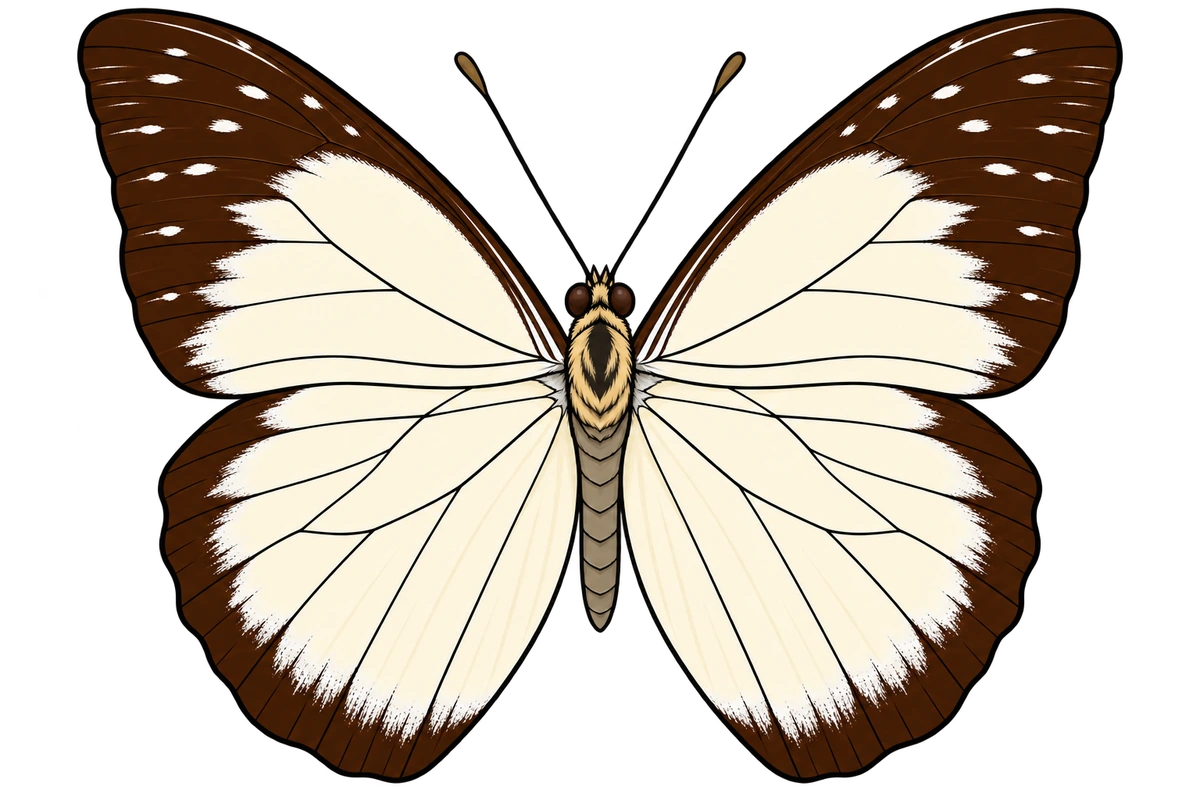
At a glance
- Range context ↘
- Sumatran taxon [2]
- Identification detail ↘
- Original description compared autothisbe [2]
- Biological reference ↘
- MCZ retains autothisbe hypsipyle [3]
Identity and close relatives
This guide uses Prioneris hypsipyle at the species rank listed in the current catalogue. Harvard's specimen MCZ:Ent:128749 instead uses Prioneris autothisbe hypsipyle. These are alternative ranks for the named taxon, not two additional butterflies to count independently. The disagreement belongs in the identification record. [1][3]
How to look at the wings
Weymer's original description compared hypsipyle closely with autothisbe and emphasized underside differences. His series suggested consistent distinctions, while he also entertained a Sumatran local form. Modern comparison should test those proposed characters rather than assume that an artistic difference in darkness settles the question. [2]
Range and living habitat
A life in four stages
The checked references chiefly concern adults and nomenclature. A reliable account of development would require immature stages connected to a determined Sumatran adult. Such evidence could be especially informative here: it would allow comparison with autothisbe beyond the adult wing pattern.
Leaves for larvae, food for adults
A food-plant claim needs to belong to the same taxonomic concept. A record published for autothisbe cannot automatically be assigned to hypsipyle without inspecting its locality and determination. Direct feeding and successful development would be the clearest evidence for a Sumatran host association.
Behaviour in the living landscape
The museum record documents a preserved insect rather than living activity. Flight, courtship and seasonal emergence remain separate topics for field observation. Recording those observations with photographs of both surfaces would help prevent this rank question from contaminating a future behavioural data set.
A closer scientific story
The original description itself recognized the difficulty of separating geographic variation from a species. That is the strongest scientific story attached to the name. A modern revision could compare type-linked morphology, geographic series and genetic evidence, explaining any disagreements among those approaches. [2]
Connections in the ecosystem
Ecological comparison with autothisbe becomes meaningful only after the populations being compared are identified. Differences in food plants or emergence timing could support further investigation, but they would not by themselves establish species rank. The evidence should keep biological differences separate from nomenclatural decisions.
Names and natural-history records
Habitat and conservation context
The rank conflict should remain visible in conservation searches, because records may appear under either combination. An assessment needs to state whether it includes only Sumatra or a broader autothisbe concept. This account does not convert taxonomic uncertainty into a threat category.
Reading the specimen views
Compare the same sex and the same wing surface with autothisbe, retaining the full Sumatran label. The historical diagnosis gives hypotheses to inspect in a series. One attractive specimen cannot show whether a proposed difference is stable throughout a population.
From biological reference to artwork
Use an identified Sumatran reference and record the combination on its label. A faithful rendering should retain small pale marks and border widths rather than exaggerate them for drama. The illustration can show a taxon clearly while its accompanying text explains the unresolved rank.
Caring for a framed specimen
Retain both the current display name and the original label text. Protect the frame from damp conditions and physical knocks. If the determination changes, add the revision date and supporting publication so that earlier records remain intelligible. [4]
Questions worth asking
Which revision explains the catalogue's species rank? Do localized male and female series consistently differ from autothisbe? Are genetic samples linked to accessible vouchers? Those answers would distinguish a justified species boundary from the continued use of two historical naming traditions.
Sources and further reading
The catalogue, Weymer's description and Harvard's specimen record answer different questions: present classification, original reasoning and surviving collection usage. Read them together. The source set makes the disagreement explicit but does not substitute for a modern revision of the two taxa.
- Prioneris classification and museum-image catalogue ↗
University of Florida Lepiverse; Catalogue of Life 2026-08-26 XR · Accessed 2026-10-09
Indexed genus classification lists the named taxon at species rank; current classification basis.
- Weymer's original Prioneris hypsipyle description (1887) ↗
Stettiner Entomologische Zeitung; digitized historical primary paper · Accessed 2026-10-09
Indexed original description compares hypsipyle with autothisbe and raises the local-form possibility.
- MCZ:Ent:128749 ↗
Harvard Museum of Comparative Zoology · Accessed 2026-10-09
Primary preserved specimen record uses Prioneris autothisbe hypsipyle; source label records Sumatra.
- Caring for natural history collections ↗
Canadian Conservation Institute; Fiona Graham · Accessed 2026-10-09
Preventive care of fragile biological collections; the brief enclosure-handling and environment recommendations are general collection practice. Species-label recordkeeping recommendations are editorial.
Continue exploring
Sources checked 2026-10-09. Illustrations · Luminary Oddities.
Return to the Entomological Atlas ↑