

Luminary Oddities · Natural history & art
Prioneris autothisbe
Prioneris autothisbe
Lepidoptera / Pieridae
A Javan sawtooth whose dark females and close relationship with the Sumatran hypsipyle make sex, locality and wing surface central to its identification.
Explore this insect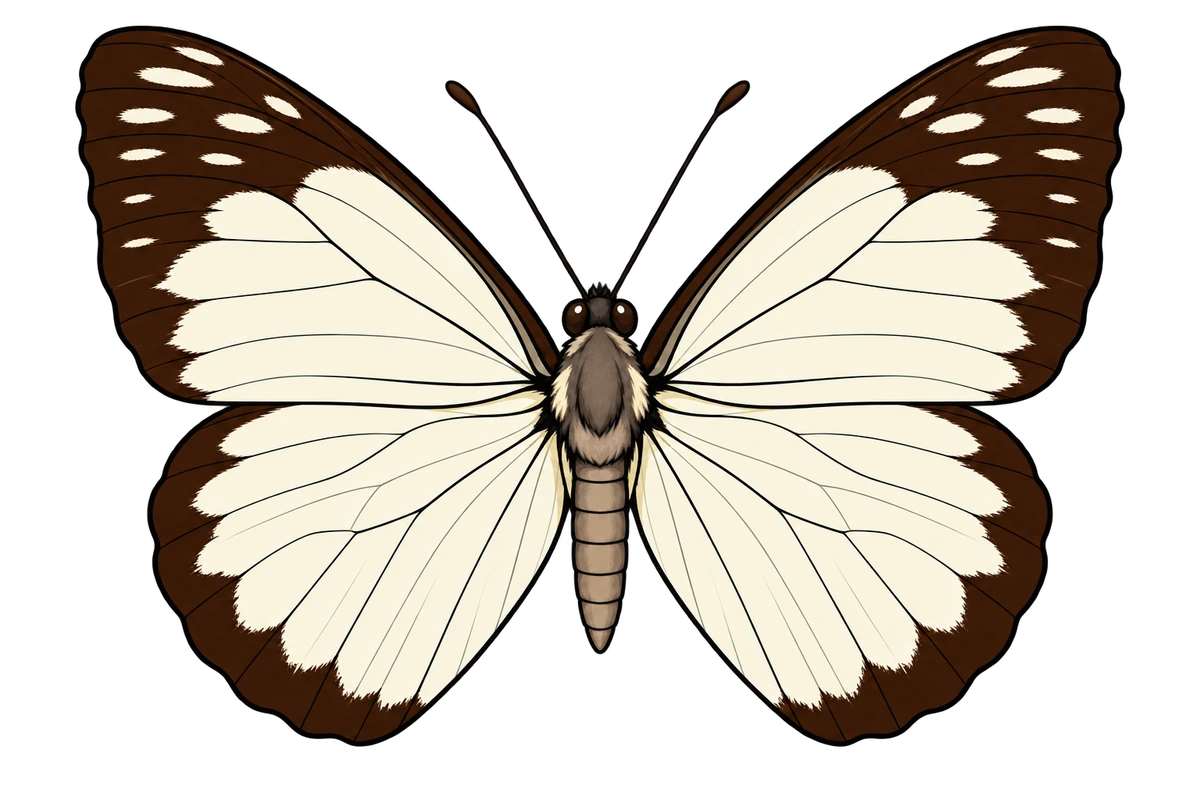
At a glance
- Range context ↘
- Java, with historical western mountain records [2]
- Identification detail ↘
- Female forewings especially dark [2]
- Biological reference ↘
- Compare with the taxon hypsipyle [4]
Identity and close relatives
Prioneris autothisbe is a sawtooth. A central comparison is hypsipyle: some collections retain that name within autothisbe, whereas the current catalogue separates them. This article follows the catalogue's species treatment while keeping the alternative combination visible. A name on an old label may therefore describe a different taxonomic boundary. [1][4]
How to look at the wings
Wallace emphasized the dark female forewings. Read the distribution of pale areas through that darkness rather than judging the butterfly by a white-and-yellow impression. A comparison should place females beside females and show corresponding surfaces; otherwise sex differences can be mistaken for differences between species. [2]
Range and living habitat
Wallace's own autothisbe material came from the mountains of western Java, around 4,000 feet. That is a valuable historical locality, not a measured lower elevation limit or proof of occupancy throughout Java today. A modern map needs independently checked, dated records. [2]
A life in four stages
The adult is much better represented in the sources checked here than its immature stages. A useful life-history account would connect an identified parent, eggs, successive larvae, pupa and emerged adult from one Javan population. Without that connection, a caterpillar photograph cannot safely inherit this adult's name.
Leaves for larvae, food for adults
No source checked for this article establishes a specific autothisbe food plant. Plant identification would need the same care as butterfly identification: a feeding record, a botanical voucher and a successfully reared adult would establish a much stronger association than an adult resting on foliage.
Behaviour in the living landscape
The historical mountain observation provides a place to begin field work, rather than a complete behavioural portrait. Repeated observations could distinguish feeding stops, flight through a site and reproductive activity. Date, weather, height above ground and sex would make those observations useful to later observers.
A closer scientific story
The autothisbe–hypsipyle comparison asks where geographic differentiation becomes a species boundary. Comparing localized series is more informative than selecting two dramatically different individuals. A strong investigation would test whether the proposed characters persist across sexes, seasons and populations, and whether independent genetic evidence agrees.
Connections in the ecosystem
The ecological question begins with the Javan population, its immature stages and its plants. Until those are connected, this guide does not assign a particular host specialization or defensive chemistry. Establishing those relationships would help explain where the butterfly can reproduce rather than merely pass through.
Names and natural-history records
Wallace's nineteenth-century discussion is an observation in the history of the name. It should remain distinguishable from the catalogue treatment used today. Keeping the publication, original locality wording and subsequent determinations together allows a reader to follow changes without rewriting old labels. [2]
Habitat and conservation context
A nineteenth-century collecting locality cannot establish present abundance. Revisiting documented Javan sites with comparable effort would provide a useful baseline, especially if the survey records breeding evidence. The current article makes no global threat-category claim, because a source establishing one was not checked.
Reading the specimen views
Start with a labelled male and female from Java, then compare the same surfaces of reliably determined hypsipyle. Include scale and the full forewing apex. Darkening, wear, lighting and folded wings can obscure precisely the pale areas needed for the comparison.
From biological reference to artwork
An illustration can make the pattern easier to read by holding pose and lighting consistent. It should retain the observed placement of pale markings and dark borders, with the sex and biological reference stated. An attractive averaged pattern would remove information needed for this comparison.
Caring for a framed specimen
Handle the enclosure, not the wings. Keep the identification label and the reference image together in the collection record. If a later revision changes the rank of hypsipyle, record that determination beside the earlier one rather than erasing the specimen's history. [3]
Questions worth asking
Which characters separate Javan autothisbe from Sumatran hypsipyle in both sexes? Where are the immature stages documented, and on which plants? Can contemporary surveys recover the western Javan mountain localities? These questions would add more than another unlocalized adult portrait.
Sources and further reading
The catalogue establishes the name used here; Wallace supplies a dated Javan observation and a sex comparison. Read the hypsipyle article alongside this one for the alternative museum combination. Neither a catalogue entry nor a historic description alone supplies a complete present-day life history.
- Prioneris classification and museum-image catalogue ↗
University of Florida Lepiverse; Catalogue of Life 2026-08-26 XR · Accessed 2026-10-09
Indexed genus classification lists the named taxon at species rank; current classification basis.
- On the Pieridae of the Indian and Australian Regions (1867) ↗
Alfred Russel Wallace; scholarly transcription hosted by Western Kentucky University · Accessed 2026-10-09
Original observations and descriptions, including Java records, Sri Lankan sita, Bornean cornelia and the Sarawak description of vollenhovii. Historical observations are not a complete present-day distribution.
- Caring for natural history collections ↗
Canadian Conservation Institute; Fiona Graham · Accessed 2026-10-09
Preventive care of fragile biological collections; the brief enclosure-handling and environment recommendations are general collection practice. Species-label recordkeeping recommendations are editorial.
- MCZ:Ent:128749 ↗
Harvard Museum of Comparative Zoology · Accessed 2026-10-09
Primary preserved specimen record uses Prioneris autothisbe hypsipyle Weymer, 1887 and records Sumatra. Evidence of alternative institutional rank, not an independently resolved species boundary.
Continue exploring
Sources checked 2026-10-09. Illustrations · Luminary Oddities.
Return to the Entomological Atlas ↑