

Luminary Oddities · Natural history & art
Prioneris philonome
Prioneris philonome
Lepidoptera / Pieridae
A sawtooth anchored by Javan naming history and museum specimens, with a red patch beneath the hindwing and unsettled boundaries around several related names.
Explore this insect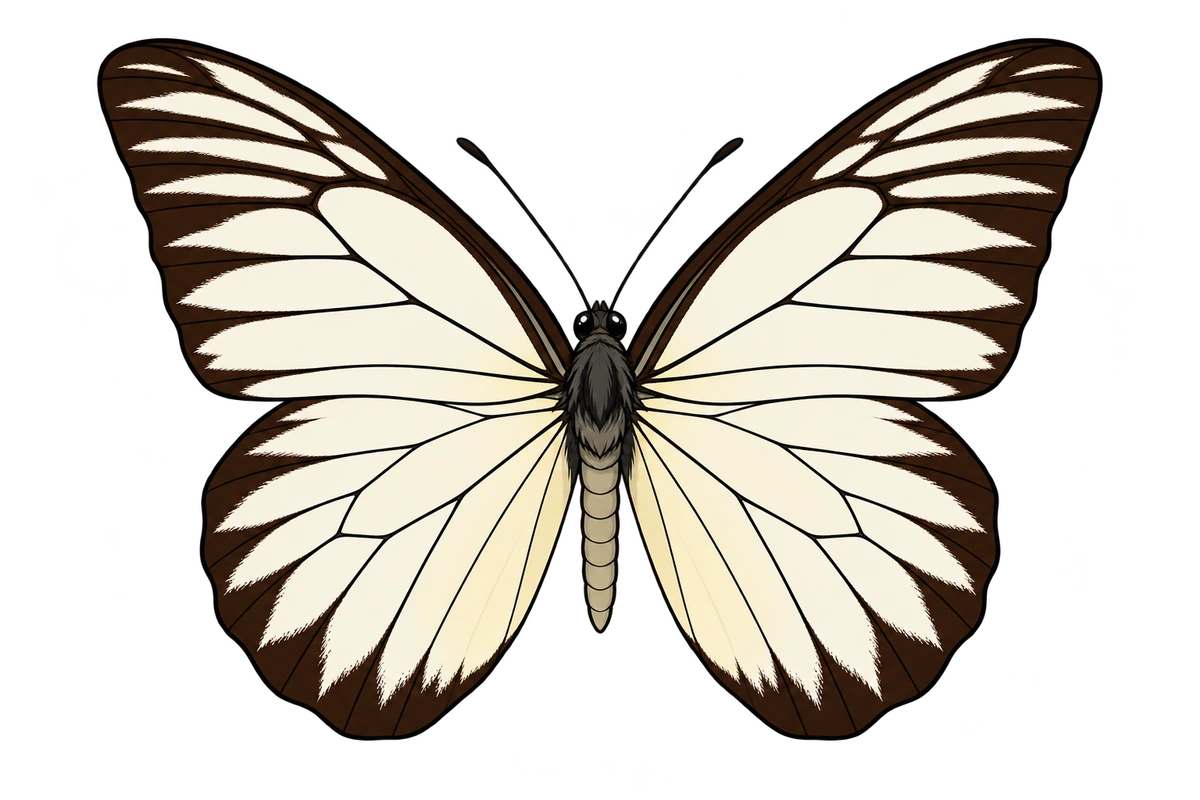
At a glance
- Range context ↘
- Javan naming history [2]
- Identification detail ↘
- Red basal hindwing patch in the historical account [2]
- Biological reference ↘
- Museum specimen USNMENT00781966 [3]
Identity and close relatives
Prioneris philonome belongs to the sawtooths. Its comparison set includes clemanthe and vollenhovii, which have sometimes been placed within philonome. Their treatment changes the breadth of the name, so a regional record should retain the exact combination used by its author rather than silently become evidence for another species. [1][5]
How to look at the wings
The red patch at the base of the hindwing underside is an important feature in Wallace's discussion. It is a location on a particular surface, not simply a red accent anywhere on the butterfly. Document the surrounding dark and pale areas before comparing it with another sawtooth. [2]
Range and living habitat
Java is the historical geographic anchor in the nineteenth-century account. Continental records require particular care because clemanthe has also been called philonome clemanthe. A range compiled without checking that rank choice can join unlike taxonomic concepts and create a misleadingly broad map. [2][5]
A life in four stages
A preserved adult establishes a physical reference for the name, but it does not document eggs, larvae or pupae. A life-history study needs a clear chain from the immature insect to the determined adult. Locality and the taxonomic treatment of clemanthe should accompany that chain.
Leaves for larvae, food for adults
This account does not assign a larval plant from a related sawtooth. An important next step is to locate a direct philonome rearing record with its botanical determination. Adults visiting a plant and larvae completing development on it answer different questions and should have separate records.
Behaviour in the living landscape
The museum's adult female is evidence of morphology and collection history. It is not evidence of a living flight pattern, nectar preference or breeding season. A behavioural account would benefit from dated field observations tied to the same geographic and taxonomic concept as the specimen.
A closer scientific story
Wallace explicitly said that he had not examined philonome himself. That candour matters: his comparison is a historical taxonomic statement, not an inspection of a personally collected series. It invites comparison with actual museum specimens rather than turning the authority of his name into certainty. [2]
Connections in the ecosystem
The uncertain breadth of philonome has ecological consequences. Combining clemanthe records with Java records may conceal different plant associations or habitat use. Ecological summaries should therefore be assembled population by population before deciding whether they describe one species or several.
Names and natural-history records
The Smithsonian records an adult female under philonome, with catalogue number USNMENT00781966. A permanent specimen identifier is valuable because another researcher can inspect the same reference, its labels and later determinations. It makes a taxonomic discussion traceable rather than dependent on an unattributed picture. [3]
Habitat and conservation context
No current global threat assessment is established here. The immediate conservation task is to build a geographically explicit record set with transparent rank choices. A large apparent range assembled from differently interpreted names should not be treated as proof that every local population is secure.
Reading the specimen views
For a useful comparison, show the hindwing base clearly on the underside and keep the specimen's complete label available. Add a dorsal view from the same individual when possible. Do not treat a red basal patch alone as sufficient to resolve philonome, clemanthe and vollenhovii.
From biological reference to artwork
The artwork should follow one documented butterfly or a clearly explained reference series. Preserve the relation of the basal red patch to veins and adjacent colour fields. Record which taxonomic combination accompanied the reference; that information remains valuable even if a future revision changes its rank.
Caring for a framed specimen
Keep the frame away from direct sun and inspect it for loose fragments. Preserve catalogue numbers and original determinations in the accompanying record. A revised label can be added without discarding the older name or the publication that used it. [4]
Questions worth asking
Which revision best resolves philonome against clemanthe and vollenhovii? Are diagnostic ventral characters consistent between males and females? Which direct host records belong to the Javan population? Resolving those questions would improve both identification and an eventual population-specific ecological account.
Sources and further reading
Read the Smithsonian record for the physical specimen and Wallace for the historical discussion. The current catalogue is the classification basis of this article. The separate clemanthe and vollenhovii accounts retain alternative ranks, so their observations should not automatically be pooled with philonome.
- Prioneris classification and museum-image catalogue ↗
University of Florida Lepiverse; Catalogue of Life 2026-08-26 XR · Accessed 2026-10-09
Indexed genus classification lists the named taxon at species rank; current classification basis.
- On the Pieridae of the Indian and Australian Regions (1867) ↗
Alfred Russel Wallace; scholarly transcription hosted by Western Kentucky University · Accessed 2026-10-09
Original observations and descriptions, including Java records, Sri Lankan sita, Bornean cornelia and the Sarawak description of vollenhovii. Historical observations are not a complete present-day distribution.
- Prioneris philonome specimen USNMENT00781966 ↗
Smithsonian National Museum of Natural History, Entomology · Accessed 2026-10-09
Primary pinned adult female specimen record; identity and specimen provenance, not a complete range.
- Caring for natural history collections ↗
Canadian Conservation Institute; Fiona Graham · Accessed 2026-10-09
Preventive care of fragile biological collections; the brief enclosure-handling and environment recommendations are general collection practice. Species-label recordkeeping recommendations are editorial.
- Prioneris bibliographic taxonomy catalogue ↗
Markku Savela / FUNET · Accessed 2026-10-09
Bibliographic trail records philonome clemanthe and philonome vollenhovi combinations. Used only to expose historical/alternative name usage and locate literature, not independently resolve modern rank.
Continue exploring
Sources checked 2026-10-09. Illustrations · Luminary Oddities.
Return to the Entomological Atlas ↑