

Luminary Oddities · Natural history & art
Prioneris vollenhovii
Prioneris vollenhovii
Lepidoptera / Pieridae
A Bornean sawtooth originally described from Sarawak, whose yellow underside and red basal patch sit within a taxonomic history that sometimes places it under philonome.
Explore this insect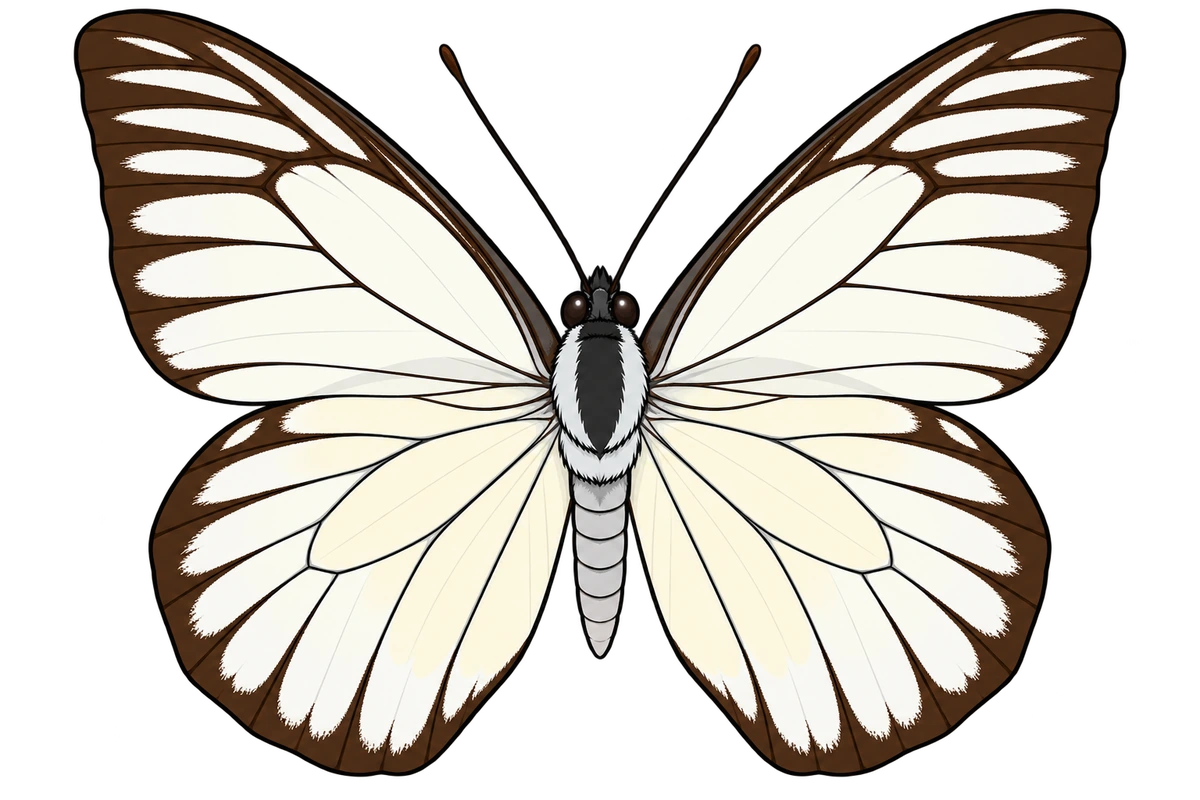
At a glance
- Range context ↘
- Original description from Sarawak [2]
- Identification detail ↘
- Yellow underside with a red basal patch [2]
- Biological reference ↘
- Alternative rank: philonome vollenhovii [3]
Identity and close relatives
This article follows the catalogue's species treatment, Prioneris vollenhovii. The FUNET bibliography also records it as Prioneris philonome vollenhovii. The Sabah compilation uses the spelling vollenhovi. Those differences should be preserved when citing records rather than mistaken for three separate species. [1][3][4]
How to look at the wings
Range and living habitat
A life in four stages
The sources checked here chiefly document adults. An immature-stage series should end with a determined Bornean adult, carrying the exact rank adopted in the study. That would allow biological observations to remain usable if vollenhovii is later treated within philonome again.
Leaves for larvae, food for adults
A specific larval food plant is not established by the checked adult descriptions. An original rearing report would need a plant determination, feeding evidence and the emerged butterfly. Host claims for philonome should be inspected for locality and taxonomic breadth before being transferred here.
Behaviour in the living landscape
Living behaviour cannot be reconstructed from the posture of a pinned plate. Observers could use the adult comparison to identify individuals, then document flight height, resting place and feeding events. Each behaviour needs its own evidence rather than a narrative inferred from wing colour.
A closer scientific story
Vollenhovii illustrates how a recognizable named population can move between species and subspecies treatments. The useful scientific question is why a revision chooses a particular boundary. Type-linked specimens and localized series can test that decision more directly than an online list of names.
Connections in the ecosystem
The ecological scope depends on the rank choice. If Bornean vollenhovii is pooled with Javan philonome, a summary may conceal geographic differences. A population-specific host and habitat account would remain valuable under either treatment, provided its records retain their original determinations.
Names and natural-history records
Wallace's Sarawak description and the current regional compilation provide a traceable naming history. The bibliography documents an alternative combination. The article uses one display name for clarity while recording the others in context; historical spelling does not establish a new biological entity. [2][3]
Habitat and conservation context
The Bornean endemic listing is not a current global threat assessment. To evaluate status, surveys would need explicit locality, repeat visits and a consistent determination. The rank question also needs to remain visible when searching assessments and combining regional records.
Reading the specimen views
Show upper and lower surfaces from the same individual, and compare the same sex of cornelia. The red basal mark, vein pattern and pale fields should all remain visible. A close crop that removes the wing apex can discard useful shape information.
From biological reference to artwork
A reference-based illustration should preserve the Bornean specimen's actual pattern and document the label combination. It should not merge the paler areas of cornelia with the basal patch of another sawtooth. Rank uncertainty can be explained in the caption without distorting the butterfly.
Caring for a framed specimen
Keep the specimen in a stable, dry display location. Store alternate combinations and the bibliography with the catalogue record. When a determination changes, retain the original label as evidence of the historical taxonomic concept under which the insect was acquired. [5]
Questions worth asking
What modern revision explains species rank against philonome? Which characters remain stable across Bornean males and females? Where is breeding directly documented? These questions would connect the original description with a defensible current identification and a living ecological account.
Sources and further reading
Use the Sabah adult plate for comparison, Wallace for the original Sarawak discussion and the catalogue for the present naming basis. FUNET is a bibliographic trail to alternative treatments. It should lead to the relevant revision rather than replace examination of its evidence.
- Prioneris classification and museum-image catalogue ↗
University of Florida Lepiverse; Catalogue of Life 2026-08-26 XR · Accessed 2026-10-09
Indexed genus classification lists the named taxon at species rank; current classification basis.
- On the Pieridae of the Indian and Australian Regions (1867) ↗
Alfred Russel Wallace; scholarly transcription hosted by Western Kentucky University · Accessed 2026-10-09
Original observations and descriptions, including Java records, Sri Lankan sita, Bornean cornelia and the Sarawak description of vollenhovii. Historical observations are not a complete present-day distribution.
- Prioneris bibliographic taxonomy catalogue ↗
Markku Savela / FUNET · Accessed 2026-10-09
Bibliographic index documents alternative combinations hypsipyle under autothisbe and vollenhovii under philonome. Used only to expose rank conflict and locate original literature.
- Bornean Endemic Butterflies: Prioneris vollenhovi ↗
Sabah Forestry Department; Arthur Chung and colleagues · Accessed 2026-10-09
2020 regional compilation; adult specimen photographs and comparison with cornelia, page 11. Uses the spelling vollenhovi.
- Caring for natural history collections ↗
Canadian Conservation Institute; Fiona Graham · Accessed 2026-10-09
Preventive care of fragile biological collections; the brief enclosure-handling and environment recommendations are general collection practice. Species-label recordkeeping recommendations are editorial.
Continue exploring
Sources checked 2026-10-09. Illustrations · Luminary Oddities.
Return to the Entomological Atlas ↑