
Luminary Oddities · Natural history & art
Prioneris clemanthe
Prioneris clemanthe
Lepidoptera / Pieridae
A continental sawtooth with well-documented Cambodian photographs, whose current species listing contrasts with field papers that place clemanthe within Prioneris philonome.
Explore this insect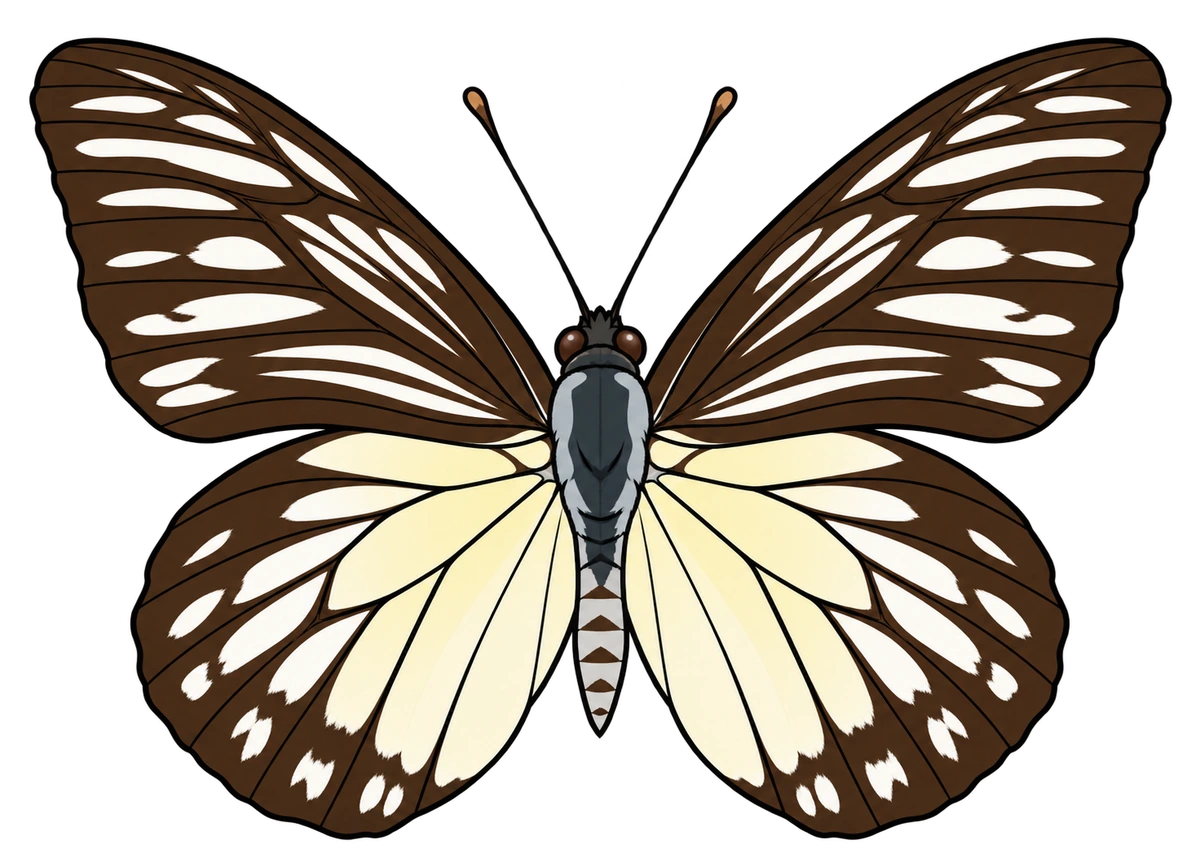
At a glance
- Range context ↘
- Continental Asian taxon [2]
- Identification detail ↘
- Photographed near O’Som, Cambodia [4]
- Biological reference ↘
- Alternative rank: philonome clemanthe [3]
Identity and close relatives
This article uses Prioneris clemanthe following the current catalogue. Cambodia's 2022 checklist and Kosterin's field paper instead use Prioneris philonome clemanthe. The disagreement concerns rank within a broader philonome concept; clemanthe should not be counted again as an additional unnamed species. [1][3][4]
How to look at the wings
The photographer-linked record supplies an underside view of a male. Compare the red basal hindwing mark, yellow field and surrounding dark veins with an identified reference, retaining the whole pattern. Its resemblance to philonome is precisely why the regional naming treatment should accompany the image. [2]
Range and living habitat
The primary Cambodian photographic paper records a male near O’Som in Pursat Province on 24 March 2015. The country checklist adds province-level records. These observations document occurrence under the authors' combination; they are not a complete continental range or an elevation envelope. [3][4]
A life in four stages
The dated adult record does not provide a developmental series. Connecting eggs, caterpillars and pupae with a successfully determined adult from that population would add a distinct kind of evidence. The study should state whether it adopts species rank or philonome clemanthe.
Leaves for larvae, food for adults
A host record needs the same geographic and naming precision as the adult photograph. This article does not transfer a plant association from sita or a broadly named philonome population. A feeding observation with botanical identification and a reared adult would establish the relevant local relationship.
Behaviour in the living landscape
A photograph made during a field encounter is stronger behavioural context than a mounted specimen, but a still image records only a moment. Resting on a plant should not become feeding, territoriality or oviposition in the caption unless the observer documented that action.
A closer scientific story
The scientific story is unusually practical: field observations can be sound even when the rank of their name differs from a current catalogue. Retaining the exact original combination lets a future revision reuse the observations. Silently modernizing the name risks changing their meaning.
Connections in the ecosystem
Ecological comparisons should begin with the Cambodian population and its documented activities. Pooling its records with Javan philonome before inspecting the species concept could create a false host range or seasonal pattern. Local evidence remains useful whichever rank is ultimately preferred.
Names and natural-history records
Habitat and conservation context
Conservation searches should include both clemanthe and philonome clemanthe. A rank change can fragment records across databases and publications. The dated Cambodian photographs supply occurrence evidence, but they do not establish population trend or justify assigning a present global threat category.
Reading the specimen views
Keep the author's locality, date and original determination beside the underside image. If adding a dorsal view, use the same individual or label the separate reference. Matched surfaces from males and females would be more informative than several almost identical side views.
From biological reference to artwork
An illustration should follow a documented continental reference and preserve the relative positions of the ventral marks. A caption can name the original philonome clemanthe determination and the catalogue rank used in the Atlas. That keeps the artwork legible and the taxonomy traceable.
Caring for a framed specimen
Keep printed reference records and digital originals linked to the frame catalogue. Handle the frame gently and avoid wing contact. If a determination changes, add its authority and date; the original field name remains part of the evidence. [5]
Questions worth asking
What evidence supports clemanthe at species rank? Can Cambodian vouchers be compared directly with Javan philonome and Bornean vollenhovii? Which local hosts are confirmed by rearing? A revision combining geography, morphology and voucher-linked genetics would clarify the records already available.
Sources and further reading
The Cambodian papers are the key primary occurrence sources; the current catalogue explains the article's rank. FUNET provides the photograph and bibliographic trail. Use the original published combination when citing a field observation, even when the Atlas display name differs.
- Prioneris classification and museum-image catalogue ↗
University of Florida Lepiverse; Catalogue of Life 2026-08-26 XR · Accessed 2026-10-09
Indexed current classification lists clemanthe at species rank.
- Prioneris bibliographic taxonomy catalogue ↗
Markku Savela; FUNET · Accessed 2026-10-09
Bibliographic trail and photographer-linked Cambodian images; records alternative philonome clemanthe combination.
- An annotated checklist of the butterflies of Cambodia (2022) ↗
G. Chartier and O. Kosterin · Accessed 2026-10-09
Primary country checklist; indexed table uses Prioneris philonome clemanthe.
- Occasional photographic records of butterflies in Cambodia, Part 3 (2020) ↗
Oleg E. Kosterin; Acta Biologica Sibirica 6:293–338 · Accessed 2026-10-09
Primary photographic field record near O’Som, Pursat Province, 24 March 2015; uses philonome clemanthe.
- Caring for natural history collections ↗
Canadian Conservation Institute; Fiona Graham · Accessed 2026-10-09
Preventive care of fragile biological collections; the brief enclosure-handling and environment recommendations are general collection practice. Species-label recordkeeping recommendations are editorial.
Continue exploring
Sources checked 2026-10-09. Illustrations · Luminary Oddities.
Return to the Entomological Atlas ↑