
Luminary Oddities · Natural history & art
Vagrant butterfly
Vagrans egista
Lepidoptera / Nymphalidae
A warm orange upper surface and a more intricate underside give the vagrant two different visual voices. Australian life-history observations add spiny caterpillars, silver-marked pupae and unusual egg placement to the story of this widely named brush-footed butterfly.
Explore this insect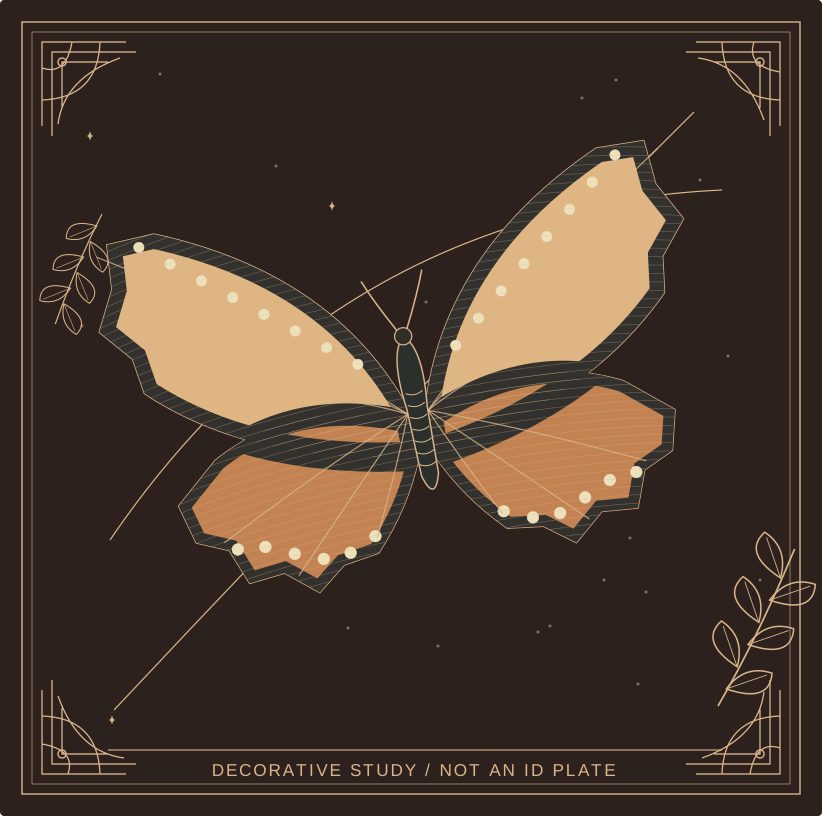
At a glance
- Australian name ↘
- Tailed rustic or Australian vagrant for subspecies propinqua. [2]
- Larval hosts ↘
- Homalium circumpinnatum and Xylosma ovatum in Australian observations. [1]
- Range record ↘
- An Indian field paper documents a southern West Bengal locality. [3]
Vagrant and tailed rustic
Vagrans egista is a butterfly in Nymphalidae. Australian accounts often call it the tailed rustic, and Museums Victoria lists Australian vagrant as another common name for Vagrans egista propinqua. The guide uses the species name to connect those records without assigning the Australian subspecies to every specimen in the collection. A common name is useful for orientation; a precise subspecies designation needs appropriate evidence about the individual and the taxonomic treatment. [2][1]
Two surfaces with different detail
The illustrated Australian account describes orange upper wings with dark brown edges and scattered dark markings. Below, orange-brown wings carry more complex arcs of white, black, orange and grey spots. It gives a wingspan up to about six centimetres. Those descriptions are a useful regional visual portrait. A complete upper and underside view can show why one spread-wing photograph cannot represent all the detail of the insect. The underside is a separate patterned surface, not simply the top rendered duller. [1]
Regional records within a broad story
The Australian account places subspecies propinqua on the tropical northeastern coast of Queensland. Museums Victoria has a documented example from the Mulgrave River area. Separately, a 2021 Indian paper records a southern West Bengal locality farther from the previously known locality within that state. The museum specimen and the field paper are different kinds of geographic anchors. Neither provides the collecting location of the framed insect, and a newly published locality is not automatically evidence that the butterfly has recently expanded its biological range. [1][2][3]
Spines and silver-marked pupae
Australian illustrated observations describe caterpillars that can be green or brown, with a white lateral line, a brown head and branched black spines. The pupa is green, spiky and silver-marked, suspended beneath a leaf. These earlier stages contrast strongly with the orange adult. The butterfly follows the egg–larva–pupa–adult cycle familiar from complete metamorphosis, but each stage has its own appearance. A larval portrait should be captioned with its locality and stage rather than treated as a tiny adult. [1][5]
Young caterpillars were observed hanging on silk threads at night. The observer account suggests a possible protection from wandering predators, but that explanation remains a hypothesis. The visible behaviour and the proposed reason should be kept separate: an observation can be fascinating even when its full biological function has not been experimentally settled. [1][5]
Australian connections to Salicaceae
The Australian life-history account lists brown boxwood, Homalium circumpinnatum, and oval logwood, Xylosma ovatum, as caterpillar foods. Both are placed in Salicaceae in that account. These named plants are more useful than a claim that the species eats any green leaf. Keep their geographic context visible when applying the information. A host record concerns caterpillar development; an adult perching on a plant or taking nectar nearby is not by itself a record of larval host use. [1]
Eggs beside the food plant
The same account reports single eggs laid on nearby plants, dead twigs or debris near a food plant, rather than always directly on the host. That observation gives the reader an unexpected detail at the start of the life cycle. It does not establish that every female in every population uses the same placement. Nor does the placement by itself establish a cause. An illustrated natural-history report can preserve a useful observation while leaving the mechanism open to further investigation. [1]
When a locality is a discovery of evidence
The West Bengal paper reports a locality roughly 525 kilometres from the previous known state locality. The meaningful result is better documentation of occurrence within that regional account. A butterfly can exist at a place before anyone publishes a convincing record of it. This distinction matters when reading a headline about a range extension: the map of known observations can change without proving the timing, route or cause of the animal's own movement. [3]
A plant relationship that begins nearby
The reported egg placements invite a close view of the area around a host plant, not only its leaves. Caterpillar food records and photographs of the early stages connect the butterfly with a local plant community. This is a useful reason to record surroundings when observing eggs and larvae. For the collection, the living story extends well beyond the orange adult: it includes named trees, small caterpillars and a different-looking pupa before the final winged stage. [1]
One taxon, several common names
Vagrant, tailed rustic and Australian vagrant are common-name pathways into this butterfly's literature. The museum's three-part name, Vagrans egista propinqua, identifies a regional subspecies. It does not turn the Australian record into a separate framed-art edition or identify an artwork's subject more narrowly without evidence. The word vagrant itself is not proof that an individual wandered unusually far. A movement claim requires observations or records, rather than an inference from a common name. [2][1]
Document what a regional record establishes
This account uses a museum specimen and a field occurrence paper as evidence of identity and place. It does not convert them into a current global conservation category. Host observations provide another useful part of the living context. Careful records of insects and plants contribute knowledge, while information about a displayed individual's collecting circumstances belongs to its separate documentation. No claim about rarity, sustainability or lawful supply is inferred merely from an attractive specimen or an apparently broad range. [2][3]
Begin above, continue below
Look at the large orange fields and the dark edges in a complete upper view. Then compare the underside, following one curved row of marks at a time. Notice how much detail was invisible in the first view. If early-stage illustrations accompany the account, compare the caterpillar spines and the shape of the pupa with the adult without assuming that the same visual character serves the same purpose in each stage. Enlargement can support this looking exercise without touching the specimen.
Orange fields and patterned reverses
A framed composition can emphasize the warm upper surface, while a digital interpretation may give the quieter underside a more central role. These are artistic choices about which view to present. The surrounding symbols, palette and title belong to the artwork rather than to an established cultural tradition of Vagrans egista. When several pieces appear in the gallery, compare how each treatment directs attention to the outline, the border or a small detail that was easy to miss.
Keep the insect safely enclosed
Use the frame as the handling surface and keep the specimen enclosure closed. Avoid direct sun, strong heat and persistent damp. Natural-history conservation guidance treats dried insect material as brittle and stresses prevention of physical damage alongside appropriate environmental conditions. A loose fragment or change in the mount is worth documenting. Seek suitable advice before opening a frame; brushing a wing, wiping a surface or attempting to realign a damaged part can remove the detail the display is meant to preserve. [4]
Names, silk threads and egg placement
Does the name vagrant prove migration? It is a common name, not a movement record. Do all individuals belong to propinqua? That is the Australian subspecies named in the cited museum account. Why do young larvae hang on silk? The observer report suggests protection, but the reason is not presented here as experimentally demonstrated. Does a newly reported locality prove recent arrival? It records occurrence; explaining when and how a population arrived takes further evidence. [1][2][3]
Illustrated observations and a museum anchor
The Australian illustrated life-history account supplies the early-stage observations, named hosts and upper/underside descriptions. Museums Victoria anchors the Australian subspecies with a preserved specimen record. The West Bengal paper adds a distinct Indian field example. Reading them together keeps a broad species account connected to specific evidence. The linked general butterfly and preventive-conservation references explain stage distinctions and display care without assigning unverified timings or a history to the framed individual. [1][2][3]
- Vagrans egista Australian life-history account ↗
Don Herbison-Evans and Stella Crossley · Accessed 2026-10-09
Exact URL retained. Australian context: Homalium circumpinnatum, Xylosma ovatum, spiny larvae, green silver-marked pupa, eggs near/off host.
- Specimen LEP 19795 Vagrans egista propinqua ↗
Museums Victoria · Accessed 2026-10-09
A.N. Burns Collection; one pinned specimen, Mulgrave River, Queensland. Museum is Museums Victoria; neither collection nor locality transfers to shop specimen.
- Vagrans egista southern West Bengal record ↗
Revista Chilena de Entomología · Accessed 2026-10-09
Exact URL retained. New documented locality about 525 km from previous known state locality; observation does not alone prove recent range expansion.
- Caring for natural history collections ↗
Canadian Conservation Institute · Accessed 2026-10-09
Preventive care of organic collections, including brittle insect material.
- About Butterflies ↗
Smithsonian Gardens · Accessed 2026-10-09
General butterfly metamorphosis, anatomy and stage distinctions; not species-specific timings.
Artworks in the collection
Explore the framed works and digital art connected with this insect. Etsy shows current availability, options and prices.
- The Lovers ↗Framed work
Continue exploring
Sources checked 2026-10-09. Artwork © Scott Schubr / Luminary Oddities.
Return to the Entomological Atlas ↑