
The turquoise lattice
Amazonite
Green to blue-green microcline feldspar.
Colored microcline feldspar variety
Amazonite is green-to-blue-green microcline, a potassium feldspar. Blocky fragments and pale streaks give it a different architecture from green chalcedony. Its color does not identify jade or turquoise, even when a polished shape resembles those stones.
Geology · Human history · Attributed traditions
Explore the specimen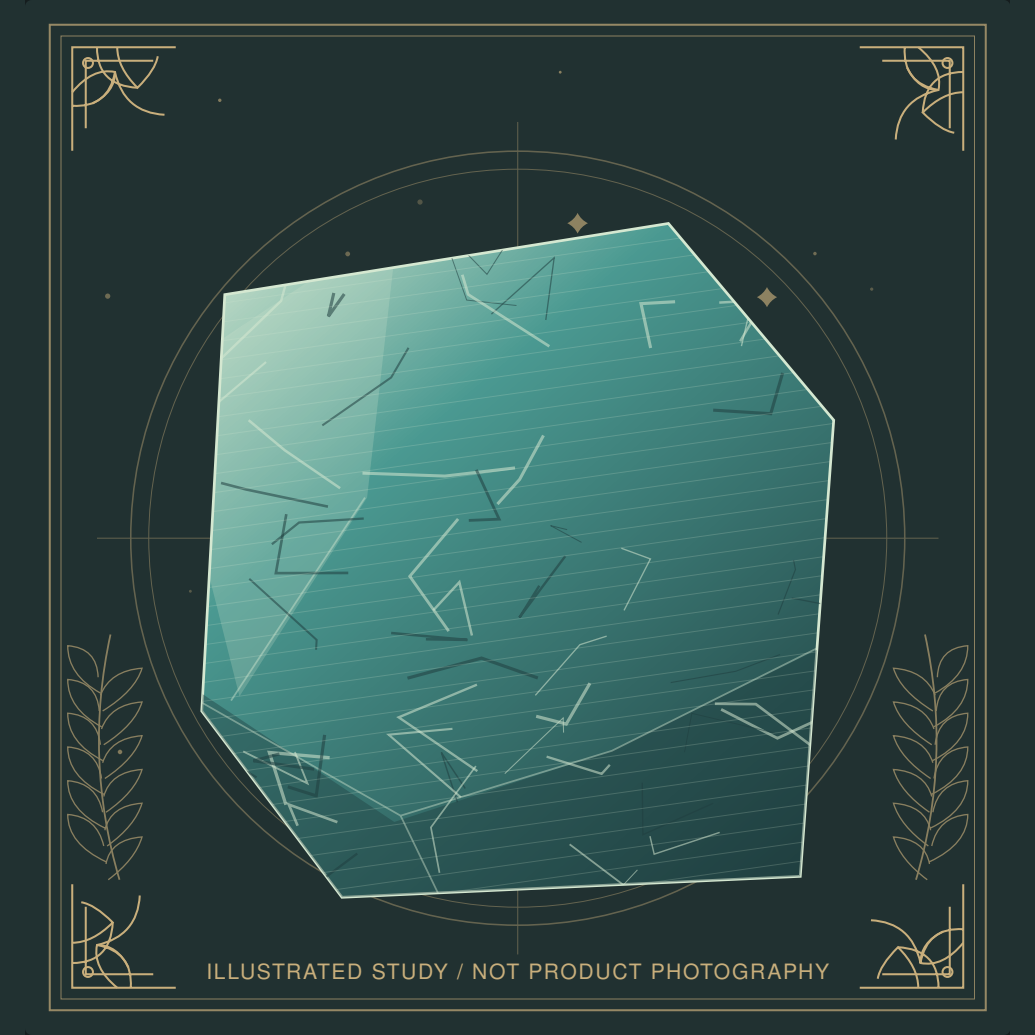
Material
Green to blue-green microcline feldspar. [1]
Family
Feldspar family [1]
Appearance
Contrasting irregular veins [1]
Traditions
Margaret Ann Lembo’s 2013 chart places amazonite with blue stones used for communication and speaking up. [5]
In this guide
Visual identity
Amazonite is green-to-blue-green microcline, a potassium feldspar. Blocky fragments and pale streaks give it a different architecture from green chalcedony. Its color does not identify jade or turquoise, even when a polished shape resembles those stones. [1]
Amazonite is the blue-green to green decorative variety associated with microcline. A surface may contain white streaks or patches, and color can vary within the same object. Microcline may be intergrown with albite, a feature described as perthitic texture in mineralogy; that mineral context explains why feldspar material can look less uniform than a simple color name suggests. The particular minerals in a visible white patch should nevertheless be identified rather than assumed. A photograph can show contrast, but not every underlying structural relationship. [1]
Earth story: geology and formation
The feldspar can occur with quartz and mica in granitic settings. Cleavage and fine feldspar intergrowths help explain the block-like and streaked texture. The occurrence of smoky quartz alongside amazonite is a mineral association rather than a requirement for every specimen. The Handbook records microcline at Colorado’s Pikes Peak region, Namibia and several Brazilian localities, alongside numerous other occurrences. Its associations include quartz, sodic plagioclase and mica. Those relationships explain why a rough piece can preserve contrasting crystals, while a polished amazonite tumble may show little of its original surroundings. An individual association is still not a stand-alone locality fingerprint, because similar minerals can coexist in more than one region. [1]
Microcline is potassium aluminium silicate, KAlSi₃O₈, in the alkali feldspar group. It has triclinic symmetry, hardness 6–6.5 and measured density around 2.54–2.57 grams per cubic centimetre. Two strong cleavage directions meet at approximately right angles, creating block-like fragments. Its crystals can contain fine intergrowths of another feldspar, albite; a pale pattern need not be a separate vein introduced later. Microcline occurs in granite, granite pegmatite and syenite as well as metamorphic rocks and some veins. These settings explain why amazonite is frequently collected with quartz or mica. Surface fractures and cleavage planes are part of the feldspar structure, distinct from the curved fracture typical of quartz. [1]
Microcline is a potassium feldspar with triclinic symmetry. Its framework contains aluminum and silicon linked with oxygen, and potassium is a defining major constituent. The species commonly occurs with quartz, other feldspars and micas in granitic or pegmatitic settings. Its two prominent cleavage directions make a different structural impression from the conchoidal fracture familiar in quartz. A worked amazonite tower can therefore share a silhouette with a quartz tower while the materials inside respond differently to a sharp impact. [1][2]
Varieties and lookalikes
These names describe different levels of information: a mineral species, a visual variety, a crystal habit or a retail label. The distinctions below keep the recognizable shop vocabulary alongside its material explanation.
Turquoise and greenish-blue chalcedony are useful visual comparisons because their colors can overlap with polished amazonite. They belong to different compositions and structures, and uniform color does not make them interchangeable. Larvikite and labradorite provide a different comparison within the wider feldspar-related catalogue: their conspicuous optical flashes should not be assumed to occur in amazonite merely because they are grouped near it. Family membership explains some shared framework chemistry, while optical behavior depends on more specific mineral and texture conditions. [1][3][4]
- Amazonite and amazonstone
- These familiar gem names denote blue-green microcline. Naming alone does not supply a geographic origin. [1]
- Amazonite with smoky quartz
- A documented mineral pairing can preserve two growth forms and colors. The quartz and feldspar remain separate species within one specimen. [1]
Human story: history and naming
The Handbook of Mineralogy records microcline in sites including the Pikes Peak region of Colorado, Namibia and Brazil. These are documented collection contexts for the species. A name resembling Amazon does not authenticate Brazilian provenance or establish an Amazonian spiritual tradition. [1]
The mineral locality list includes Pikes Peak, Colorado, as well as Namibia and Brazil. These establish that the microcline species occurs in several recognized collection regions; they do not make any unlabelled green carving a specimen from one of those places. A modern amazonite object can be linked to mining, cutting and trade where records survive. The geographic suggestion in the name is a separate issue, and should not replace a documented source locality or be used to assign the object to a particular community’s traditions. [1]
Meaning and practice: attributed traditions
Margaret Ann Lembo’s 2013 chart places amazonite with blue stones used for communication and speaking up. The association belongs to her modern color framework. The mineral’s cleavage and composition have their own physical descriptions, separate from the intended meaning. [5]
An optional communication reflection is to identify a message that needs clearer wording, using the material’s contrasting streaks as a cue to separate the central point from surrounding detail.
Lembo groups amazonite with light-blue materials used for expression and speaking up. In that system, color supplies a correspondence even though amazonite is feldspar, aquamarine is beryl and angelite is anhydrite. Keeping those distinctions visible lets the reader understand how one symbolic theme can span very different geological identities. A personal practice might use the stone as a reminder to communicate deliberately; the effect depends on what the participant chooses to do, rather than a claim that potassium feldspar physically transmits truth. [5]
Material identity and trade terminology
Amazonite is neither jade nor turquoise. A seller should state microcline and any known source or color treatment separately. White streaks, the shade of blue-green and a polished shape cannot independently certify locality. A mixed amazonite-and-quartz piece is a specimen containing more than one mineral. [1]
Sources and related specimens
The references below distinguish mineral identification and physical properties from historical interpretation and practitioner symbolism. A cited material category describes a kind of stone; it does not certify the identity, treatment or provenance of an untested individual retail specimen.
- Handbook of Mineralogy: Microcline
Mineralogical Society of America · Mineral composition, structure, physical properties and occurrence · Accessed October 9, 2026
- Handbook of Mineralogy: Quartz
Mineralogical Society of America · Mineral composition, structure, physical properties and occurrence · Accessed October 9, 2026
- Quartz
Australian Museum · Geological, gemological or documented material-history evidence · Accessed October 9, 2026
- GIA: Optical Effects in Phenomenal Gemstones
Gemological Institute of America · Geological, gemological or documented material-history evidence · Accessed October 9, 2026
- Margaret Ann Lembo: Colors, Enlivening the Rainbow Body (2013)
Llewellyn Worldwide · Contemporary practitioner symbolism and retailer terminology; distinct from mineralogical evidence · Accessed October 9, 2026