
A flash beneath gray
Labradorite
A plagioclase feldspar variety known for labradorescence.
Plagioclase feldspar variety with an optical effect
Labradorite is plagioclase feldspar, frequently with a gray body and a blue, green or gold flash. The broad flash changes with angle and lighting. A motionless photograph can show a vivid view or a subdued one without either representing the entire appearance.
Geology · Human history · Attributed traditions
Explore the specimen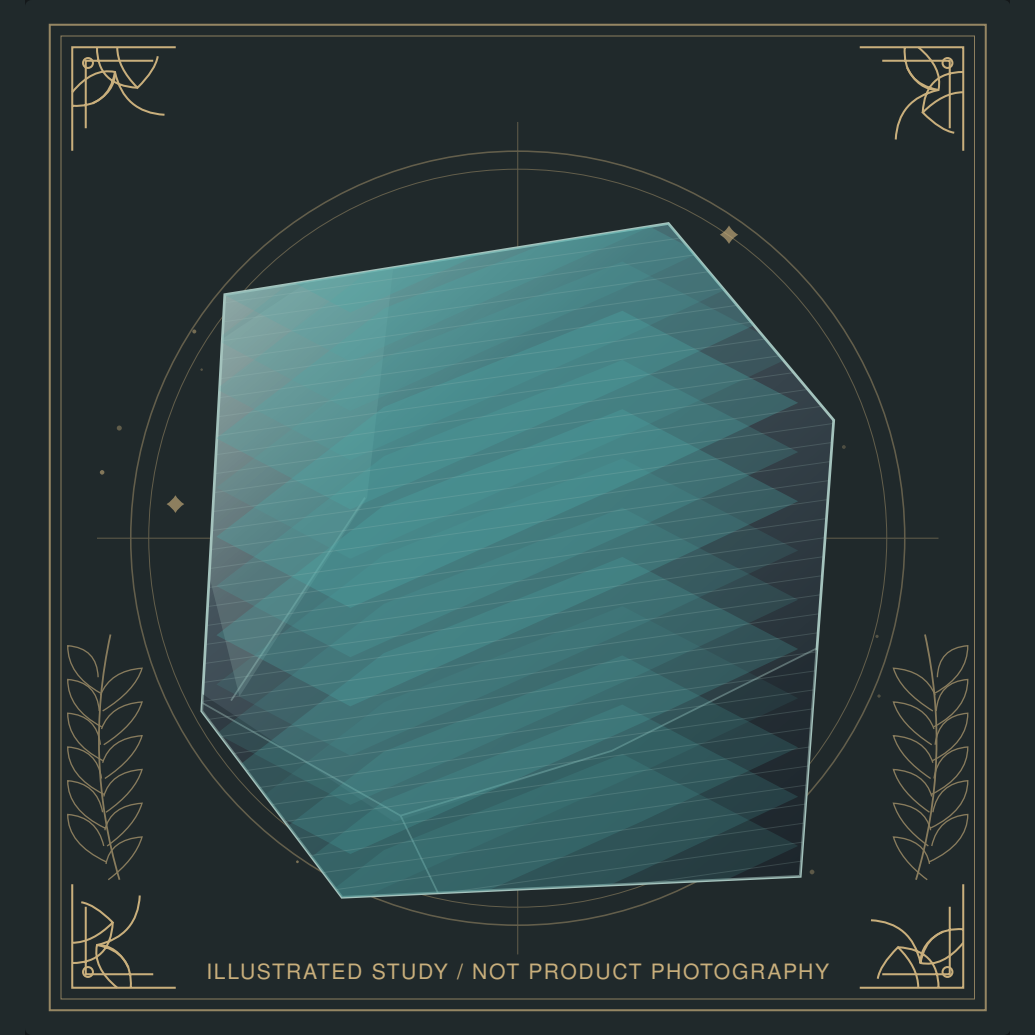
Traditions
Sandra Kynes’s 2018 home-correspondence article includes labradorite among balance-oriented stones. [5]
In this guide
Visual identity
Labradorite is plagioclase feldspar, frequently with a gray body and a blue, green or gold flash. The broad flash changes with angle and lighting. A motionless photograph can show a vivid view or a subdued one without either representing the entire appearance. [1][2]
Body color and flash color should be recorded separately. A polished object can appear dark gray from one direction and display a broad bright field from another, with individual parts responding at different angles. This change is a real viewing effect, rather than a change in the stone’s chemical identity. A diffuse room light, a directed light and a backlit photograph can reveal different aspects. The fairest specimen illustration shows the base material along with the flash instead of implying that every surface remains permanently luminous. [1]
Earth story: geology and formation
GIA’s 2025 review explains iridescence through internal feldspar layers. Light interacting with those textures produces the color, which is distinct from a uniform pigment or dye. Labradorite also names a composition range in the plagioclase series; not every labradorite specimen has dramatic iridescence. GIA’s review distinguishes a compositional plagioclase term from the iridescent variety most familiar in shops. Some labradorite is comparatively transparent and lacks the broad blue flash. This distinction prevents the common visual example from becoming a rule that every labradorite must obey. The orientation and spacing of internal layers influence which wavelengths are reflected, so the bright appearance is a property of structure and illumination together. [1][2]
Feldspars are major rock-forming aluminium silicates. Alkali feldspars and the sodium–calcium plagioclase series are related but compositionally distinct. Their microscopic intergrowths or included particles can interact with light in different ways: a floating sheen, iridescent flash and scattered glitter should not be collapsed into one effect. GIA’s optical review uses microscopy and crystallographic relationships to distinguish these textures. A cabochon’s orientation emphasizes selected optical features, and turning the same stone can alter which colors or reflective regions are visible. Body color, transparency, inclusion texture and directional sheen are useful separate observations; none alone certifies a named deposit. [1]
Labradorescence is an iridescent effect associated with fine internal layering in plagioclase feldspar. GIA’s optical review separates the broad observations of light from the much smaller textures that produce them. An ordinary viewer sees a sudden blue, green, gold or multicolored flash, while microscopy examines the layers and their relationship. The effect therefore depends on structure as well as composition. Two pieces with similar base color can display very different flashes because their internal orientation and the way they were cut differ. [1]
Varieties and lookalikes
These names describe different levels of information: a mineral species, a visual variety, a crystal habit or a retail label. The distinctions below keep the recognizable shop vocabulary alongside its material explanation.
Rainbow moonstone illustrates how trade terminology follows an optical appearance across host distinctions. GIA identifies it as transparent labradorite, even though conventional moonstone is associated with orthoclase and albite. The shared lunar name does not convert plagioclase into potassium feldspar. Likewise, a blue flash in larvikite occurs in a feldspar-rich rock containing several minerals, not in a single isolated labradorite specimen. These comparisons preserve the familiar shop vocabulary while making the host identity and the kind of object clear. [2][3][4]
Human story: history and naming
GIA traces the name to Labrador in Canada and records iridescent material worldwide. The name is a mineralogical and naming history, not a certificate of Canadian source. A northern-lights resemblance can be appreciated without being attributed to an unnamed Indigenous legend. [1]
The GIA review includes a Finnish labradorite cabochon from the Dr. Edward J. Gübelin collection. A recorded collection provides a documented human setting for a particular specimen, including source attribution and the choice to cut it as a cabochon. Its carefully selected view makes an internal optical texture visible to an audience. This is a supported collecting history distinct from widely repeated but unsourced stories about captured northern lights. A beautiful metaphor may describe an impression without serving as a historical account of a community. [1]
Meaning and practice: attributed traditions
Sandra Kynes’s 2018 home-correspondence article includes labradorite among balance-oriented stones. This is a modern practitioner interpretation. Its optical transformation can provide an editorial metaphor for changing viewpoints without establishing a supernatural mechanism. [5]
An optional attention practice is to view the same surface from two angles, then consider how another viewpoint might change an initial interpretation.
Kynes includes labradorite in her balance-oriented home correspondences. The theme belongs to her contemporary practice and can be considered alongside the way the stone changes appearance with viewpoint. A reflective use might involve attending to more than one perspective before reaching a decision. That activity is chosen by the participant. The changing flash supplies visual material for the reflection, while the mineralogical explanation remains interference in a structured feldspar rather than proof that the specimen controls balance in the home. [5]
Material identity and trade terminology
Rainbow moonstone is transparent labradorite in accepted gem-trade usage, rather than traditional moonstone. Spectrolite is associated with Finnish trade usage and requires provenance; vivid color alone is not sufficient. The underlying feldspar and an advertised origin should be stated separately. [1][2]
Flash strength is a property of the displayed portion and its orientation, so a small moving view is more informative than one saturated still image. An isolated bright spot does not measure the coverage across the entire object. It also cannot independently authenticate a geographic subtype or exclude enhancement. A clear material label should distinguish a labradorite piece, a feldspar-rich rock and a manufactured imitation. The familiar optical appeal can then be appreciated without replacing the underlying identity with a marketing superlative. [1][6]
Sources and related specimens
The references below distinguish mineral identification and physical properties from historical interpretation and practitioner symbolism. A cited material category describes a kind of stone; it does not certify the identity, treatment or provenance of an untested individual retail specimen.
- GIA: Optical Effects in Phenomenal Gemstones
Gemological Institute of America · Geological, gemological or documented material-history evidence · Accessed October 9, 2026
- GIA: Is rainbow moonstone really moonstone?
Gemological Institute of America · Geological, gemological or documented material-history evidence · Accessed October 9, 2026
- GIA: Moonstone Description
Gemological Institute of America · Geological, gemological or documented material-history evidence · Accessed October 9, 2026
- National treasure of global significance: Dimension-stone deposits in larvikite, Oslo igneous province, Norway (2008)
Geological Survey of Norway · Geological, gemological or documented material-history evidence · Accessed October 9, 2026
- Sandra Kynes: 365 Days of Crystal Feng Shui for Your Home (2018)
Llewellyn Worldwide · Contemporary practitioner symbolism and retailer terminology; distinct from mineralogical evidence · Accessed October 9, 2026
- GIA: An Introduction to Gem Treatments
Gemological Institute of America · Geological, gemological or documented material-history evidence · Accessed October 9, 2026