
Silver in the dark
Larvikite
Norwegian igneous rock rich in feldspar that can show blue-silver iridescence.
Feldspar-dominated intrusive igneous rock
Larvikite is a dark coarse-grained igneous rock whose feldspar grains can flash silver-blue. A polished piece contains intergrown minerals; it is not one large labradorite crystal. Architectural slabs make the whole-rock texture especially easy to see.
Geology · Human history · Attributed traditions
Explore the specimen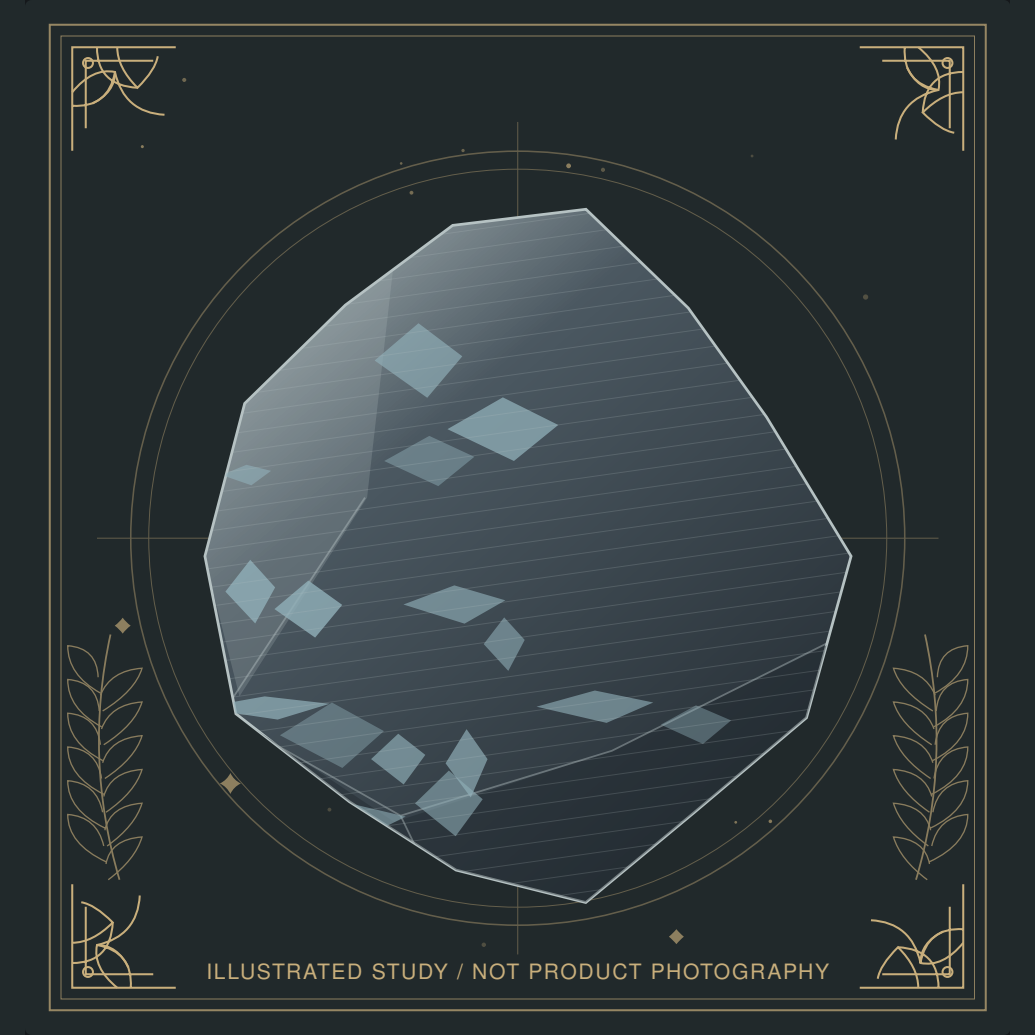
Material
Norwegian igneous rock rich in feldspar that can show blue-silver iridescence. [1]
Family
Igneous rock [1]
Appearance
Directional optical flash [1]
Traditions
The Crystal Council interprets larvikite through grounding and protection in its modern spiritual account. [3]
In this guide
Visual identity
Larvikite is a dark coarse-grained igneous rock whose feldspar grains can flash silver-blue. A polished piece contains intergrown minerals; it is not one large labradorite crystal. Architectural slabs make the whole-rock texture especially easy to see. [1]
The characteristic blue-to-silvery flash is produced by fine feldspar intergrowths and optical interference. The NGU study records patchy, more homogeneous and zoned distributions within individual feldspar crystals. Thus the cut surface may show isolated flashes or a more continuous appearance depending on the rock type and the displayed grains. Color and flash are reasons for its decorative appeal, but they do not imply that the entire object is homogeneous at mineral scale. Darker interstitial minerals remain part of the same rock. [2]
Earth story: geology and formation
The Geological Survey of Norway describes a deep-seated rock formed in the Oslo region around 290 million years ago. Its characteristic play of color comes from feldspar texture. Larvikite’s rock composition and a single feldspar species are different levels of description. [1]
NGU describes larvikite as a deep-seated igneous rock containing feldspars whose mixture can produce a distinctive play of color. Its origin lies in the Oslo region’s ancient igneous activity, and the named rock has a much broader life as dimension stone than a crystal-shop tumble suggests. A coarse-grained polished section preserves boundaries between different grains. Some grains flash while neighbouring dark components remain subdued, making whole-rock texture more informative than one isolated glint. The rock’s composition and age are not a single mineral formula or a personal specimen’s extraction date. [1]
Heldal and colleagues’ 2008 NGU study describes a coarse-grained intrusive rock dominated by ternary feldspar. Pyroxene, amphibole, iron-titanium oxides, biotite and other minerals contribute to the rock, with quartz in some eastern varieties and nepheline in later western ones. The composition is therefore a mixture rather than one mineral formula. Individual feldspar grains can display separate patches of iridescence. A polished dark carving is a worked view of this mixed rock, not a single black feldspar crystal. [2]
The intrusive complex consists of successive, broadly ring-shaped bodies related to the Oslo Rift. The paper reviews dating that places different intrusions around 297 to 293 million years ago and a younger nepheline-syenite phase near 292 million years. These ages fit the broader approximately 290-million-year summary used by NGU. They record a sequence of igneous events, not one instantaneous creation of every larvikite type. Coarse crystals formed within intrusive rock and later weathering, fractures and alteration affected how quarryable blocks could be selected. [2][1]
Varieties and lookalikes
These names describe different levels of information: a mineral species, a visual variety, a crystal habit or a retail label. The distinctions below keep the recognizable shop vocabulary alongside its material explanation.
Blue Pearl, Emerald Pearl and other commercial quarry names organize differences in color, flash and source type. They do not identify new mineral species. The NGU resource study explains that fractures, dykes, alteration and weathering also influence the usefulness of a deposit, because large architectural blocks require particular uniformity and integrity. A small tumble may incorporate material unsuited to those large-block demands without ceasing to be larvikite. Retail terms such as black moonstone instead require clarification because they can obscure the rock identity. [2]
- Larvikite
- The geological rock name retains the relationship among its intergrown minerals and its origin in the Norwegian igneous province. [1]
- Norwegian moonstone and black labradorite
- These search-friendly retail names require correction: larvikite is a rock, not a synonym for either individual gem material. [1]
Human story: history and naming
NGU identifies larvikite as Norway’s national rock and an important architectural stone named after Larvik. This is a documented material and place history. The building stone tradition is firmer evidence than attributing an untraceable ancient Viking magical practice to a modern tumble. [1]
The rock name was first applied as laurvikite by Waldemar Brøgger in 1890 and later adjusted to the present spelling, preserving the connection with Larvik. The NGU paper places the start of commercial quarrying in 1884 near Stavern and discusses its growth as a dimension-stone industry. This supported naming and industrial history is unusually rich for a familiar shop stone. Larvikite appears in architectural cladding and worktops as well as small polished objects, linking the collectible to a much larger history of stone use. [2]
Meaning and practice: attributed traditions
The Crystal Council interprets larvikite through grounding and protection in its modern spiritual account. These are publisher-specific meanings. The national-rock designation and the iridescence do not establish an ancient Nordic correspondence. [3]
An optional grounding reflection is to compare a small polished object with its building-scale use, noticing how context changes the appreciation of the same rock.
The Crystal Council discusses larvikite through grounding and protection. Those are modern practitioner associations, separate from NGU’s account of Norway’s national rock and its dimension-stone uses. A participant may choose the dark body and sudden flash as a focus for steadiness or perspective. The symbolic role is not evidence that the rock blocks radiation or carries a measurable protective field. The geological texture, documented Norwegian place history and present-day personal meaning can all remain visible without being collapsed into one claim. [3]
Material identity and trade terminology
Norwegian moonstone and black labradorite are retail aliases that can obscure the whole-rock identity. A correct description states larvikite and, where established, Norway provenance. Similar flashing dark rocks require identification rather than automatic assignment to Larvik. The whole-rock texture is especially helpful: visible boundaries surround separate flashing feldspar grains, with darker components between them. A small cut piece may expose only a few grains and resemble a single crystal more closely. That change of scale does not make the rock moonstone or labradorite. Recording the intergrown texture explains the distinction in plain language while keeping the familiar retail aliases available for comparison. [1]
Sources and related specimens
The references below distinguish mineral identification and physical properties from historical interpretation and practitioner symbolism. A cited material category describes a kind of stone; it does not certify the identity, treatment or provenance of an untested individual retail specimen.
- Larvikitt
Geological Survey of Norway · Geological, gemological or documented material-history evidence · Accessed October 9, 2026
- National treasure of global significance: Dimension-stone deposits in larvikite, Oslo igneous province, Norway (2008)
Geological Survey of Norway · Geological, gemological or documented material-history evidence · Accessed October 9, 2026
- The Crystal Council: Larvikite
The Crystal Council · Contemporary practitioner symbolism and retailer terminology; distinct from mineralogical evidence · Accessed October 9, 2026