

Blue with white seams
Sodalite
A blue to variable-colored feldspathoid mineral.
Mineral species; ornamental specimens may include other minerals
Sodalite is a sodium-rich feldspathoid, Na8Al6Si6O24Cl2.
Geology · Human history · Attributed traditions
Explore the specimen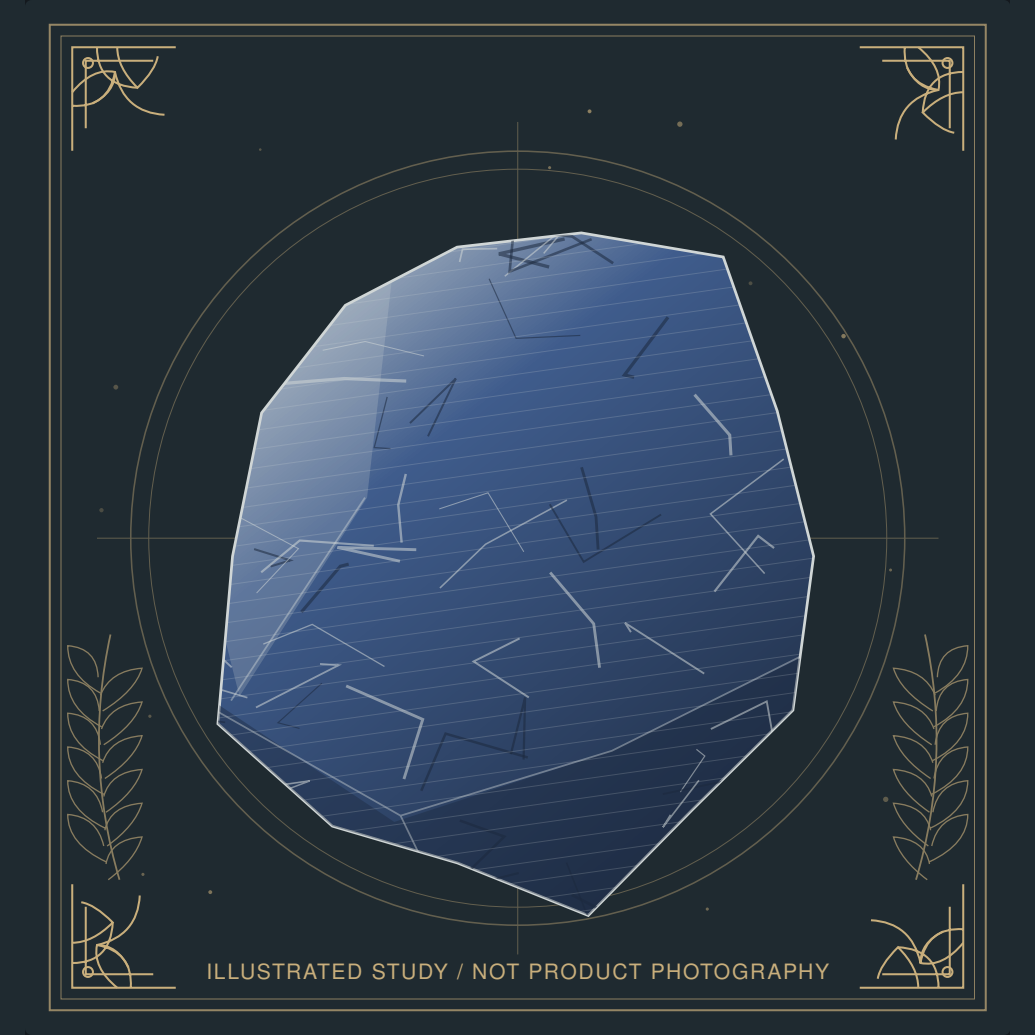
Material
A blue to variable-colored feldspathoid mineral. [2]
Family
Feldspathoid [2]
Appearance
Blue masses with pale veins and sometimes orange UV fluorescence. [2]
Meaning & tradition
Kynes: balance, a modern interpretation. [3]
In this guide
Visual identity & plain-language name
Sodalite is a sodium-rich feldspathoid, Na8Al6Si6O24Cl2. Pale veins and other colored components mean a blue ornamental piece may be sodalite-bearing rock rather than one pure mineral. Feldspathoid identifies a distinct family; it is not a decorative spelling of feldspar. [2]
Earth story: formation, structure & color
The mineral is cubic, usually massive or present as embedded grains, with uncommon recognizable crystals. The Handbook lists hardness 5.5–6, poor cleavage and brittle behavior. Nepheline syenites and related silica-poor rocks are characteristic settings. Some specimens fluoresce orange-red or show photochromism, but neither effect is guaranteed for every tumble. [2]
Sodalite has a framework structure containing sodium, aluminum, silicon, oxygen and chlorine. It belongs among feldspathoids characteristic of silica-poor alkaline assemblages, including nepheline syenites and related rocks. A decorative object cut from such an assemblage can contain feldspar and other minerals as well as sodalite. That is why the composition of pure sodalite cannot be assigned to an entire white-veined blue sphere. A rock description and identification of its blue component complement one another. [2][1]
Cubic symmetry does not mean that a tumble began as a perfect cube. The Handbook records rare dodecahedral crystals, embedded grains and massive occurrences; polishing generally removes their growth boundaries. Its comparatively modest density, about 2.27–2.33, is another property that can assist a suitable examination. Orange-red luminescence, phosphorescence and photochromism are conditional effects, not three synonymous observations. Fluorescence occurs during excitation; an afterglow and a persistent change in bodycolor are different phenomena and should be captioned accordingly. [2][1]
The Ontario Geological Survey inventory explicitly records Yooperlite as an unofficial name for fluorescent sodalite-bearing syenite and discusses a probable Ontario bedrock source for Michigan beach material. The proposed glacial transport connection is an interpretation, not a provenance certificate for every pebble. Its field description includes a gray to buff host with mafic inclusions, demonstrating why orange fluorescence identifies a component while the whole object remains a rock assemblage. This modern record also prevents a recent trade word from being presented as an old mineral species. [4]
Varieties & look-alikes
Blue is an appearance description. Hackmanite is sulfur-bearing sodalite associated with reversible color behavior in suitable specimens. Sunset labels may describe a mixture. Yooperlite names fluorescent sodalite-bearing rock in trade, not a new species. Lapis lazuli is another blue rock with different essential components. [2]
- Blue sodalite
- Familiar blue sodalite can be massive or occur as grains within a multicomponent rock. Pale veins and contrasting areas should not be assigned the pure sodalite formula without identification. Blue intensity alone does not establish an origin. Hardness, density, framework chemistry and conditional optical effects offer several complementary lines of evidence for a suitable examination. [2]
- Sunset or orange trade labels
- These commercial descriptions can emphasize orange or pale components beside blue areas. They do not define a new mineral species or guarantee that orange material is itself sodalite. A precise label states which constituents are confirmed and preserves the seller's commercial term separately. Color names remain appearance vocabulary until component identification establishes something more. [2]
- Hackmanite
- Hackmanite denotes sodalite with conspicuous reversible color behavior. GIA's studied Myanmar and Afghan samples varied in transparency, luminescence and tenebrescence, and sulfur was detected in all examined material. Some samples changed too weakly to justify the hackmanite label in the authors' view. A before-and-after observation is therefore more informative than sulfur-bearing as a sales slogan. [1]
- Yooperlite trade rock
- Yooperlite is retained here as a commercial comparison for fluorescent sodalite-bearing rock, not as a formal species. The rock's ordinary-light texture and the glowing components under UV are separate parts of its presentation. An orange response by itself does not identify all of the gray host material, prove a beach locality or establish the specimen's collection history. [4]
Human story: objects, names & cultural context
The name alludes to sodium content. Blue is only one possible appearance, whereas sodium-rich framework chemistry explains the mineral name. A recent label for a fluorescent rock does not establish an ancient cultural category. [2]
The mineral name emphasizes sodium chemistry rather than a particular decorative color. GIA's 2009 investigation of sodalite and hackmanite from Myanmar and Afghanistan belongs to modern gemological history: it compares locality samples, inclusion patterns, chemical measurements and light responses. The authors found variation within both sample sets, not a single universal response for each country. This documented study is a firmer basis for describing the material than assigning an exact mine from an orange UV photograph. [2][1]
Meaning & practice: attributed traditions
Sandra Kynes gives sodalite a balance correspondence in her 2018 account. This is an attributed modern belief. [3]
An editorial balance reflection can use pale and dark areas to remind you to allocate attention between two commitments. Write a realistic division of time. This practical intention keeps fluorescence and chemistry within the separate account of physical observations.
Material truth: trade names & treatments
Captions should separate ordinary light and ultraviolet illumination and name a sodalite-bearing rock as a rock. Fluorescence does not establish every grain or an origin. Blue may be enhanced or imitated. Do not turn sunset, hackmanite and Yooperlite into interchangeable species labels. [2]
GIA cautions that sulfur traces alone do not sharply separate hackmanite from ordinary sodalite; its investigators recommend noticeable tenebrescence as the practical naming distinction. A specimen can fluoresce strongly without demonstrating a lasting reversible color change. Exposure conditions, prior lighting and the recorded observation matter. A sales label that combines sunset sodalite, hackmanite and fluorescent rock without explaining which effect or constituent was verified obscures rather than clarifies the identity. [2][1]
Compare ordinary-light and UV photographs of the same piece only when the illumination is identified. Record whether bright orange areas correspond to specific grains and whether visible bodycolor remains altered after the excitation ends. This observation record is useful even if it does not establish every mineral in the rock. White veins, gray groundmass and blue zones deserve separate description. The result can be a beautiful sodalite-bearing assemblage without becoming a newly discovered mineral species or a naturally pure single crystal.
Sources & related specimens
The mineralogical source supports chemistry, occurrence and conditional optical effects; Kynes supports the modern meaning. Compare lapis lazuli for another blue mineral mixture and arfvedsonite for a mineral of alkaline rock assemblages.
- Hackmanite/Sodalite from Myanmar and Afghanistan
Gemological Institute of America · Mineralogy, geology, naming and documented material history · Accessed October 9, 2026
- Handbook of Mineralogy: Sodalite
Mineralogical Society of America · Identity and natural history · Accessed October 9, 2026
- Sandra Kynes: 365 Days of Crystal Feng Shui for Your Home (2018)
Llewellyn Worldwide · Sandra Kynes’s contemporary crystal-placement and intention framework · Accessed October 9, 2026
- Ontario Mineral Inventory: Yooperlite Source, Crazy Corner
Ontario Geological Survey · Mineralogy, geology, naming and documented material history · Accessed October 9, 2026