
Blue fibers in stone
Dumortierite
Aluminium borosilicate, commonly encountered in quartz-rich material.
Mineral species; ornamental specimens may include other minerals
Dumortierite is an aluminium borosilicate.
Geology · Human history · Attributed traditions
Explore the specimen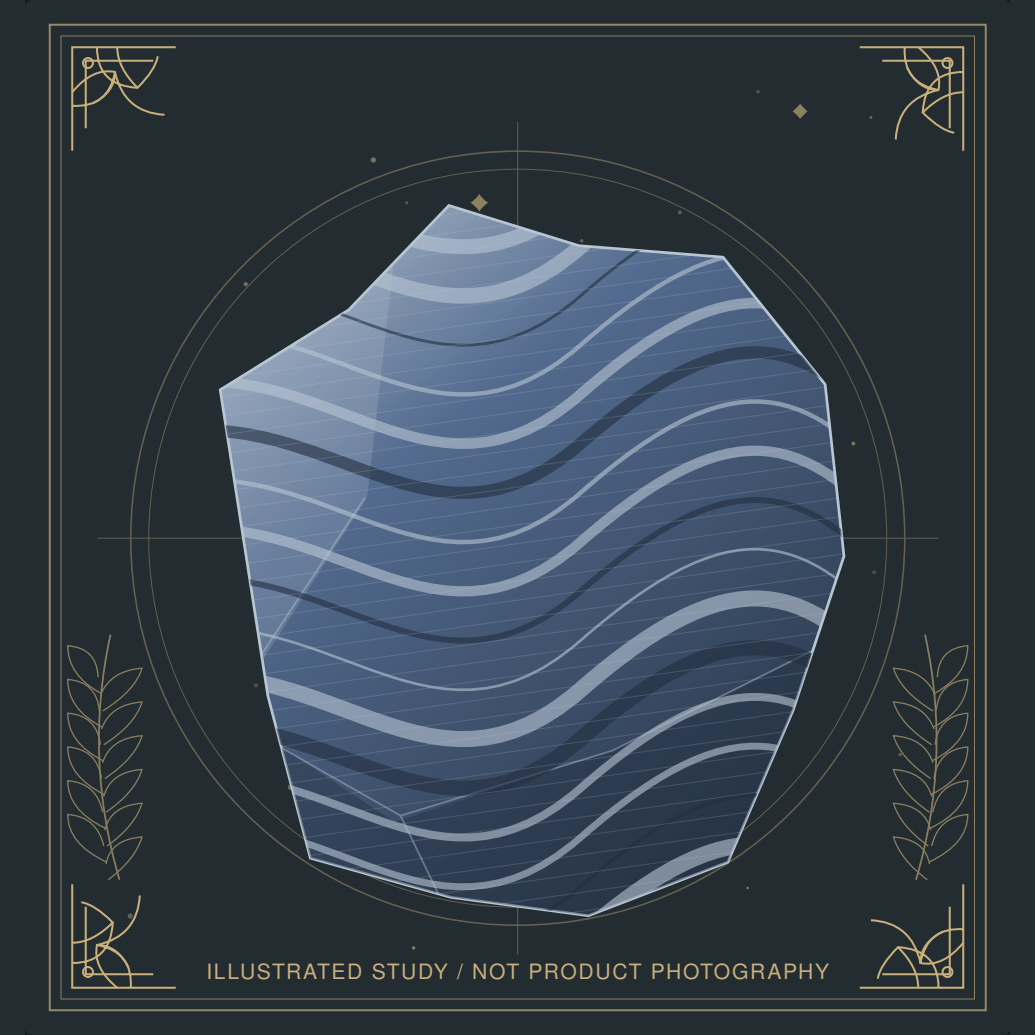
Material
Aluminium borosilicate, commonly encountered in quartz-rich material. [1]
Family
Borosilicate [1]
Appearance
Blue-violet fibrous mineral or blue quartz-rich rock. [1]
Meaning & tradition
Kynes: communication. [2]
In this guide
Visual identity & plain-language name
Dumortierite is an aluminium borosilicate. In the lapidary trade it is often encountered as inclusions or aggregates within quartz-rich material. Calling such a piece dumortierite describes a significant component; it does not establish that the entire tumble is pure mineral. [1]
Earth story: formation, structure & color
The Handbook gives the ideal composition Al7(BO3)(SiO4)3O3, orthorhombic structure and a broad hardness range around 7–8.5. Fibrous or columnar aggregates are characteristic. Aluminium-rich metamorphic settings and other environments provide occurrence context. Quartz intergrowth changes the appearance and behavior of ornamental rock. [1]
Dumortierite is a boron-bearing aluminum silicate, with the Handbook giving the idealized formula Al7(BO3)(SiO4)3O3. Its orthorhombic crystals are commonly fibrous or columnar and may form intimate parallel aggregates of needles. That morphology can account for streaky or silky-looking regions in a blue specimen. Blue and violet are documented appearances, but red-violet, purple and brown also occur; a uniformly deep blue photograph is not a definition of the species. [1]
The mineralogical source records hardness 7–8.5 and density about 3.21–3.41, together with cleavage and pronounced directional optical color in suitable material. It occurs in aluminum-rich metamorphic rocks and pegmatitic veins, commonly with quartz and aluminum silicate minerals such as kyanite, andalusite or sillimanite. A quartz-rich ornamental material can contain dumortierite as a component instead of being a block of pure dumortierite. That distinction is useful for both the material formula and the interpretation of measured bulk properties. [1]
Strong pleochroism is recorded in suitable dumortierite: color can vary with direction in transmitted-light examination. That laboratory property is not the same as a moving surface glitter on an opaque rock. Fibrous or needle aggregates and associated quartz can obscure what individual crystals reveal. The Handbook's noted association with cordierite, kyanite, andalusite, sillimanite and muscovite also situates the mineral among aluminum-rich assemblages. A specific sample's mineral inventory remains an examination question rather than a list inferred automatically from its blue trade name. [1]
Varieties & look-alikes
Compare raw fibrous mineral, dumortierite-bearing quartz and other blue quartz. Blue coloration alone does not establish the identity of inclusions. Sodalite, lapis and dyed quartz can overlap visually with a blue tumble while belonging to different categories. A pale area may be host material rather than a paler dumortierite species. [1]
- Blue dumortierite
- Blue fibrous or massive material can represent a dumortierite-rich aggregate, but the hue alone is not diagnostic. The boron-bearing aluminum silicate identity distinguishes it from sodalite, lapis constituents and dyed silica. Grain texture, natural morphology and appropriate analytical properties provide stronger evidence. Describe any host or accessory material when it is known. [1]
- Dumortierite quartz
- This name should indicate quartz containing confirmed dumortierite rather than a distinct species of quartz with a new formula. The host and inclusion have separate mineral identities. Their proportions and texture influence transparency, pattern and bulk properties. Preserve that two-part account instead of assigning the pure dumortierite formula to the entire polished stone. [1]
- Blue quartz comparison
- Blue quartz describes an appearance unless its coloring features have been established. It can serve as a useful broad label while the particular inclusion or treatment remains unknown. Do not assume that every blue quartz object contains dumortierite. A careful comparison asks what colors the silica, how that was determined and whether treatment was assessed. [1]
Human story: objects, names & cultural context
The name honors the French palaeontologist Eugène Dumortier. This scientific commemoration is a documented naming story. It should remain separate from modern claims that blue stones inherited one universal communication tradition. [1]
The species name honors Eugène Dumortier, the French paleontologist associated with Lyon. The Handbook records early descriptions and later studies refining structure and chemistry, including work on boron-bearing composition. That scientific history is a supported alternative to an invented ancient blue-stone tradition. A specimen from a documented locality can contribute its own collector and material-use history, while a modern polished blue object should not inherit cultural claims simply because its color resembles an older artifact. [1]
Meaning & practice: attributed traditions
Sandra Kynes includes dumortierite in communication correspondences in her 2018 account. This is contemporary spiritual interpretation. [2]
An editorial communication intention might begin by separating a main point from supporting details. The blue component within host rock offers a visual analogy, but the writing and speaking practice produces the practical result.
Material truth: trade names & treatments
Label quartz-rich material accordingly when the mixture is known. High hardness is not a promise that a fibrous surface or fractured host cannot chip. Repair, dye and coating are separate product questions. An exact mineral formula belongs to identified dumortierite, not an untested blue object selected by resemblance. [1]
Blue quartz is a broad descriptive phrase, while dumortierite quartz claims a particular constituent. Different blue coloring features can occur in silica materials, and their identities should not be settled from hue alone. A microscope may reveal inclusions and textures, but a confident mineral determination can require additional analysis. When a product has been dyed or filled, that treatment deserves its own disclosure. The hardness of pure dumortierite cannot authenticate every blue tumble or establish the hardness of a mixed rock. [1]
For a collection record, describe whether blue appears as slender aligned inclusions, diffuse opaque patches or a massive-looking aggregate. A pale translucent quartz host and a deep opaque blue zone may tell different parts of the material story. Keep the observation separate from the conclusion: visible fibers suggest a texture, while confirmed dumortierite requires an identification basis. Surface polish removes original growth clues, so a documented raw specimen can be a helpful comparison without becoming a universal visual template.
Sources & related specimens
The Handbook supports composition, structure, habits and naming. Kynes supplies modern symbolism. Compare quartz and sodalite before treating blue appearance as a species-level answer.
- Handbook of Mineralogy: Dumortierite
Mineralogical Society of America · Identity and natural history · Accessed October 9, 2026
- Sandra Kynes: 365 Days of Crystal Feng Shui for Your Home (2018)
Llewellyn Worldwide · Sandra Kynes’s contemporary crystal-placement and intention framework · Accessed October 9, 2026