
Blue blades
Kyanite
Aluminium silicate mineral, polymorphous with andalusite and sillimanite.
Aluminum silicate mineral species and associated appearance varieties
Kyanite is an aluminium silicate frequently recognized by long blue blades. Fans, intergrown blades and dark aggregates express habit rather than a new mineral species. Color varies, so blue is characteristic but not a complete identification.
Geology · Human history · Attributed traditions
Explore the specimen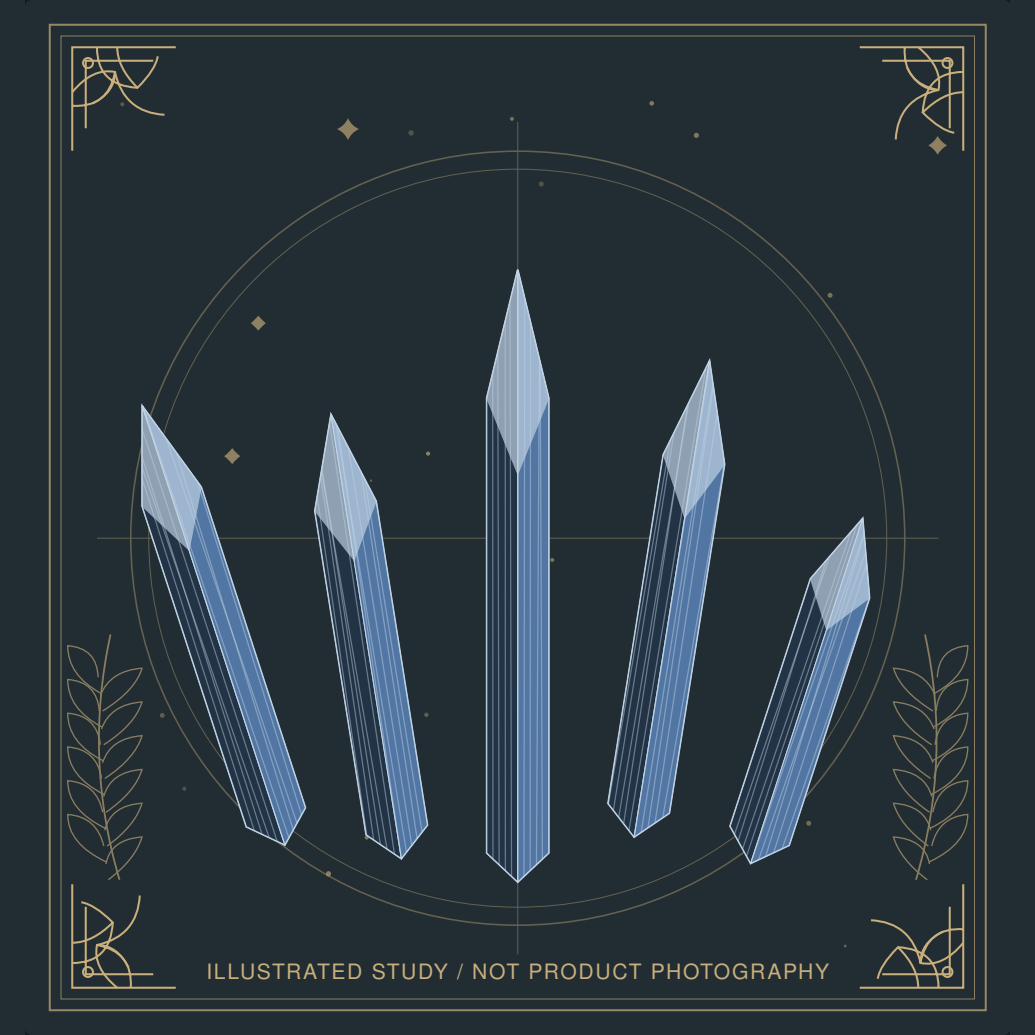
Material
Aluminium silicate mineral, polymorphous with andalusite and sillimanite. [1]
Family
Aluminum silicate [1]
Appearance
Lengthwise face markings [1]
Traditions
Michelle Welch’s 2021 article assigns symbolic clearing to black kyanite. [4]
In this guide
Visual identity
Kyanite is an aluminium silicate frequently recognized by long blue blades. Fans, intergrown blades and dark aggregates express habit rather than a new mineral species. Color varies, so blue is characteristic but not a complete identification. [1]
Long blades are characteristic, but broken fragments and intergrown sprays can look quite different from an ideal single crystal. Its hardness is famously direction-dependent: the Handbook gives approximately 5.5 along one direction and 7 across another. This variation is a crystallographic property rather than inconsistent quality in the material. The blue color can be uneven or accompanied by pale regions, and some specimens have other colors. A comparison based on blue alone overlooks the blade habit, cleavage and orientation-dependent physical behavior. [1]
Earth story: geology and formation
Kyanite shares Al₂SiO₅ composition with andalusite and sillimanite while having a different crystal structure. It is associated with relatively high-pressure regional metamorphism. Its hardness differs by crystal direction, an unusually clear demonstration that one specimen does not always have one simple scratch response. The Handbook records kyanite in schist, gneiss and quartz veins and lists specimens from Brazil, the European Alps and North Carolina among many occurrences. Associated metamorphic minerals can help interpret the host rock’s conditions. A loose blue blade lacks much of that association. Preserving matrix and a documented locality supplies more information than assigning a geological pressure history from the color or blade length alone. [1]
Kyanite has triclinic symmetry and the formula Al₂SiO₅. The Handbook lists hardness approximately 5.5 along one direction and 7 across another, with density around 3.53–3.65 grams per cubic centimetre. Perfect or good cleavage and splintery fracture contribute to the appearance of broken blades. This directional hardness is not an invitation to scratch a valued specimen; it explains why a simple single-number comparison can mislead. A metamorphic mineral’s structure can help interpret the pressure and temperature history of its host, but the observed blue color alone does not reconstruct that whole history. [1]
Kyanite is an aluminum silicate with the composition Al₂SiO₅, formed in metamorphic settings that commonly record comparatively high pressure. Andalusite and sillimanite have the same overall composition but different structures and stability relationships. The comparison shows why a chemical formula alone is not a full mineral identity. Kyanite can occur in schists, gneisses and related veins, with associations including quartz and other metamorphic minerals. An isolated blade may lose that matrix evidence while retaining the structure that identifies the mineral. [1][2]
Varieties and lookalikes
These names describe different levels of information: a mineral species, a visual variety, a crystal habit or a retail label. The distinctions below keep the recognizable shop vocabulary alongside its material explanation.
Blue, green and black kyanite are color descriptions within the mineral identity where confirmed. A black fan or intergrown spray is not a polished gemstone simply because it is displayed with crystal-shop goods. Blue calcite, sodalite-bearing rock and blue glass can supply visual comparisons in limited views, while their structures and properties differ greatly. The collector’s useful observations include whether a specimen is bladed, intergrown or massive and whether a seller’s black or green label is supported by an actual mineral identification. [1][3]
- Blue kyanite
- The common bladed blue appearance motivates the name, but color alone does not supply analytical identity. [1]
- Black kyanite fans
- A dark, fan-like aggregate describes habit and color. Its modern symbolic profile does not redefine its geology. [1]
- Green and orange kyanite
- Other color appearances remain within a mineral identification that needs appropriate evidence rather than a retail photograph. [1]
Human story: history and naming
The Handbook of Mineralogy derives the name from a Greek blue-related root. That naming history concerns a common visible color, not a documented ancient chakra practice. A blue blade can retain its geological meaning without acquiring an unsupported myth. [1]
The Handbook records kyanite from the Alps, Brazil and North American localities, giving a documented collecting setting for the species. Its descriptive naming and recognition as a metamorphic mineral are more supportable historical subjects than claims of universal ancient kyanite ceremony. A recorded rock association can also reveal how collectors and geologists encountered it. The loose blade’s present ritual role, if any, comes from a particular owner or practitioner; it cannot be reconstructed from the blue color or a national source name alone. [1]
Meaning and practice: attributed traditions
Michelle Welch’s 2021 article assigns symbolic clearing to black kyanite. That correspondence is tied to the specifically named dark variety in contemporary practice. Blade and fan forms have a mineralogical description independent of the author’s energetic vocabulary. [4]
An optional clearing reflection is to name one item of unfinished work and decide whether to complete, defer or release it through an ordinary practical action.
Lembo’s indigo grouping associates kyanite with wisdom and intuition, while Welch discusses black kyanite within a contemporary clearing practice. These are related but distinct attributions from named authors. The dark fan’s shape or a blue blade’s color can inform a chosen contemplative setting. Neither appearance establishes that the mineral mechanically sweeps an invisible field. The encyclopedia can preserve the intended meaning and practitioner context while separately explaining pressure-related formation, directional hardness and the mineral’s structural relationship to other aluminum silicates. [5][4]
Material identity and trade terminology
A blade or fan is a crystal habit, not proof of a metaphysical function. Black color does not independently establish a species or source. Splintery breakage and strong cleavage also distinguish the rough structure from a smoothly rounded polished tumble. [1]
A high hardness in one tested direction does not make a thin blade robust in every direction. Good cleavage and a splintery fracture can leave narrow projections vulnerable to handling. Measuring a property destructively on a valued specimen is also different from reading a mineral reference range. For identification, a photograph may suggest the habit, but an ambiguous polished piece can require appropriate testing. The relevant account distinguishes the general species properties from the condition, shape and evidence attached to the individual object. [1]
Sources and related specimens
The references below distinguish mineral identification and physical properties from historical interpretation and practitioner symbolism. A cited material category describes a kind of stone; it does not certify the identity, treatment or provenance of an untested individual retail specimen.
- Handbook of Mineralogy: Kyanite
Mineralogical Society of America · Mineral composition, structure, physical properties and occurrence · Accessed October 9, 2026
- Handbook of Mineralogy: Andalusite
Mineralogical Society of America · Mineral composition, structure, physical properties and occurrence · Accessed October 9, 2026
- Handbook of Mineralogy: Calcite
Mineralogical Society of America · Mineral composition, structure, physical properties and occurrence · Accessed October 9, 2026
- Michelle Welch: 14 Crystals for Clearing, Protecting, and Transmuting (2021)
Llewellyn Worldwide · Contemporary practitioner symbolism and retailer terminology; distinct from mineralogical evidence · Accessed October 9, 2026
- Margaret Ann Lembo: Colors, Enlivening the Rainbow Body (2013)
Llewellyn Worldwide · Contemporary practitioner symbolism and retailer terminology; distinct from mineralogical evidence · Accessed October 9, 2026