
A cross section
Andalusite and Chiastolite
Andalusite; chiastolite is the cross-patterned inclusion variety.
Aluminum silicate mineral species and associated appearance varieties
Andalusite is an aluminium silicate; chiastolite is its inclusion-patterned variety with a dark cross visible in a cut section. The internal cross is different from two whole crystals intersecting as a staurolite twin.
Geology · Human history · Attributed traditions
Explore the specimen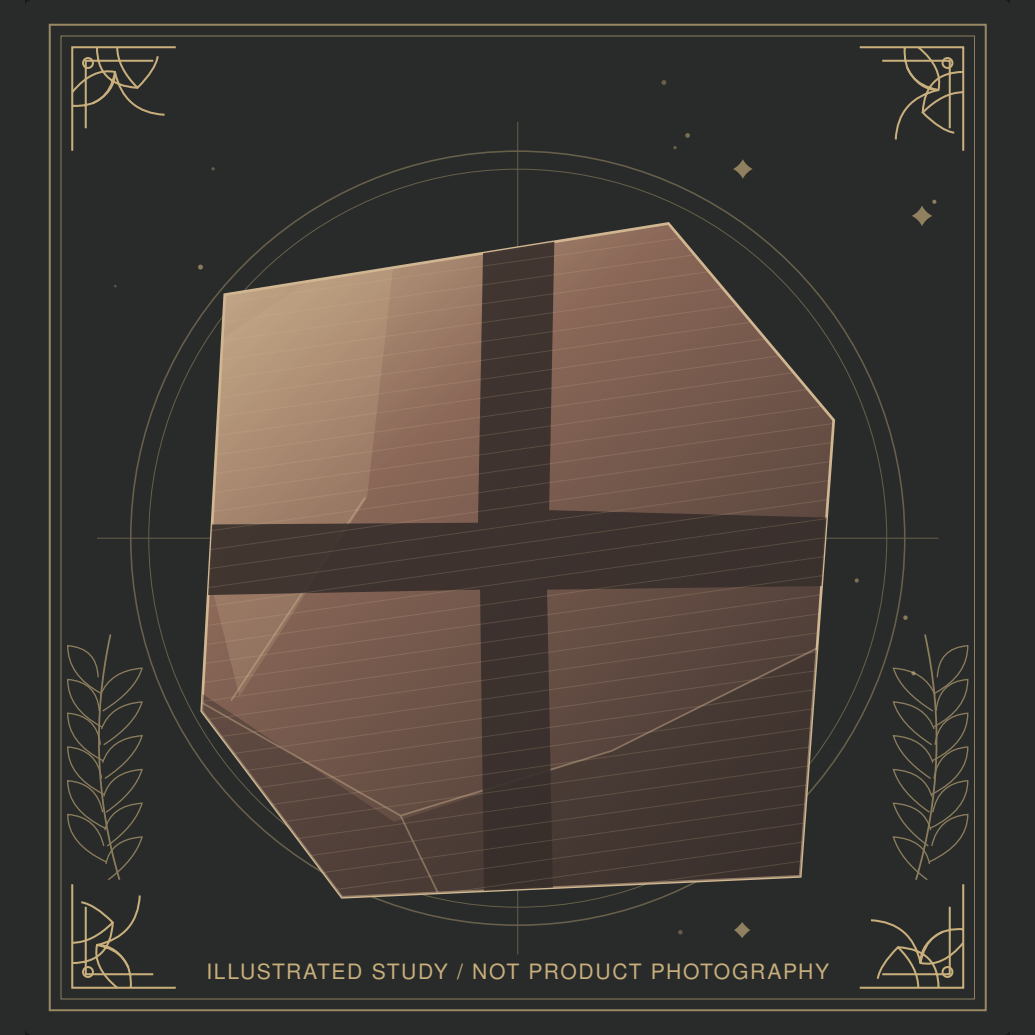
Material
Andalusite; chiastolite is the cross-patterned inclusion variety. [1]
Family
Andalusite [1]
Appearance
Visible internal inclusions [1]
Traditions
The Crystal Council’s chiastolite account uses protection and grounding symbolism. [4]
In this guide
Visual identity
Andalusite is an aluminium silicate; chiastolite is its inclusion-patterned variety with a dark cross visible in a cut section. The internal cross is different from two whole crystals intersecting as a staurolite twin. [1]
Chiastolite is known for a dark cross-like inclusion pattern seen through sections of andalusite. The cross concerns included material and its distribution inside one host crystal. A slice exposes that internal arrangement; the slice’s rounded or rectangular polished outline is a later lapidary choice. Transparent gem andalusite instead emphasizes directional color and clarity. These appearances can be treated within the same parent article because the host framework is shared, while the distinctive inclusion pattern supplies the chiastolite variety description. [1]
Earth story: geology and formation
The Handbook of Mineralogy places andalusite in metamorphic rocks, especially settings involving heated aluminium-rich sediments. Chiastolite’s dark inclusions reveal a growth texture when the crystal is sectioned. Shared composition with kyanite and sillimanite does not mean the three have identical structures or formation conditions. The Handbook records andalusite commonly in contact-metamorphosed clay-rich sediments and in regional metamorphic rocks. Associated minerals can include cordierite, garnet, mica and other aluminium silicates. A cross-patterned slice highlights one growth texture but does not reproduce the host assemblage. This geological setting differs from the external twin relationship that makes a staurolite cross, even where both become objects of symbolic interest. [1]
Andalusite has orthorhombic symmetry and Al₂SiO₅ composition, the same chemical formula as kyanite and sillimanite. The Handbook records hardness 6.5–7.5 and density around 3.13–3.16 grams per cubic centimetre. The distinct structures have different stability conditions, making the association useful in metamorphic interpretation. Good cleavage and brittle fracture remain relevant even when an attractive cross dominates a polished slice. The section’s orientation determines which part of an internal pattern is exposed; a shape visible on one face should not automatically be extended to the entire original crystal. [1]
Andalusite has the composition Al₂SiO₅ but a structure different from kyanite’s. It is associated with contact metamorphism of clay-rich rocks and also occurs in some regional metamorphic settings. The mineral framework is orthorhombic, and a well-developed crystal may preserve a prismatic outline. This structural context explains why the same overall formula can identify several distinct minerals. A brown crystal’s formation account should therefore concern andalusite specifically, rather than importing the higher-pressure account associated with kyanite. [1][2]
Varieties and lookalikes
These names describe different levels of information: a mineral species, a visual variety, a crystal habit or a retail label. The distinctions below keep the recognizable shop vocabulary alongside its material explanation.
A chiastolite cross should not be confused with a staurolite cross twin. The former is a pattern inside andalusite, while the latter is the intersecting growth of a different mineral. The distinction is visible in principle but can be obscured by polished forms or heavily stylized drawings. A correct illustration preserves whether the cross is a dark internal figure or the external outline of intergrown crystals. The religious interpretation a viewer gives a cross-shaped object is a separate question from how the structure or pattern formed. [1][3]
- Andalusite
- The mineral species includes material without the distinctive chiastolite cross. It should not be illustrated as universally cross-patterned. [1]
- Chiastolite
- A patterned variety in which dark inclusions form a cross in section. The mineral and included components remain distinct. [1]
- Cross stone and staurolite comparison
- A cross inside chiastolite is an inclusion pattern in andalusite. Staurolite instead forms intergrown twins, commonly near 60 degrees and less commonly near 90 degrees. The cross is therefore structural in a different way, and the host is a different mineral. The external outline of a staurolite twin should not be drawn as a dark internal chiastolite pattern. Religious or personal imagery is an additional interpretation of either object rather than its mineralogical identity. [1][3]
Human story: history and naming
The Handbook derives the andalusite name from Andalusia and chiastolite from cross-related language. This is a naming account, not proof of a universal Christian or older protective ritual. A carved cross-shaped object and a natural internal cross have different histories. [1]
The andalusite name records its connection with Andalusia in the mineral’s naming history. That geographical term is distinct from a provenance claim for every modern chiastolite slice. The Handbook’s occurrence list gives a broader collecting context for the species. Cross imagery can attract later interpretation, but a historically specific religious use needs an object or text with a recorded setting. A recognizable internal cross alone cannot provide the date, community or purpose of a stone’s previous human use. [1]
Meaning and practice: attributed traditions
The Crystal Council’s chiastolite account uses protection and grounding symbolism. This is an attributed contemporary interpretation. A mineral cross can be meaningful to an individual without requiring an invented ancient lineage or a measurable protective effect. [4]
An optional boundary reflection can use the intersecting lines as a reminder to consider which responsibilities meet and where a practical limit is needed.
The Crystal Council associates chiastolite with grounding and protection in its present-day practice. The source is useful for that attributed meaning rather than for proving a universal ancient cross-stone tradition. A participant might use the four-part pattern as a reminder to consider different directions or establish a personal boundary. The intention belongs to the person. Geology separately describes the andalusite host and its inclusion pattern, without turning the cross into evidence of a measured protective field. [4]
Material identity and trade terminology
Chiastolite’s pattern is inside the crystal; a staurolite fairy cross is a twinned external growth. The name cross stone can obscure this difference. A precisely cut slice may emphasize an inclusion pattern while a different orientation reveals less of it. [1]
Andalusite is hard but brittle and has recognized cleavage. A polished slice can conceal fractures while exposing the attractive cross, and a transparent faceted gem can conceal the natural crystal exterior while emphasizing pleochroism. Both are worked objects whose condition matters. The material identity should not be inferred merely from a cross symbol printed in a listing. Natural inclusion pattern, assembled decorative object and another mineral’s cross twin represent different possibilities that deserve accurate descriptions rather than a single undifferentiated fairy-cross label. [1]
Sources and related specimens
The references below distinguish mineral identification and physical properties from historical interpretation and practitioner symbolism. A cited material category describes a kind of stone; it does not certify the identity, treatment or provenance of an untested individual retail specimen.
- Handbook of Mineralogy: Andalusite
Mineralogical Society of America · Mineral composition, structure, physical properties and occurrence · Accessed October 9, 2026
- Handbook of Mineralogy: Kyanite
Mineralogical Society of America · Mineral composition, structure, physical properties and occurrence · Accessed October 9, 2026
- Handbook of Mineralogy: Staurolite
Mineralogical Society of America · Mineral composition, structure, physical properties and occurrence · Accessed October 9, 2026
- The Crystal Council: Chiastolite
The Crystal Council · Contemporary practitioner symbolism and retailer terminology; distinct from mineralogical evidence · Accessed October 9, 2026