
The turning violet
Iolite
Gem-quality cordierite, often violet-blue and strongly pleochroic.
Gem-quality cordierite variety
Iolite is gem-quality cordierite, often violet-blue with strongly different colors in different viewing directions. This property is pleochroism. The changing hue is not the same phenomenon as a rainbow flash produced by layered feldspar.
Geology · Human history · Attributed traditions
Explore the specimen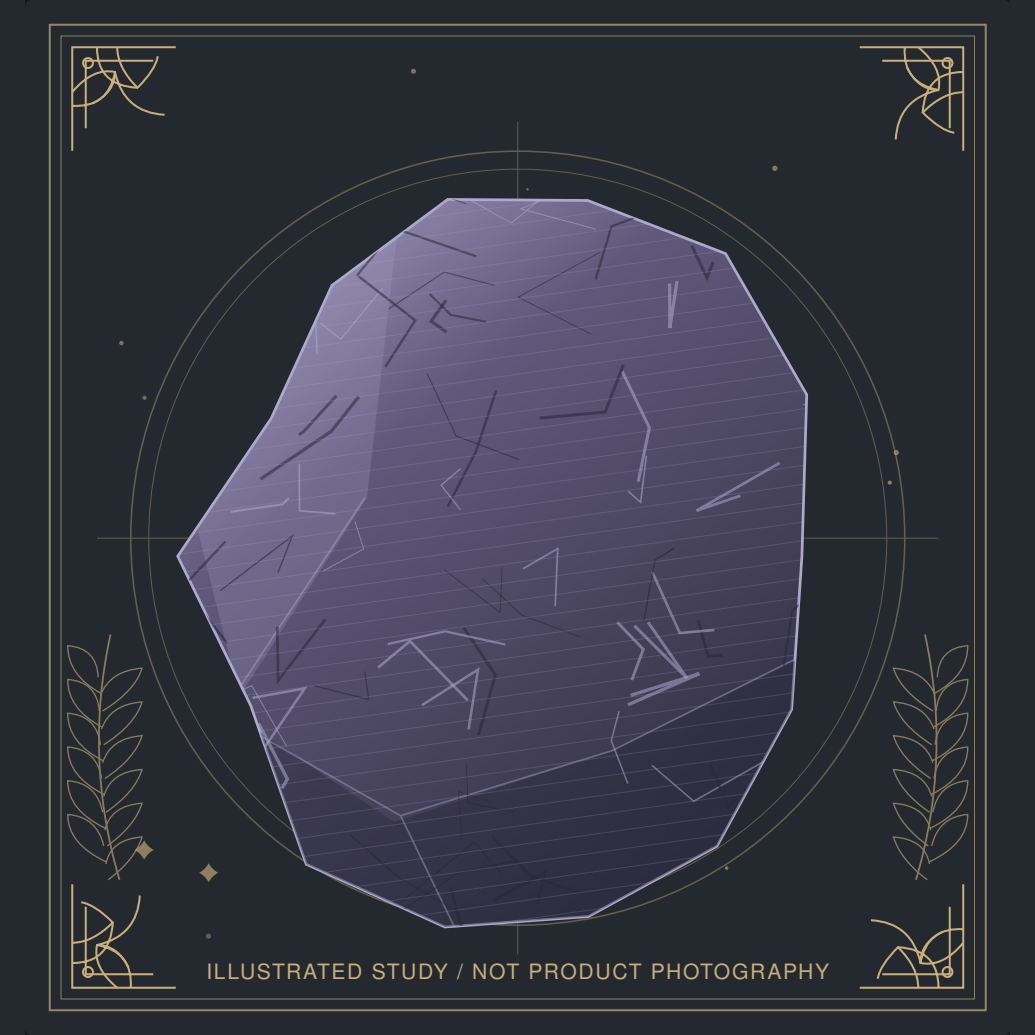
Traditions
The Crystal Council interprets iolite through an inner journey, meditation and self-discovery. [5]
In this guide
Visual identity
Iolite is gem-quality cordierite, often violet-blue with strongly different colors in different viewing directions. This property is pleochroism. The changing hue is not the same phenomenon as a rainbow flash produced by layered feldspar. [1][2]
Strong pleochroism is central to the gem’s appearance: different viewing directions can show blue to violet, paler yellowish or comparatively colorless impressions. This is a directional absorption effect, not a rainbow-colored surface coating. Cutters need to consider the orientation because an attractive blue view may be weaker from another direction. A single photograph can accordingly overstate how blue the entire object appears. A moving view is particularly useful for comparing the saturated direction with the lighter directions and the actual body condition. [2][1]
Earth story: geology and formation
The Handbook of Mineralogy records cordierite in metamorphic settings and gives an orthorhombic structure. GIA explains how viewing direction and cutting influence the apparent color. A pale or brownish direction within a blue crystal is part of its optical character rather than automatically evidence of an added dye. Cordierite is recorded in heat-altered clay-rich sediments and high-grade metamorphic rocks, with additional igneous occurrences. The Handbook lists localities in Finland, Madagascar, India, Australia and Canada. These are occurrence examples, not an authentication method for a cut violet-blue gem. Its directional color describes how light encounters the crystal structure; reconstructing the source rock and historical use requires evidence beyond that visible effect. [1][2]
Cordierite is a magnesium–iron aluminium silicate with orthorhombic symmetry. The Handbook lists hardness 7–7.5, measured density around 2.60–2.66 grams per cubic centimetre, glassy luster and brittle fracture. Its strong directional color is a property of how light travels through the structure. GIA distinguishes this pleochroism from the layered-interference effects familiar in feldspar. The direction chosen by a cutter can emphasize blue-violet color or produce a less saturated view. These optical observations support description and identification but are independent of claims about historical navigation or present-day intuition. [1][2]
Iolite is gem-quality cordierite, an orthorhombic magnesium-iron aluminum silicate. The Handbook places cordierite in metamorphic rocks, including thermally altered clay-rich material, and in some igneous settings. Its magnesium-to-iron variation belongs to the mineral’s composition. The familiar blue-violet gem appearance represents a selected transparent portion of that broader species. A crystal embedded in metamorphic rock and a small faceted iolite can therefore supply different views of the same mineral family without having identical transparency or preserved growth relationships. [1][2]
Varieties and lookalikes
These names describe different levels of information: a mineral species, a visual variety, a crystal habit or a retail label. The distinctions below keep the recognizable shop vocabulary alongside its material explanation.
Water sapphire is a historical trade name for iolite, but the material is cordierite rather than corundum. Sapphire supplies an important blue lookalike with different composition, hardness and optical behavior. The familiar name should therefore be accompanied by the actual host identity. Iolite’s pleochroism is a helpful observation, yet an unfamiliar dark polished stone should not be confidently assigned to it from one directional color change alone. Several materials display directional color, and a specific mineral determination may need further testing. [2][1][3]
Human story: history and naming
GIA recounts the Viking compass-stone story as legend and leaves actual historical use uncertain. This qualification matters: a possible navigation account is not proof that every modern iolite gem was used by Vikings. Cordierite’s naming and mineral description remain a separate documented history. [4]
GIA discusses the often-repeated suggestion that Viking navigators used iolite, but treats the historical connection cautiously rather than as established fact. A mineral’s optical suitability for a proposed task does not demonstrate that a particular population actually used it. The more secure species history includes the cordierite name honoring the French mineralogist Louis Cordier. Keeping these two levels separate allows a reader to appreciate the navigation story as an uncertain hypothesis while retaining the documented naming and mineralogical account. [4][1]
Meaning and practice: attributed traditions
The Crystal Council interprets iolite through an inner journey, meditation and self-discovery. These are contemporary practitioner meanings. Its changing colors can inspire a personal metaphor for perspective without proving psychic vision or a bodily effect. [5]
An optional self-discovery reflection is to ask how a familiar situation looks from a second viewpoint, using directional color as a visual metaphor.
The Crystal Council emphasizes an inner journey and meditation in its contemporary iolite profile. The theme can draw on the stone’s changing views without making the Viking hypothesis an authority for a modern practice. A participant may use the object while comparing perspectives or reflecting on direction. This is a chosen symbolic activity. The optical property is pleochroism in cordierite, and does not certify the accuracy of intuition or provide a clinical outcome simply because a publisher uses journey-related imagery. [5]
Material identity and trade terminology
Water sapphire is a trade name, not corundum sapphire. Pleochroism can help describe a specimen but a photograph alone cannot confirm cordierite or authenticate a navigation story. Host identity, orientation and provenance should remain separate. [1][2]
The Handbook lists hardness 7–7.5 and a density range near 2.60–2.66 grams per cubic centimeter. It also records brittle behavior. Those properties explain why scratch resistance and impact resistance are different questions for a faceted gem or thin carving. The directional appearance should be considered under consistent illumination when comparing objects. Neither the water-sapphire name nor a strongly blue photograph provides a source locality or a treatment declaration; an informative listing keeps those statements separate from the visible color effect. [1][2]
Sources and related specimens
The references below distinguish mineral identification and physical properties from historical interpretation and practitioner symbolism. A cited material category describes a kind of stone; it does not certify the identity, treatment or provenance of an untested individual retail specimen.
- Handbook of Mineralogy: Cordierite
Mineralogical Society of America · Mineral composition, structure, physical properties and occurrence · Accessed October 9, 2026
- GIA: Iolite
Gemological Institute of America · Geological, gemological or documented material-history evidence · Accessed October 9, 2026
- Handbook of Mineralogy: Corundum
Mineralogical Society of America · Mineral composition, structure, physical properties and occurrence · Accessed October 9, 2026
- GIA: Iolite History and Lore
Gemological Institute of America · Historical naming, material use and explicitly attributed lore · Accessed October 9, 2026
- The Crystal Council: Iolite
The Crystal Council · Contemporary practitioner symbolism and retailer terminology; distinct from mineralogical evidence · Accessed October 9, 2026