
The corundum pair
Ruby and Sapphire
Red and other colored gem varieties of corundum.
Corundum mineral species with gem color and optical varieties
Ruby and sapphire are gem varieties of corundum, aluminium oxide. Ruby is red; other gem colors fall under sapphire. A matrix specimen, a transparent cut gem and an opaque star cabochon reveal different appearances of this shared mineral.
Geology · Human history · Attributed traditions
Explore the specimen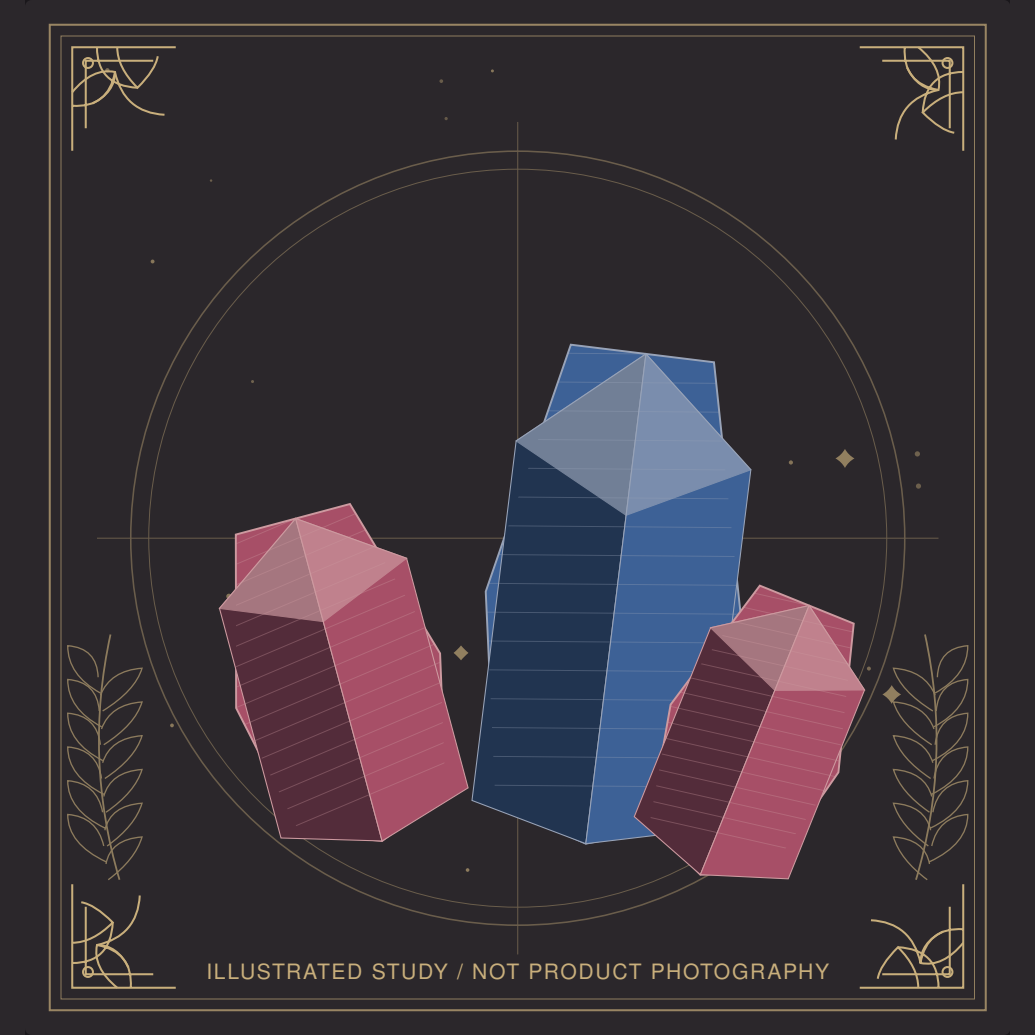
Traditions
Margaret Ann Lembo’s 2013 chart uses ruby for vitality-oriented symbolism and sapphire within wisdom-related blue-stone associations. [8]
In this guide
Visual identity
Ruby and sapphire are gem varieties of corundum, aluminium oxide. Ruby is red; other gem colors fall under sapphire. A matrix specimen, a transparent cut gem and an opaque star cabochon reveal different appearances of this shared mineral. [1][2][3][4]
Well-formed corundum crystals can be barrel-shaped, tabular or prismatic, while gem rough may be rounded by transport or broken during extraction. A star is an optical effect produced by oriented internal inclusions when displayed with suitable illumination and cutting. It is distinct from a naturally star-shaped crystal outline. GIA’s optical review separates the effect from the structure that creates it. A cabochon intended to show a star should therefore be illustrated as an illuminated worked gem rather than a permanently glowing symbol inside every corundum specimen. [3][5]
Earth story: geology and formation
GIA explains color-producing components and the optical role of fine oriented inclusions. A star requires appropriate material and cutting orientation. Corundum’s high hardness does not mean immunity to fracture, and an inclusion or an opaque area can carry information about growth rather than simply being a defect. [1][2][3][4]
Corundum is Al₂O₃ with hardness 9, one of the standard reference values of the Mohs scale. The Handbook gives measured density around 3.98–4.10 grams per cubic centimetre. It has no ordinary simple cleavage, though parting and uneven or curved fracture occur. Its high scratch resistance should not be interpreted as indestructibility. Color zones and inclusions may reveal growth history, while an oriented inclusion network can create a star in a suitably cut cabochon. A species determination, growth-origin determination and assessment of treatment each address a different question. [3][1][2]
Corundum is aluminum oxide, Al₂O₃, with trigonal symmetry. The red gem variety is ruby; sapphire covers the other recognized gem colors, including blue, yellow, green, pink and colorless material in familiar usage. Trace chemistry, structure and inclusions contribute to the appearances. The Handbook records hardness 9 but also brittle behavior and possible parting. Corundum’s excellent resistance to scratching therefore does not make a crystal unbreakable or remove vulnerabilities caused by an existing fracture or a particular cut. [3][1][2]
Varieties and lookalikes
These names describe different levels of information: a mineral species, a visual variety, a crystal habit or a retail label. The distinctions below keep the recognizable shop vocabulary alongside its material explanation.
The pink-sapphire versus ruby boundary can depend on how gem authorities and markets interpret the color category. The shared corundum host may be secure while the variety word remains a descriptive standard. Star ruby and star sapphire add an optical qualifier, not a different mineral formula. Color-change material adds another observational qualifier. These names can be combined meaningfully if the host, color and actual phenomenon are stated, without pretending that every commercial designation identifies an independent approved mineral species. [1][2][5]
Human story: history and naming
GIA documents historical ruby imagery involving passion and power and sapphire associations with nobility, truth and faithfulness. Historical gem names can encompass materials that would receive different modern identifications, so a story about an old red or blue stone should retain that uncertainty. [6][7]
GIA’s historical pages record longstanding ruby associations with power and passion and sapphire associations with nobility and faithfulness. Older red-gem names could also encompass material that modern analysis would identify differently. A famous historical jewel’s inherited name is therefore not always proof of corundum. The most reliable account ties material identity to a documented object, date and use where available. Broad color lore remains an attributed historical interpretation rather than a record that every red or blue specimen was used identically. [6][7]
Meaning and practice: attributed traditions
Margaret Ann Lembo’s 2013 chart uses ruby for vitality-oriented symbolism and sapphire within wisdom-related blue-stone associations. These are distinct contemporary profiles within one mineral framework. Shared corundum identity does not collapse their cultural meanings into one. [8]
An optional truth reflection is to distinguish the material’s shared structure from the meanings people assign to its different colors.
Lembo uses ruby and sapphire in different color-based symbolic lanes: the former with vitality-oriented themes and the latter with wisdom and intuition. This is a contemporary practitioner system, not a direct consequence of both being aluminum oxide. It also demonstrates why one corundum article can retain distinct spiritual attributions for its important gem varieties. A participant’s intended meaning can differ between objects while their shared species identity remains true. Neither red nor blue corundum guarantees the personal quality associated with it. [8]
Material identity and trade terminology
Natural, laboratory-grown, heated, diffusion-treated or glass-filled material needs precise disclosure. Ruby-in-zoisite and ruby-in-fuchsite are mixed materials, not pure ruby crystals. A star or vivid color alone cannot settle growth origin or treatment. A gem report can distinguish the identity corundum from an origin or treatment conclusion. Heating, diffusion and fracture filling do not all modify the stone in the same way, so the word treated is only a starting category. A matrix sample likewise needs component-level description. Red spots in a green rock may be corundum, but calling the whole object ruby would erase the rock’s composition and setting. [1][2][3][4]
Heat treatment, diffusion, fracture filling and synthetic growth raise different identification questions in the corundum trade. GIA’s overview explains that some processes alter an existing natural stone, while synthesis creates a laboratory-grown counterpart. A filled ruby can have a natural corundum host and substantial introduced material; a synthetic sapphire can have corundum’s structure while lacking natural geological origin. Glass imitation is different again. A complete listing needs more than the word genuine or the hardness associated with the ideal mineral. [4][1][2]
Sources and related specimens
The references below distinguish mineral identification and physical properties from historical interpretation and practitioner symbolism. A cited material category describes a kind of stone; it does not certify the identity, treatment or provenance of an untested individual retail specimen.
- GIA: Ruby
Gemological Institute of America · Geological, gemological or documented material-history evidence · Accessed October 9, 2026
- GIA: Sapphire
Gemological Institute of America · Geological, gemological or documented material-history evidence · Accessed October 9, 2026
- Handbook of Mineralogy: Corundum
Mineralogical Society of America · Mineral composition, structure, physical properties and occurrence · Accessed October 9, 2026
- GIA: An Introduction to Gem Treatments
Gemological Institute of America · Geological, gemological or documented material-history evidence · Accessed October 9, 2026
- GIA: Optical Effects in Phenomenal Gemstones
Gemological Institute of America · Geological, gemological or documented material-history evidence · Accessed October 9, 2026
- GIA: Ruby History and Lore
Gemological Institute of America · Historical naming, material use and explicitly attributed lore · Accessed October 9, 2026
- GIA: Sapphire History and Lore
Gemological Institute of America · Historical naming, material use and explicitly attributed lore · Accessed October 9, 2026
- Margaret Ann Lembo: Colors, Enlivening the Rainbow Body (2013)
Llewellyn Worldwide · Contemporary practitioner symbolism and retailer terminology; distinct from mineralogical evidence · Accessed October 9, 2026