
The many faced seed
Garnet
A group of related silicate minerals.
Silicate mineral group with end members, solid solutions and gem varieties
Garnet is a mineral group, not only a red gemstone. Equant crystals, massive material and orange or green gems show its breadth. Shared crystal structure links compositions that can differ substantially in chemistry and appearance.
Geology · Human history · Attributed traditions
Explore the specimen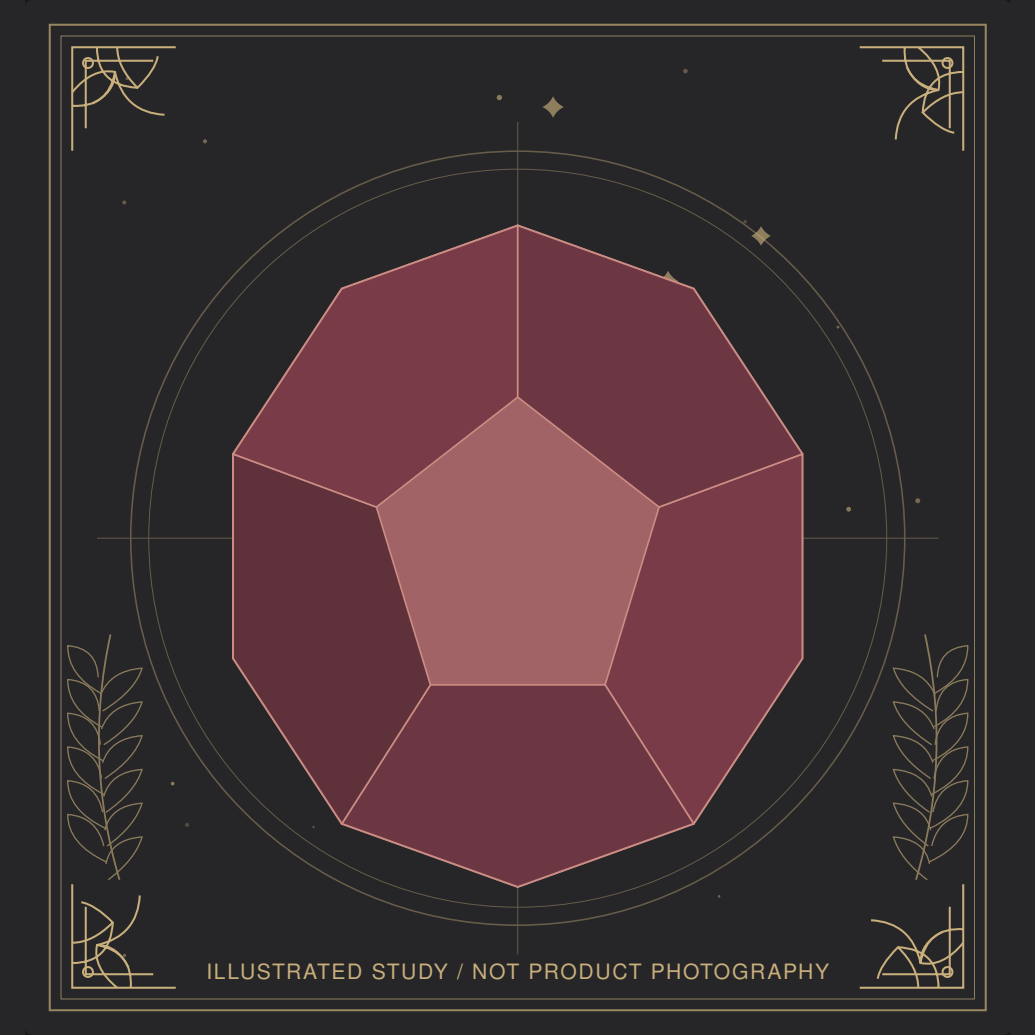
Traditions
Margaret Ann Lembo’s 2013 chart associates garnet with vitality and motivation in a root-centered framework. [6]
In this guide
Visual identity
Garnet is a mineral group, not only a red gemstone. Equant crystals, massive material and orange or green gems show its breadth. Shared crystal structure links compositions that can differ substantially in chemistry and appearance. [1][2][3][4]
Well-formed garnet crystals can have equant faces, and many collectors recognize the dodecahedral habit, but rounded grains and embedded crystals are also common. A faceted jewel emphasizes transparency and optical performance; a crystal in a rock matrix emphasizes the growth relationship. These views answer different questions about the same family. Red, orange, green and other appearances reflect the group’s chemical diversity. A green grossular or andradite example is not an anomaly that must be repainted as red to match a popular garnet stereotype. [2][3][4][1]
Earth story: geology and formation
GIA describes several gem garnet species and mixtures. Almandine is iron-aluminium rich, pyrope magnesium-aluminium, and grossular calcium-aluminium. Their mineral properties and formation contexts differ. A red gem cannot reliably be assigned to a species by color alone, and a trade variety need not correspond to one end-member formula. [1][2][3][4]
Garnets share a cubic structural pattern but permit substantial chemical variation. Almandine, grossular and andradite have different dominant elements and corresponding property ranges. Many crystals are roughly equant, with dodecahedral or more complex faces, rather than the elongated prisms typical of tourmaline. Mixed compositions can make a retail variety name more useful visually than an ideal end-member formula. GIA’s gem overview treats several garnets together while preserving these differences. A smooth tumble may conceal its original crystal faces, so neither a rounded shape nor red color is a reliable species-level test. [1][2][3][4]
The garnet group shares a structural family but varies in the elements occupying its principal chemical sites. Almandine is iron-aluminum rich, grossular is calcium-aluminum rich and andradite is calcium-iron rich. Mixing between end members contributes to the compositions of real specimens. GIA consequently gives property ranges for the gem family rather than one universal specific gravity or refractive index. Familiar red color identifies a useful appearance category, but does not by itself settle the proportions of the named end members. [2][3][4][1]
Varieties and lookalikes
These names describe different levels of information: a mineral species, a visual variety, a crystal habit or a retail label. The distinctions below keep the recognizable shop vocabulary alongside its material explanation.
Rhodolite is a familiar pyrope-almandine gem term, while hessonite and tsavorite are grossular varieties and demantoid belongs to andradite. The names sit at different levels from the broader group name. They also show why a variety cannot be authenticated by color alone: orange is not exclusive to one garnet member, and green is not exclusive to another. Species or composition testing may be needed for a precise label. A mixed garnet specimen can retain its attractive color name while its mineralogical account explains the underlying solid-solution relationship. [1][3][4]
- Almandine, pyrope and rhodolite
- Deep red material includes different compositions and mixtures. Rhodolite is trade terminology, not an additional approved species. [1][2][3][4]
- Spessartine
- A manganese-aluminium garnet familiar for orange appearances. Color alone is still insufficient for a species determination. [1][2][3][4]
Human story: history and naming
GIA records Egyptian red-garnet adornment, Roman carved signet rings and medieval elite use. It also warns that carbuncle referred broadly to red gems, so an ancient carbuncle story cannot always be assigned to a modern garnet species. Later Bohemian deposits supported a regional jewelry industry. [5]
GIA connects red garnet to Roman seal rings and describes the later Bohemian deposits as the center of a regional jewelry industry. The supply expanded around the sixteenth century, and that industry reached a nineteenth-century peak. These are documented changes in mining and fashion. The historical word carbuncle was used for a wider assortment of red gems, so it cannot always be translated directly into a modern garnet species. Old color language and current mineralogical identity need to be interpreted within their respective settings. [5]
Meaning and practice: attributed traditions
Margaret Ann Lembo’s 2013 chart associates garnet with vitality and motivation in a root-centered framework. This is contemporary correspondence writing. It should not be generalized to every green garnet or every ancient object merely because both fall within the mineral group. [6]
A motivation reflection can identify one action that sustains a project. A favored garnet color may symbolize that action without guaranteeing stamina or success.
Lembo’s chart places garnet in a red-stone symbolic group concerned with motivation and vitality. The cited grouping is not a chemical definition, nor should it be assigned without qualification to every green or orange garnet. A practitioner can choose a red specimen as a visual reminder of an intended action. The mineral’s chemical end members and its historical use in sealing documents remain separate subjects. A historically red jewel does not independently prove the chakra interpretation that a modern publication gives it. [6]
Material identity and trade terminology
Rhodolite is a gem-trade variety rather than a separate mineral species. Hessonite, tsavorite and demantoid need their parent mineral identities. Natural, imitation and treated material should retain separate disclosures; the term garnet does not certify a locality or one uniform value. A group-level property range and an end-member formula serve different purposes. Garnets can contain mixed compositions, so an attractive red stone should not be assigned an ideal almandine or pyrope formula from a photograph. Similarly, tsavorite and demantoid both look green but belong to different parent minerals. The useful comparison preserves both the recognizable gem name and the parent species, rather than sorting the whole family only by color. [1][2][3][4]
Sources and related specimens
The references below distinguish mineral identification and physical properties from historical interpretation and practitioner symbolism. A cited material category describes a kind of stone; it does not certify the identity, treatment or provenance of an untested individual retail specimen.
- GIA: Garnet
Gemological Institute of America · Geological, gemological or documented material-history evidence · Accessed October 9, 2026
- Handbook of Mineralogy: Almandine
Mineralogical Society of America · Mineral composition, structure, physical properties and occurrence · Accessed October 9, 2026
- Handbook of Mineralogy: Grossular
Mineralogical Society of America · Mineral composition, structure, physical properties and occurrence · Accessed October 9, 2026
- Handbook of Mineralogy: Andradite
Mineralogical Society of America · Mineral composition, structure, physical properties and occurrence · Accessed October 9, 2026
- GIA: Garnet History and Lore
Gemological Institute of America · Historical naming, material use and explicitly attributed lore · Accessed October 9, 2026
- Margaret Ann Lembo: Colors, Enlivening the Rainbow Body (2013)
Llewellyn Worldwide · Contemporary practitioner symbolism and retailer terminology; distinct from mineralogical evidence · Accessed October 9, 2026