
Olive light
Peridot
Gem-quality olivine, usually magnesium-rich.
Gem-quality olivine variety, commonly magnesium-rich
Peridot is gem-quality olivine, usually yellow-green through olive green. Rough can occur as grains in a darker volcanic host rather than a long pointed crystal. Its green appearance differs from many gems whose color chiefly depends on trace components.
Geology · Human history · Attributed traditions
Explore the specimen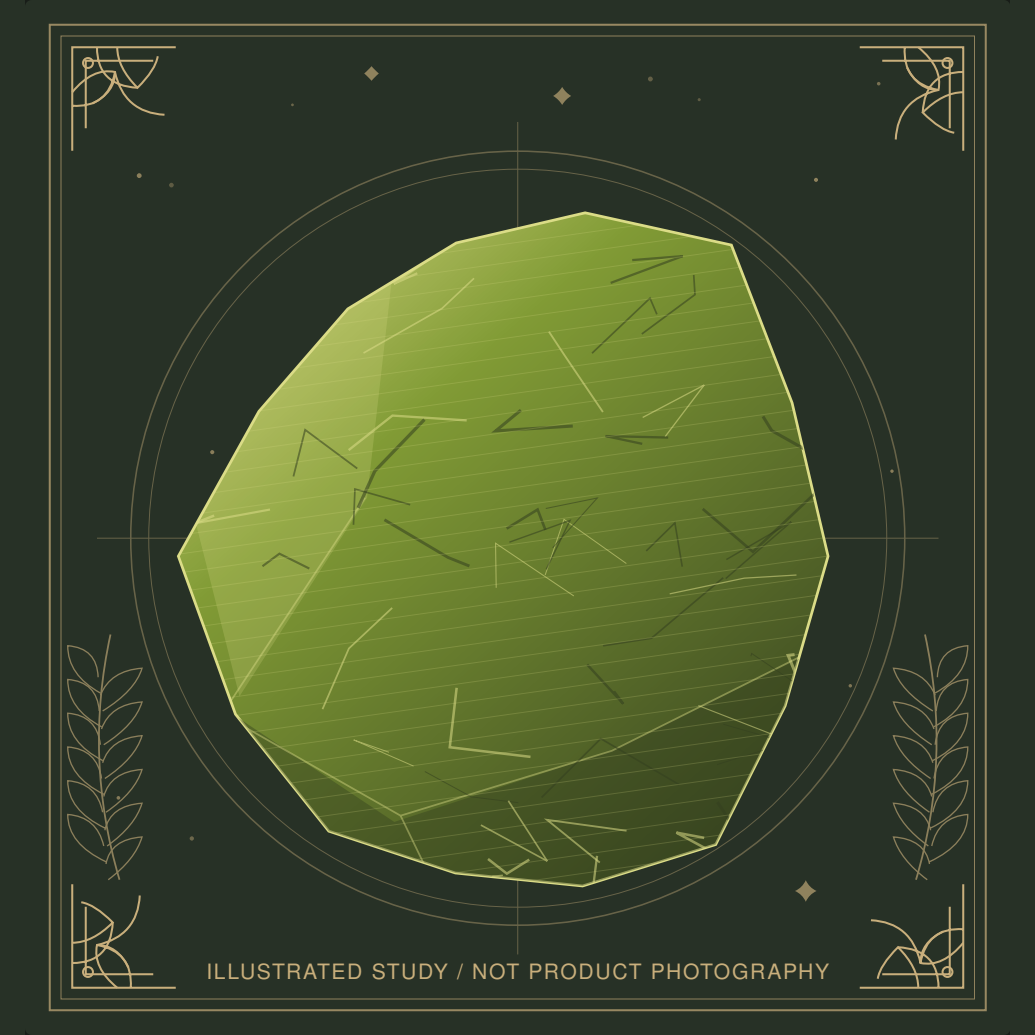
Traditions
Stephanie Rose Bird’s 2003 account includes peridot in prosperity-oriented symbolism. [4]
In this guide
Visual identity
Peridot is gem-quality olivine, usually yellow-green through olive green. Rough can occur as grains in a darker volcanic host rather than a long pointed crystal. Its green appearance differs from many gems whose color chiefly depends on trace components. [1][2]
The characteristic yellowish-green to green color comes from the material’s composition rather than from one universally necessary included particle. Its appearance can differ in tone and saturation, and a faceted stone emphasizes transparency more strongly than a rough olivine grain. The orthorhombic structure and optical properties separate it from green beryl, tourmaline and glass. The gem name is therefore a useful specific identity, not a general category for all olive-colored crystals offered in shops. [1][2]
Earth story: geology and formation
GIA describes mantle-derived olivine carried toward the surface by volcanic processes. The Handbook of Mineralogy records forsterite, a magnesium-rich member of the olivine series. Terrestrial volcanic material and rare olivine from meteorites are separate source stories; a green gem does not establish an extraterrestrial origin. The Handbook records forsteritic olivine in mafic and ultramafic rocks as well as thermally altered impure dolomitic limestone. It lists examples from Arizona, Pakistan and the Red Sea island of Zabargad. These contexts show why the phrase mantle gem is informative but not a complete account of every olivine occurrence. A basalt-hosted grain preserves a visible rock relationship that a detached faceted peridot no longer shows. [1][2]
Forsterite is magnesium silicate, Mg₂SiO₄, within the olivine series. The Handbook records orthorhombic symmetry, hardness around 7, density about 3.275 grams per cubic centimetre, glassy luster and brittle curved fracture. Peridot can contain iron as part of its composition, and a particular gem does not have to match the ideal magnesium end-member exactly. Mantle-derived material, a grain in a volcanic rock and a cut gemstone present different observations of that family. The mineral’s chemistry helps explain its identity but does not independently certify the extraction history or source of an individual gem. [2][1]
Peridot is gem-quality olivine, typically on the magnesium-rich side of the forsterite-fayalite series. The Handbook records forsterite in mafic and ultramafic igneous rocks and in some metamorphosed magnesium-rich carbonate settings. GIA also discusses the mantle and volcanic transport context familiar from many gem supplies. These settings concern the formation and later exposure of the material. A cut green gem may no longer preserve the surrounding rock that would show which geological route applies to the individual specimen. [2][1]
Varieties and lookalikes
These names describe different levels of information: a mineral species, a visual variety, a crystal habit or a retail label. The distinctions below keep the recognizable shop vocabulary alongside its material explanation.
GIA notes that olivine can occur in meteorites, but that unusual setting should not become the assumed origin of ordinary retail peridot. A meteorite-related claim requires evidence tying the material to a particular specimen and source. Familiar terrestrial supplies include the San Carlos region of Arizona and other documented deposits. The same green color cannot certify extraterrestrial origin, an ancient Egyptian source or a modern national source. The material name and a defensible provenance are different parts of a complete description. [1][2]
Human story: history and naming
GIA records historical confusion of peridot with topaz and emerald, including gems at Cologne Cathedral now identified as peridot. It describes Egyptian light-associated lore while marking popular stories as legend. Older gemstone names do not always map directly to modern mineral identification. [3]
GIA’s historical discussion notes that stones now recognized as peridot were sometimes called topaz or emerald in older accounts. It also identifies peridot among green stones associated with Cologne Cathedral. This is an important warning against reading modern mineral categories directly into every historical color term. The island source of Zabargad gives the material a specific collecting history, while later analytical identification can correct an inherited label. Historical prestige does not remove the need to identify what an object actually contains. [3]
Meaning and practice: attributed traditions
Stephanie Rose Bird’s 2003 account includes peridot in prosperity-oriented symbolism. The meaning is attributed practitioner interpretation. It can support an intention to appreciate resources without predicting money or assigning the same practice to every historical green gem. [4]
An optional prosperity prompt is to recognize one existing resource and choose a practical way to use it responsibly.
Bird includes peridot in prosperity-related contemporary symbolism. This offers an attributable spiritual association without turning an old topaz or emerald reference into proof of the same modern practice. A chosen reflective use can concern gratitude, sufficiency or an intention to act thoughtfully with resources. The green gem’s geological setting and its chromium-independent olivine identity explain a different set of facts. Neither terrestrial nor meteorite origin would make the participant’s intended prosperity an experimentally demonstrated property of the stone. [4]
Material identity and trade terminology
Sources and related specimens
The references below distinguish mineral identification and physical properties from historical interpretation and practitioner symbolism. A cited material category describes a kind of stone; it does not certify the identity, treatment or provenance of an untested individual retail specimen.
- GIA: Peridot
Gemological Institute of America · Geological, gemological or documented material-history evidence · Accessed October 9, 2026
- Handbook of Mineralogy: Forsterite
Mineralogical Society of America · Mineral composition, structure, physical properties and occurrence · Accessed October 9, 2026
- GIA: Peridot History and Lore
Gemological Institute of America · Historical naming, material use and explicitly attributed lore · Accessed October 9, 2026
- Stephanie Rose Bird: Using Stones, Minerals, and Metals for a Charmed Life (2003)
Llewellyn Worldwide · Contemporary practitioner symbolism and retailer terminology; distinct from mineralogical evidence · Accessed October 9, 2026