
Pistachio prisms
Epidote
Calcium aluminium iron silicate in the epidote group.
Calcium-bearing hydroxyl silicate mineral species
Epidote is a calcium aluminium iron silicate often recognized by pistachio-green prisms. It also occurs as a component of mixed rocks. Naming epidote in a piece does not make every part of the host the same mineral.
Geology · Human history · Attributed traditions
Explore the specimen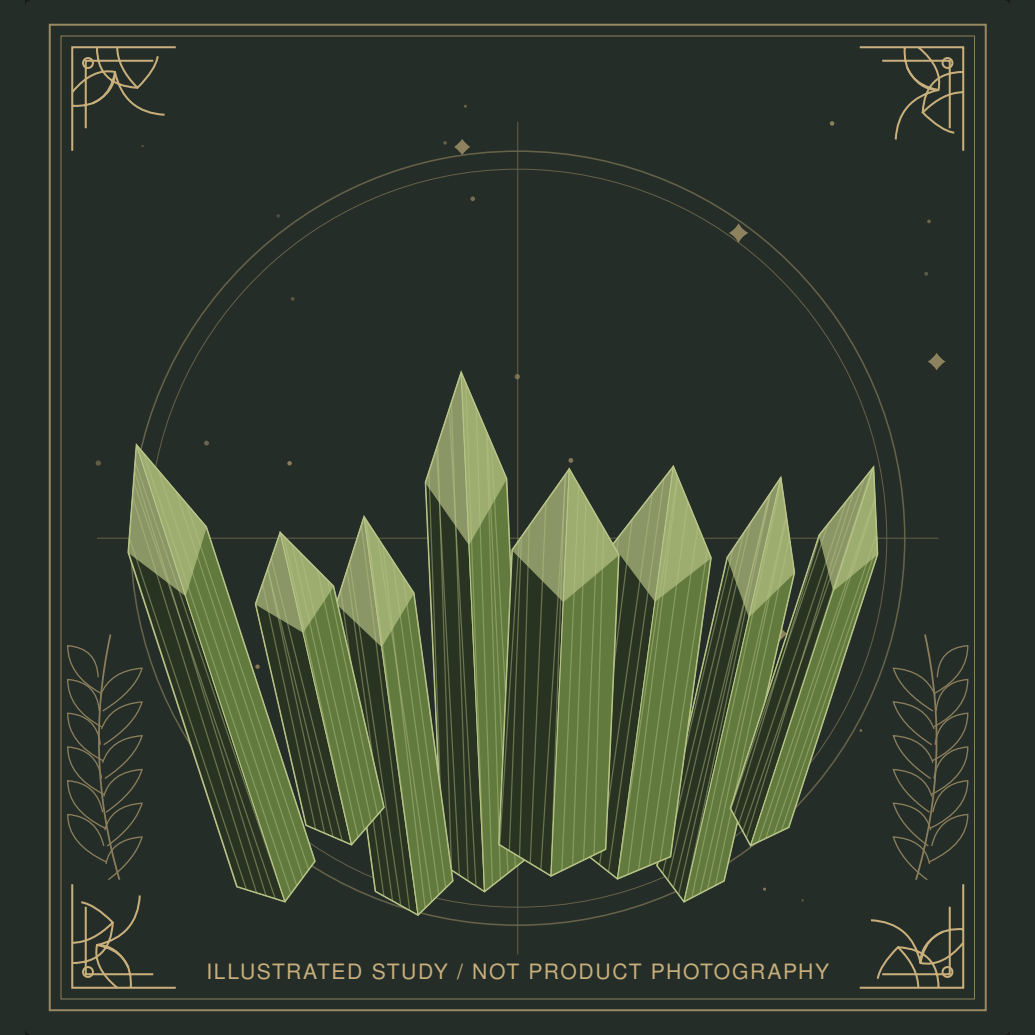
Material
Calcium aluminium iron silicate in the epidote group. [1]
Family
Epidote-related silicates [1]
Appearance
Lengthwise face markings [1]
Traditions
Sandra Kynes’s 2018 home-correspondence article includes epidote in success-oriented practice. [3]
In this guide
Visual identity
Epidote is a calcium aluminium iron silicate often recognized by pistachio-green prisms. It also occurs as a component of mixed rocks. Naming epidote in a piece does not make every part of the host the same mineral. [1]
Individual crystals are commonly elongated prisms, sometimes deeply striated, and can look nearly black in thicker directions even where the mineral has a pistachio-green color in a lighter view. Massive or fine-grained epidote in a rock does not present the same habit as a display-quality crystal. An illustration can show the contrast between a sharply outlined prism and green material dispersed through a matrix. The visible tone depends on thickness and illumination as well as composition, so darkness alone is not a diagnosis of a different mineral. [1]
Earth story: geology and formation
The Handbook of Mineralogy records epidote in metamorphic and altered rocks. Its growth can reflect reactions involving earlier minerals and fluids. Quartz-hosted crystals and epidote within unakite provide different geological relationships, which should not be flattened into one green-tumble identity. The Handbook records epidote in several metamorphic environments, contact zones and altered plagioclase. It lists notable crystals from Austria’s Knappenwand and Pakistan’s Tormiq, among other places. Different host assemblages record different reactions, so a green prism does not represent a universal metamorphic setting. Matrix and associated minerals preserve context that may be lost when the crystal becomes a detached tumble. [1]
Epidote has monoclinic symmetry and a calcium aluminium iron silicate composition containing hydroxyl. The Handbook lists hardness 6–7 and density around 3.38–3.49 grams per cubic centimetre, with strong cleavage and brittle uneven fracture. Its pistachio-to-dark-green color can vary in depth and direction. A loose prism, an inclusion in quartz and a grain within a decorative rock preserve different geological relationships. These forms share a mineral identity only where identified; the common green color is not a substitute for component analysis or a complete description of the surrounding rock. [1]
Epidote is a calcium-aluminum-iron hydroxyl silicate whose iron contribution is important to its familiar green appearance. The Handbook records regional and contact metamorphic occurrences and alteration of calcium-bearing feldspar. This supplies a specific reaction and rock-context account rather than a generic assertion that all green stones grew in volcanic lava. Epidote may accompany quartz, feldspar, calcite and other minerals. Preserved associations can help tell how a crystal relates to its surrounding rock, while an isolated polished piece reveals only a selected part of that setting. [1]
Varieties and lookalikes
These names describe different levels of information: a mineral species, a visual variety, a crystal habit or a retail label. The distinctions below keep the recognizable shop vocabulary alongside its material explanation.
Pistacite is a historical name associated with the familiar pistachio-green mineral. Epidote-bearing rock and prehnite containing confirmed epidote are component descriptions, not separate approved species. Unakite, discussed elsewhere in the catalogue, illustrates how green epidote can be one constituent of a larger decorative rock. A mixed object should retain its whole-rock identity rather than inherit every property of pure epidote. The matrix and included crystals contribute their own chemistry, texture and durability to the material a collector actually handles. [1][2]
- Green epidote
- Color and prismatic form provide useful observations, but confirmed identity remains more specific than a green appearance. [1]
- Epidote in quartz
- The inclusion and quartz host are different minerals. Their association should be captioned as such. [1]
- Pistacite
- A historical name associated with epidote, useful for interpreting old labels rather than multiplying species. [1]
Human story: history and naming
The Handbook derives its name from Greek increase-related language associated with unequal prism dimensions. This historical naming detail concerns crystal appearance. It does not establish an inherited success ritual for every epidote specimen. [1]
The name’s increase-related Greek derivation refers to the unequal dimensions of prism faces in its descriptive history. The Handbook also records notable collection localities including Knappenwand in Austria and the Tormiq area of Pakistan. Such information situates the species within observation, collecting and mineral description. It does not give an unlabelled crystal a proven origin, but it provides concrete historical and geographical context. The naming story concerns what observers noticed about crystals rather than a documented ancient success ritual. [1]
Meaning and practice: attributed traditions
Sandra Kynes’s 2018 home-correspondence article includes epidote in success-oriented practice. The association is contemporary spiritual interpretation. The mineral’s formation reactions do not provide a mechanism for guaranteed personal success. [3]
An optional success reflection is to identify one condition that helps a project proceed, distinguishing that practical condition from a symbolic reminder.
Kynes includes epidote in success-oriented correspondences for a contemporary home practice. This is an identifiable author’s symbolic placement. A participant can choose to use the stone as a reminder of effort, attentiveness or a desired next step, while recognizing that outcomes depend on actions and circumstances. The Greek naming detail should not be recruited as proof that the mineral increases wealth or emotion. Crystal shape, chemical structure and a modern intended meaning are different kinds of descriptions even when all concern the same green object. [3]
Material identity and trade terminology
Unakite is a mixed rock and has its own article. A dark green inclusion in prehnite or quartz should be identified rather than assumed epidote. The old name pistacite is a historical naming comparison, not an additional current species. [1]
The mineral has hardness 6–7 and a measured density around 3.38–3.49 grams per cubic centimeter, together with brittle behavior and recognized cleavage. Its substantial feel should not be converted into a promise of strength under impact. A thin dark prism can be more vulnerable than a broad polished rock containing the same mineral. Likewise, an epidote inclusion in prehnite does not change every physical property of the host into the epidote range. Mineral reference values need to be connected to the actual component being described. [1][2]
Sources and related specimens
The references below distinguish mineral identification and physical properties from historical interpretation and practitioner symbolism. A cited material category describes a kind of stone; it does not certify the identity, treatment or provenance of an untested individual retail specimen.
- Handbook of Mineralogy: Epidote
Mineralogical Society of America · Mineral composition, structure, physical properties and occurrence · Accessed October 9, 2026
- Handbook of Mineralogy: Prehnite
Mineralogical Society of America · Mineral composition, structure, physical properties and occurrence · Accessed October 9, 2026
- Sandra Kynes: 365 Days of Crystal Feng Shui for Your Home (2018)
Llewellyn Worldwide · Contemporary practitioner symbolism and retailer terminology; distinct from mineralogical evidence · Accessed October 9, 2026