
Green and salmon grains
Unakite
Altered rock combining feldspar, epidote and commonly quartz.
Altered natural rock assemblage
Unakite is a mixed rock rather than one pink-green mineral.
Geology · Human history · Attributed traditions
Explore the specimen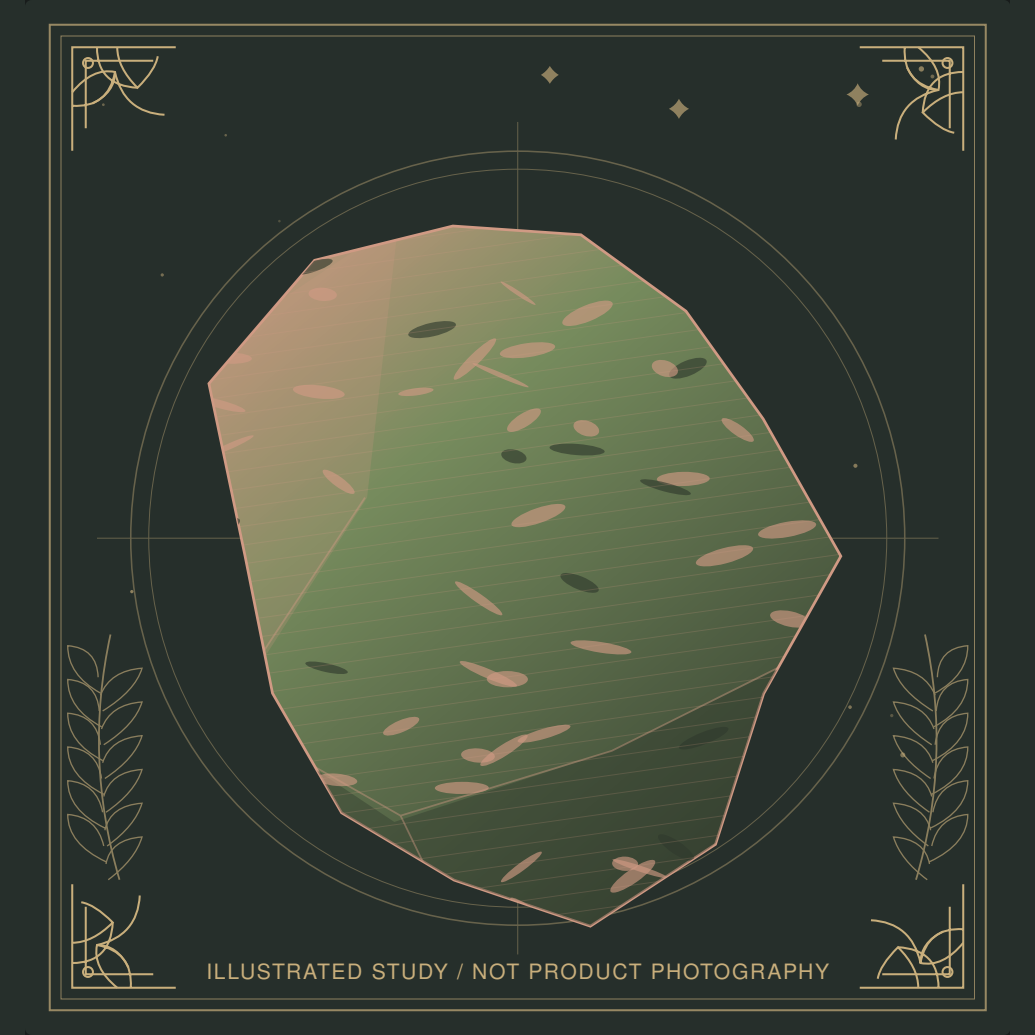
Material
Altered rock combining feldspar, epidote and commonly quartz. [2]
Family
Mixed natural rock [2]
Appearance
Pink feldspar, green epidote and quartz in altered rock. [2]
Meaning & tradition
The Crystal Council: self-love and transformation. [1]
In this guide
Visual identity & plain-language name
Unakite is a mixed rock rather than one pink-green mineral. Feldspar and epidote create the familiar contrast, with quartz commonly present. A polished surface exposes a mosaic of grains. The name applies to the assemblage, not a separate mineral for each color or a guaranteed fixed recipe. [2]
Earth story: formation, structure & color
USGS describes unakite containing pink feldspar, green epidote and quartz, with secondary epidote produced during alteration. The original igneous rock and later alteration are distinct stages. Mineral proportions can vary, so a host-rich piece may look different from an especially green example without requiring a new species. [2]
Unakite is a mineral assemblage created through alteration of a pre-existing rock. The USGS account describes pink feldspar, green epidote and quartz, together with accessory constituents in studied examples. Secondary epidote records chemical change after the original igneous assemblage formed. A polished pink-green mosaic therefore contains a history of earlier crystallization followed by modification, rather than one mineral that simply grew with two decorative colors. [2]
The rock has no single ideal formula or crystal system. Feldspar, quartz and epidote each retain their own mineral structures and properties. Their changing proportions can produce more pink, more green or more pale silica in different pieces. The USGS discussion distinguishes epidote-rich material and altered rock contexts, illustrating why not every green altered stone is automatically unakite. An unprovenanced polished sample may lack the field relationships needed to reconstruct its exact alteration conditions or assign it to a named mountain locality. [2]
USGS's studied assemblages include accessory minerals such as iron oxides, zircon and apatite, illustrating that a visually simple pink-green rock can be more complex at the mineral level. The report's historic descriptions supply evidence for naming and occurrence, while their observations should remain attached to studied material. An unknown pale grain should not receive an accessory-mineral name solely because that species appears in a published list. Texture, composition and field setting together offer stronger support. This also clarifies why a fixed recipe or one bulk crystal system is inappropriate for unakite as a rock. [2]
An ornamental sphere's round outline is manufactured, while the interlocking mineral mosaic records rock history. [2]
Varieties & look-alikes
Compare balanced pink-green rock, epidote-rich and feldspar-rich material. Granite can share some components without the same alteration assemblage. Epidosite emphasizes epidote-rich rock, and a green-pink dyed product is another category. A photograph cannot establish the exact proportion of each phase. [2]
- Unakite
- The parent rock label describes a feldspar-epidote assemblage commonly including quartz. Mineral proportions and textures vary, so a less evenly balanced sample does not automatically represent a new variety. A supported rock determination is distinct from individual mineral identification and exact source. Preserve those different confidence levels in the collection record. [2]
- Unakite jasper trade label
- The jasper suffix is commercial vocabulary and should not replace the actual mixed-rock description. A coarse mosaic of feldspar, epidote and quartz is not one jasper species or one ideal silica formula. Keep the familiar alias for search or provenance if useful, while stating unakite and its known components plainly in the scientific identity. [2]
Human story: objects, names & cultural context
USGS records the name’s application in 1874 to material from the Unaka Mountains and describes occurrences in Virginia. This place-based naming and ornamental history gives a specific human context. It does not establish an inherited chakra or healing tradition. [2]
USGS records Bradley's 1874 naming of unakite in relation to the Unaka Mountains and discusses additional occurrences in Virginia. That geographical and scientific account provides a supported human history. Modern lapidaries expose the contrasting grains in carvings, spheres and beads, adding their own craft history to the geological material. A place-derived name does not require every retail specimen to come from its namesake locality. Exact origin should follow the object's documented provenance rather than the appeal of a familiar regional story. [2]
Meaning & practice: attributed traditions
The Crystal Council associates unakite with self-love, empathy and transformation. These are modern spiritual interpretations. [1]
An editorial self-reflection exercise can name one strength and one habit you want to change. The contrasting grains can remind you that a single account need not be uniform. Practical change comes from the chosen action.
Material truth: trade names & treatments
Keep the rock name and individual minerals distinct. A specimen can be natural mixed rock yet polished into a manufactured sphere. Treatment and source claims need their own records. Different grain properties and fractures can affect finishing; visual balance of pink and green is an aesthetic description rather than a purity grade. [2]
Unakite jasper is a commercial phrasing that can obscure the coarse multicomponent rock identity. Jasper is a different silica-based material category, while unakite includes conspicuous feldspar and epidote. A confirmed natural rock can still have repairs, filling, color intervention or an assembled form. Keep those product questions separate from the geological name. Neither a pleasing pink-green balance nor a smooth polish proves pure constituents, absence of treatment or a particular origin. [2]
Identify what is known and observe the rest. Record pink grains, green patches, pale regions, visible cracks and the relationship between them rather than assigning one fixed percentage to every object. A coarse mineral mosaic may show differing responses to polishing. That texture is educational in its own right. Preserve an original source label or examination report, and state whether the rock identification was independently confirmed. The result can connect a decorative object to alteration geology without pretending to reconstruct every stage from a single photograph.
Sources & related specimens
USGS supports the mineral assemblage, alteration and naming history. The Crystal Council supplies the contemporary symbolism. Compare epidote and feldspar entries for the constituent minerals.
- The Crystal Council: Unakite
Primary publication · Contemporary symbolic associations attributed to The Crystal Council · Accessed October 9, 2026
- Granites of Virginia: Unakite
U.S. Geological Survey · Mineralogy, geology, naming and documented material history · Accessed October 9, 2026