
The opaque field
Jasper
Opaque, impure, fine-grained silica-rich material; retail use of the name is broader.
Opaque fine-grained silica material; broader trade labels may describe other rocks
Jasper is a broad name for opaque silica-rich material, usually patterned or colored by fine components. Red, yellow, brown and contrasting bands make the category visually expansive. The shop use of jasper stretches beyond strict silica identity, so a pattern name needs its own material explanation.
Geology · Human history · Attributed traditions
Explore the specimen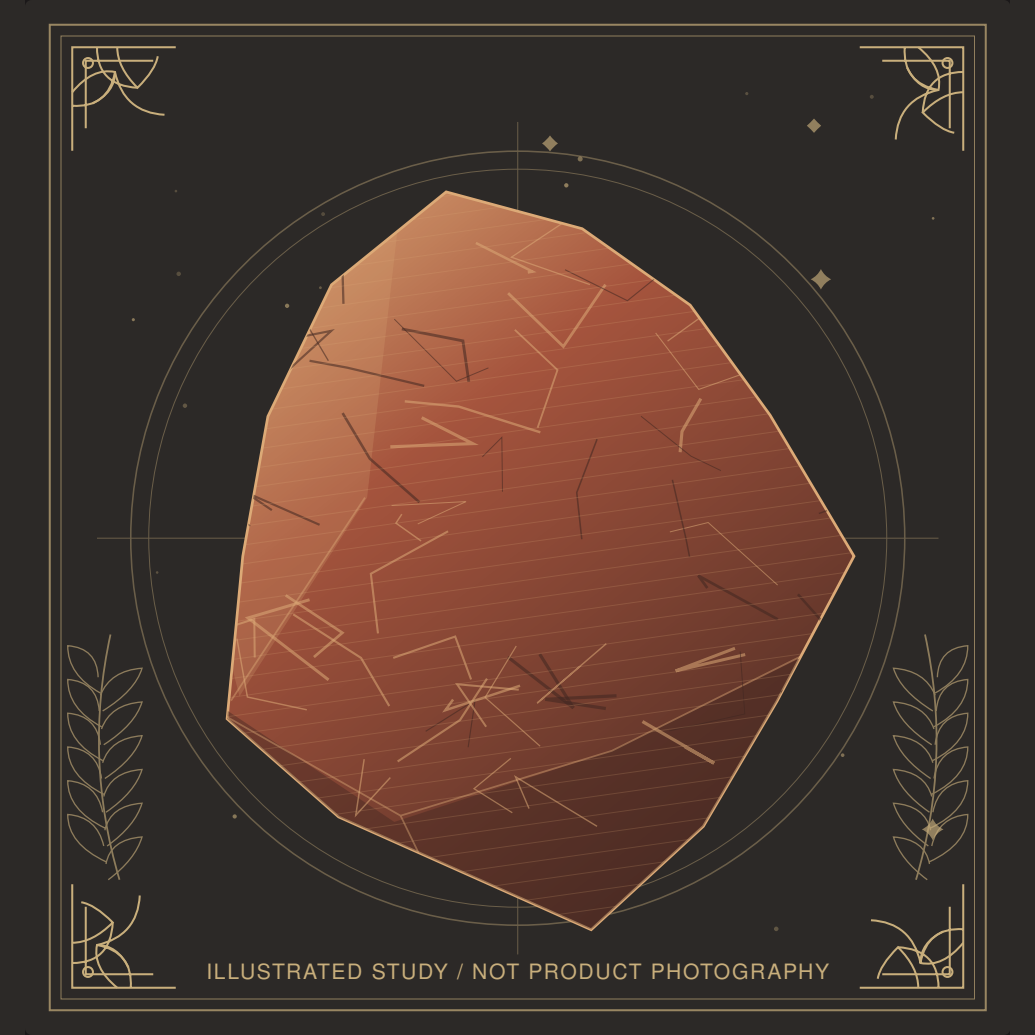
Material
Opaque, impure, fine-grained silica-rich material; retail use of the name is broader. [1][2]
Traditions
Margaret Ann Lembo’s 2013 chart assigns red jasper vitality and motivation within a root-centered color framework. [5]
In this guide
Visual identity
Jasper is a broad name for opaque silica-rich material, usually patterned or colored by fine components. Red, yellow, brown and contrasting bands make the category visually expansive. The shop use of jasper stretches beyond strict silica identity, so a pattern name needs its own material explanation. [1][2]
Opacity is a useful starting characteristic, but it does not solve the material identity of every named jasper. Iron-rich red, yellow or brown regions, fine speckling and scenic patches can all contribute to its appearance. A polished stone with a jasper label may be a silica-rich aggregate or a different decorative rock given the name because of its pattern. This is why a catalogue needs both the recognizable retail term and a geological account of what is known to compose the particular material family. [1][2]
Earth story: geology and formation
The Australian Museum distinguishes jasper’s opacity from many translucent chalcedonies. Fine inclusions and mineral components affect appearance. A brecciated piece records fragments and their cement, while a landscape-like pattern is a resemblance seen in a cut section, not necessarily a picture of its formation environment. [1][2]
Fine-grained silica differs visually from a single clear quartz crystal: its tiny crystallites and inclusions scatter light and produce a waxy or softly glassy surface. The Australian Museum gives microcrystalline quartz a hardness around 6.5, refractive indices of approximately 1.530–1.539, and specific gravity around 2.57–2.64. These are reference ranges, not a certificate for every rock sold under a related trade name. Many fine-grained silica materials accept artificial color because their microstructure can admit a staining solution. The visible pattern, the aggregate structure and any treatment must therefore be considered together. A highly polished surface reveals contrast in a cut section; it does not show the complete shape in which the material originally formed. [1]
The broad quartz-family setting includes sedimentary, hydrothermal and metamorphic occurrences, but that framework cannot be compressed into one universal formation recipe for everything marketed as jasper. A genuine fine-grained silica material and a rhyolite patterned like jasper have different geological contexts. Vapriikki explicitly identifies leopard-skin material as rhyolite and discusses volcanic mineral components in Kambaba. Such distinctions matter because a trade catalogue can group stones by appearance while the earth processes that produced them remain quite different. [3][2]
Varieties and lookalikes
These names describe different levels of information: a mineral species, a visual variety, a crystal habit or a retail label. The distinctions below keep the recognizable shop vocabulary alongside its material explanation.
Picture, landscape, brecciated and zebra names emphasize arrangements of colors and fragments. Red and yellow names emphasize color; geographic names may instead suggest a source. These labels describe different aspects of a stone and should not be treated as equivalent species boundaries. Brecciated appearance concerns broken fragments within a later cement or matrix, while a landscape appearance is a visual interpretation of a pattern. Neither word alone identifies all minerals or reconstructs the complete sequence of geological events. [2][1]
- Red and yellow jasper
- These color descriptions usually indicate opaque silica-rich material with additional components. Each shade is not a separate approved species. [1][2]
- Brecciated jasper
- Fragments and a contrasting cement create a broken-and-rejoined texture. The visible structure can be described without inventing one universal deposit history. [1][2]
- Picture, landscape and polychrome/desert jasper
- Names emphasize patterns or color fields. A landscape resemblance does not establish a fossil scene or locality. [1][2]
- Zebra, dragon blood and leopard skin
- Zebra describes contrasting stripe-like pattern, while dragon blood is an ambiguous retail label for red-and-green decorative goods whose actual components need identification. It should not be assumed to mean bloodstone or one fixed mineral species. Leopard-skin material is identified by Vapriikki’s museum as rhyolite rather than ordinary silica jasper. The comparison shows why a familiar jasper shelf category can include different rocks and why a pattern word cannot replace the underlying geological description. [2][1]
Human story: history and naming
Vapriikki’s museum explicitly warns that many named jaspers are different rocks; it identifies leopard-skin material as rhyolite and discusses volcanic Kambaba material. This history of naming illustrates why familiar retail categories require geological correction rather than one romanticized formation story. [2]
GIA’s discussion of chalcedony carving includes jasper within the established Idar-Oberstein lapidary tradition and its later expansion through imported material. That is a documented connection between natural stone and human skill. Selecting a patterned part of rough, orienting a cut and polishing a form are not incidental: they decide which portion of the geological image becomes visible. A present-day scenic jasper sphere carries this craft relationship even where its commercial pattern name has no demonstrable ancient counterpart. [4]
Meaning and practice: attributed traditions
Margaret Ann Lembo’s 2013 chart assigns red jasper vitality and motivation within a root-centered color framework. The interpretation belongs to the specifically named red material. Other picture, zebra or green trade categories should not automatically receive the same modern meaning. [5]
A personal motivation prompt is to choose one small action before interpreting the pattern. Looking closely can enrich appreciation without certifying a trade name.
Lembo specifically places red jasper in a red-stone correspondence group. Extending that attribution to every material sold as green, ocean, zebra or Kambaba jasper would exceed the cited source. Keeping the color and variety visible is therefore important in the spiritual chapter as well as the geological one. The red specimen can be used as an intended reminder of motivation within her framework, while other named materials receive the separately documented meanings of the practitioners who discuss them. [5]
Material identity and trade terminology
Dalmatian stone, Kambaba, mookaite, bumblebee material and rhyolite need their own identities. Dragon blood, zebra and picture are ambiguous without a specimen description. A familiar jasper label does not certify that a piece is uniformly silica-rich, natural-color or from a claimed locality. A descriptive name can help someone find a familiar pattern while still needing a geological correction. For example, leopard-skin material can preserve a useful retail search term alongside its rhyolite identity. This approach avoids inventing additional species for each spotted or striped product. A variety-level story should begin with the verified material, then discuss the pattern and any specific locality, instead of assuming that the generic jasper label supplies all three. [1][2]
Sources and related specimens
The references below distinguish mineral identification and physical properties from historical interpretation and practitioner symbolism. A cited material category describes a kind of stone; it does not certify the identity, treatment or provenance of an untested individual retail specimen.
- Quartz
Australian Museum · Geological, gemological or documented material-history evidence · Accessed October 9, 2026
- Chalcedonies
Vapriikki Mineral Museum · Geological, gemological or documented material-history evidence · Accessed October 9, 2026
- Handbook of Mineralogy: Quartz
Mineralogical Society of America · Mineral composition, structure, physical properties and occurrence · Accessed October 9, 2026
- Gem Cutters Reveal the Beauty of Chalcedony
Gemological Institute of America · Geological, gemological or documented material-history evidence · Accessed October 9, 2026
- Margaret Ann Lembo: Colors, Enlivening the Rainbow Body (2013)
Llewellyn Worldwide · Contemporary practitioner symbolism and retailer terminology; distinct from mineralogical evidence · Accessed October 9, 2026