

Red on green
Bloodstone
Green chalcedony/jasper material with red markings.
Patterned or colored microcrystalline silica aggregate
Classic bloodstone places red marks against a deep green silica-rich background. Heliotrope is an established alternative name. The red spots suggested blood to observers, but they are mineral coloration rather than blood or fossil organic matter.
Geology · Human history · Attributed traditions
Explore the specimen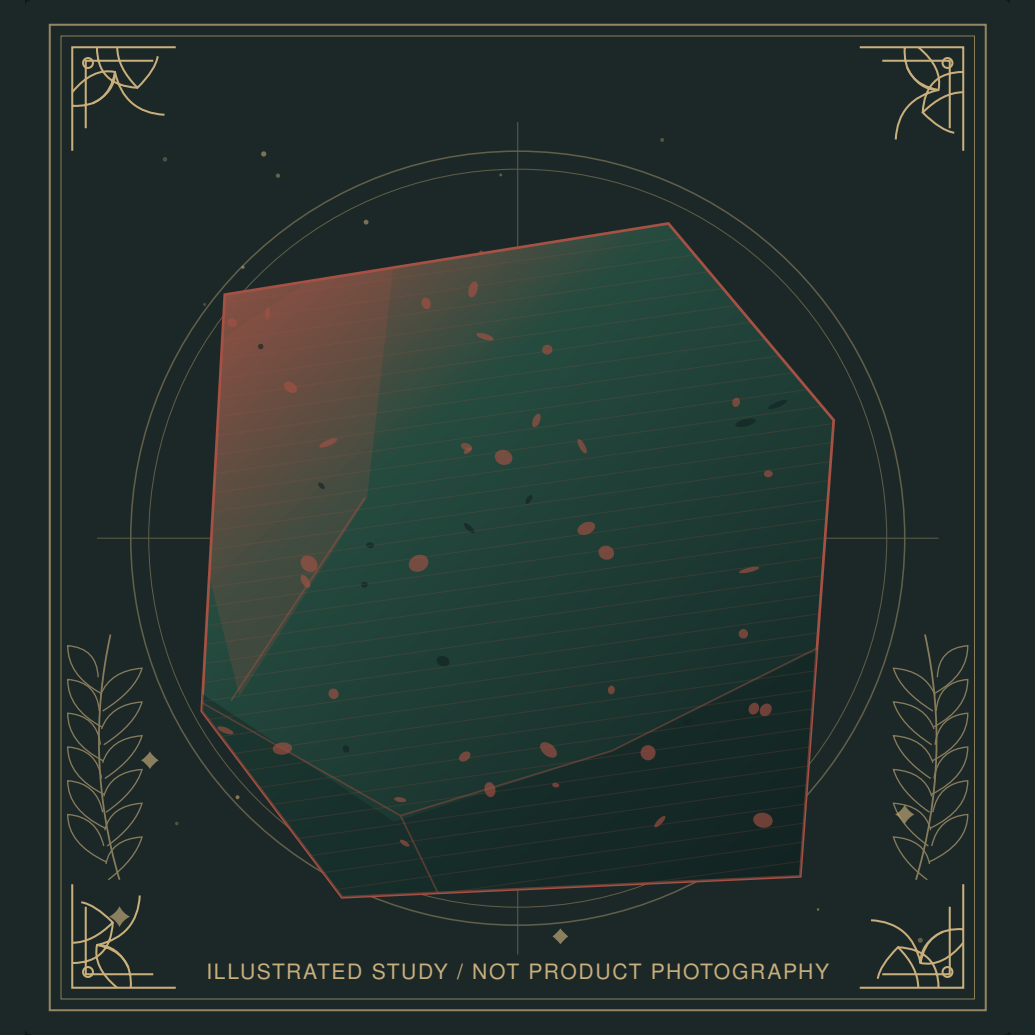
Traditions
The Crystal Council associates bloodstone with courage, willpower and confidence. [5]
In this guide
Visual identity
Classic bloodstone places red marks against a deep green silica-rich background. Heliotrope is an established alternative name. The red spots suggested blood to observers, but they are mineral coloration rather than blood or fossil organic matter. [1][2]
The contrast is often more important than any one exact shade: a dark green field carries scattered red to brown-red areas, with their size and distribution varying from piece to piece. Some cut objects reveal broad pale regions or other irregular patches as well. A very small bead can omit the most characteristic spots simply because of where it was cut. The name describes a recognizable patterned material rather than an assurance that every square centimeter will show the same red-on-green image. [1][2]
Earth story: geology and formation
The Australian Museum identifies bloodstone among fine-grained quartz materials. The relative amount and distribution of red and green vary, so a small tumble may show only one part of the pattern. The aggregate’s inclusions and host contribute together; the appearance is not a single clear crystal habit. [1][2]
Fine-grained silica differs visually from a single clear quartz crystal: its tiny crystallites and inclusions scatter light and produce a waxy or softly glassy surface. The Australian Museum gives microcrystalline quartz a hardness around 6.5, refractive indices of approximately 1.530–1.539, and specific gravity around 2.57–2.64. These are reference ranges, not a certificate for every rock sold under a related trade name. Many fine-grained silica materials accept artificial color because their microstructure can admit a staining solution. The visible pattern, the aggregate structure and any treatment must therefore be considered together. A highly polished surface reveals contrast in a cut section; it does not show the complete shape in which the material originally formed. [1]
The green host and red areas are components of a fine-grained silica material, not literal blood enclosed in a crystal. The Australian Museum places bloodstone among chalcedony varieties and discusses the role of mineral impurities in quartz-family colors. This general setting is compatible with iron-rich red material, but exact included phases should be identified for a studied specimen rather than asserted from the familiar name. Its geological story concerns mineral deposition and coloration, even where later viewers supply a religious or bodily metaphor. [1][3]
Varieties and lookalikes
These names describe different levels of information: a mineral species, a visual variety, a crystal habit or a retail label. The distinctions below keep the recognizable shop vocabulary alongside its material explanation.
Heliotrope is a traditional alternative name for bloodstone, while broader commercial descriptions may include stones with additional pale or yellow areas. These words do not create a new mineral formula for each pattern. Green jasper with red spots is a useful visual comparison and can overlap with how fine-grained silica is classified in trade. The distinction between translucent chalcedony and more opaque jasper is sometimes less tidy in a mixed object than a short catalogue label suggests. [2][4]
Human story: history and naming
The US Geological Survey records bloodstone or heliotrope among cryptocrystalline silica varieties. The two names preserve different strands of naming history. Religious origin stories circulating in commerce should be attributed to a traceable text rather than treated as a geological explanation for red spots. [2]
The USGS chart preserves bloodstone and heliotrope within its naming of cryptocrystalline silica. That documented classification is firmer ground than attaching every later legend to the origin of an individual stone. Historical color names often survive changes in scientific classification, and a material can carry an evocative inherited term without its metaphor describing a physical ingredient. A newly polished tumble has its own manufacturing history; it does not inherit an ancient object’s date or ritual context simply by sharing that material name. [2]
Meaning and practice: attributed traditions
The Crystal Council associates bloodstone with courage, willpower and confidence. These are contemporary practitioner meanings, distinct from the physical cause of its red-on-green pattern. The associations can guide personal reflection without being treated as physiological effects. [5]
A courage reflection can focus on one decision that remains within personal control. The contrasting colors are a chosen reminder, not a prediction or bodily effect.
The Crystal Council’s confidence and willpower language can be understood as a contemporary symbolic use of a visually forceful stone. It supplies an attributable interpretation for the encyclopedia without requiring a claim that the red pattern acts on circulation. A person may choose bloodstone as a reminder of courage or steadiness during a difficult decision. The act of choosing and reflecting provides the practice’s human context; mineral identity and the interpretation remain separate descriptions of the same object. [5]
Material identity and trade terminology
African bloodstone and seftonite are retail descriptions requiring material and provenance information. Dragon blood jasper is an ambiguous separate trade label and not an automatic synonym. Green background plus red spots is a visual starting point rather than a complete analytical identification. A polished green-red surface can show fine red points, larger patches or very little red in the exposed section. The relative area of the colors is an appearance description rather than proof of a religious origin. A different trade product can borrow the word blood for its visual drama. Recording the confirmed silica host, the observed pattern and the seller’s original alias separately makes comparison possible without silently accepting every alias as a geological synonym. [1][2]
Sources and related specimens
The references below distinguish mineral identification and physical properties from historical interpretation and practitioner symbolism. A cited material category describes a kind of stone; it does not certify the identity, treatment or provenance of an untested individual retail specimen.
- Quartz
Australian Museum · Geological, gemological or documented material-history evidence · Accessed October 9, 2026
- Natural Gemstones: Mineral Gemstones
US Geological Survey · Geological, gemological or documented material-history evidence · Accessed October 9, 2026
- Handbook of Mineralogy: Quartz
Mineralogical Society of America · Mineral composition, structure, physical properties and occurrence · Accessed October 9, 2026
- Chalcedonies
Vapriikki Mineral Museum · Geological, gemological or documented material-history evidence · Accessed October 9, 2026
- The Crystal Council: Bloodstone
The Crystal Council · Contemporary practitioner symbolism and retailer terminology; distinct from mineralogical evidence · Accessed October 9, 2026